You can say "best" or "No.1" only if you can prove it, unless it's obvious puffery nobody would take literally. An unqualified "best" or "No.1" reads to the ASA as a claim about every competitor, so you need objective evidence such as sales or test data, and you must make the basis of the claim clear.
On 7 January 2026, the ASA ruled against six Vodafone ads at once. TV spots, posters and social ads had all carried the same three words: "The Nation's Network".
Vodafone argued it was a brand positioning line, built on its heritage since 1984 and its role and reach across the UK, not a comparison with other networks. EE, which complained, saw a claim to be the UK's top network. EE's view won the day: at least a significant minority of people would read it as an objective comparison with the UK's other networks.
If a brand that size can lose on three words, so can yours. Here's where the line sits, the rulings that drew it, and safer wording you can use instead. Want a quick read on your own copy first? Paste it into our free Claim Risk Checker.
Puffery or a claim you must prove?
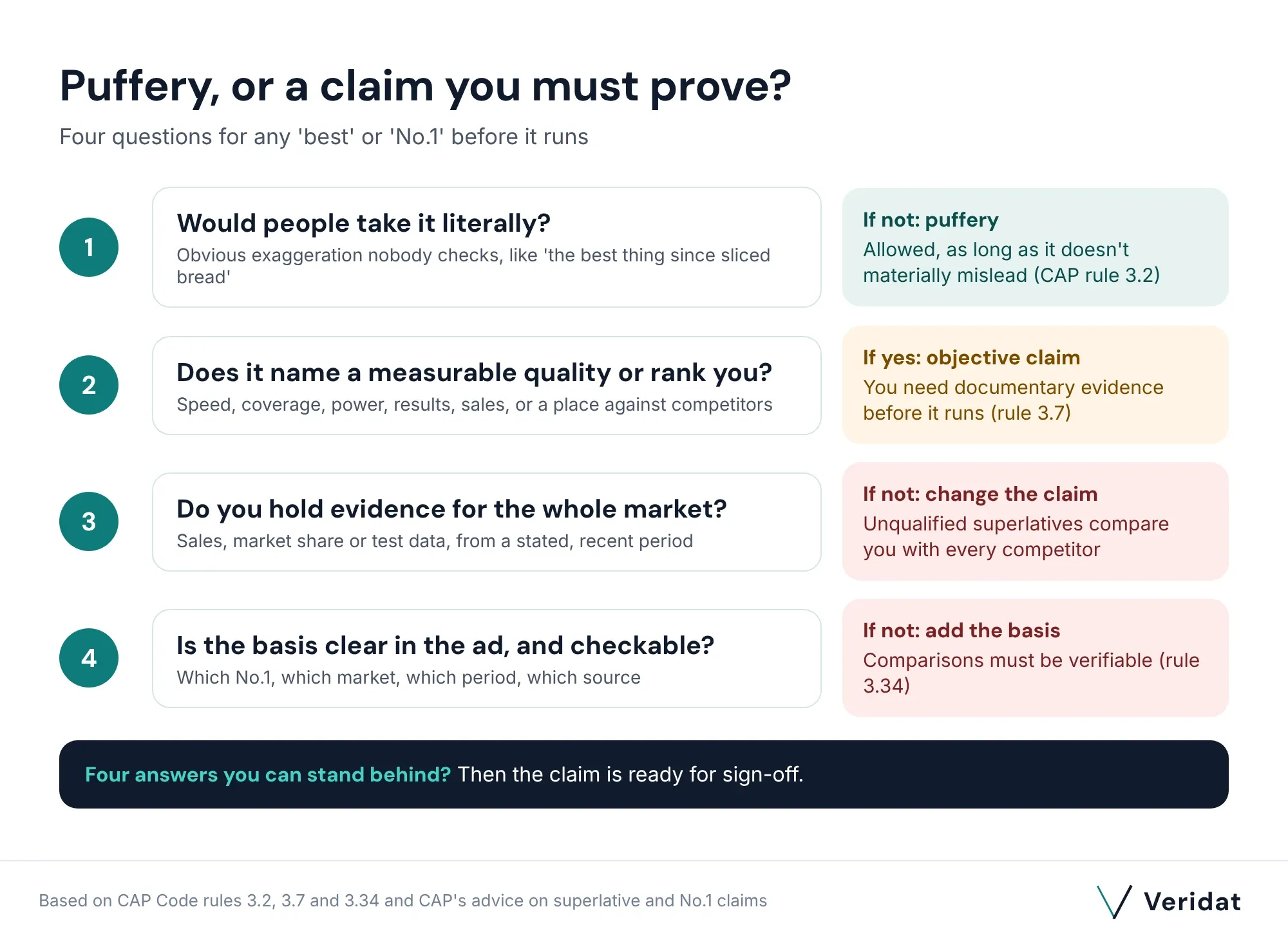
Every "best" in an ad falls into one of two boxes.
First, there's puffery. Rule 3.2 of the CAP Code allows obvious exaggerations, and claims the average person is unlikely to take literally, as long as they don't materially mislead. "The best thing since sliced bread" is puffery. Nobody checks.
Second, there's the objective claim. Under rule 3.7, before an ad runs you must hold documentary evidence for any claim people are likely to see as objective and that can be proved. If you can't, the ASA may treat the claim as misleading.
Here's the catch: superlatives usually land in the second box. In its advice on superlative claims, CAP says the ASA will consider unqualified superlative claims to be comparative claims against all competing products. So "the best serum" means better than every other serum on sale, and that needs proof.
How the ASA decides which box you're in
It doesn't matter what you meant. CAP's advice on puffery says the ASA looks at how a consumer is likely to read the claim, not at the marketer's intention.
Two rulings show the difference. In 2020, Slipsilk's homepage said "THE ORIGINAL AND THE BEST SINCE 2004". The ASA read "the best" as the company's subjective opinion, so it wasn't capable of objective proof, and the claim stood.
In 2022, Sky described its network as "the perfect network". Sky saw that as opinion too. Not so, said the ASA: people were likely to read it as objective, so it needed evidence.
So what tips a claim into the objective box? A measurable quality, such as speed, coverage, power or results. A ranking against competitors. And any wording that sounds like a fact you could check.
Pro tip: Putting a claim in quotation marks doesn't turn it into opinion. CAP's advice is clear that presenting an objective claim as opinion doesn't remove the need for evidence.
"No.1" and "best-selling": the evidence you need
"No.1" is the hardest superlative to defend, because it almost always reads as a fact. CAP's advice on No.1 claims says these claims will almost always be regarded as objective comparisons, and the ASA has often read an unqualified "number 1" as meaning best-selling.
That sets the evidence you need:
- Sales data. For a best-selling reading, CAP expects comparative evidence on unit sales, market share or both.
- All of the market. An absolute "No.1" is read as a comparison with the entire market, not just the brands you chose.
- A clear basis. CAP says ads that don't make the basis of a No.1 claim clear are likely to be seen as misleading. In 2023, EE's "No 1 for 5G" was substantiated, but the ad pointed to a whole report rather than the specific data behind the claim.
- Something people can check. Under rule 3.34, a comparison with competitors must objectively compare a "material, relevant, verifiable and representative feature". In 2017, a Wren Kitchens "number 1" kitchen retailer claim fell down because customers had no way to verify it.
Rulings that show where the line is
Vodafone: "The Nation's Network" (January 2026)
Vodafone's six ads ran on TV, YouTube, Meta and posters in 2025. As well as the strapline, two posters called Vodafone "London's Best Network", and on-screen text mentioned "99% of the UK population coverage" and "the nation's most valuable UK telecoms provider".
None of that gave the strapline a clear basis. EE's complaint was upheld because the claim didn't objectively compare a material, relevant, verifiable and representative feature.
Lesson: a slogan can be a comparative claim. If people might read it as "we beat the others", you need the comparison to back it up.
The AA: "The UK's No.1" (July 2022)
The AA's website called it "the UK's number 1 breakdown service provider", and a bus poster said "Join the UK's No.1". On paper, the AA had plenty of data: market share studies, revenue, patrol numbers and customer scores.
But the ASA thought people would read "No.1" as having the most members. Its membership figures and the RAC's were taken 11 months apart, so they weren't a fair comparison. The footnote behind its "largest" claim sat at the bottom of the page where it could be overlooked, and the separate verification page wasn't linked from the ads. All three issues were upheld.
Lesson: work out which "No.1" people will hear, then compare like with like, from the same period, and make it easy to check.
O2: "Britain's Best for Coverage" (September 2021)
O2's press ad said "On the network voted Britain's Best for Coverage". That vote came from a uSwitch survey of 12,000 people rating their own network.
In the ASA's view, "best" implied a comparison with the whole market, so it needed an objective basis. Yet the survey showed only subjective experiences, and the ASA couldn't see how a perception survey alone could rank networks on coverage. It ruled the ad misleading.
Lesson: "voted best" doesn't make a claim subjective. If people hear "best coverage", you need coverage data.
Lyma: "the world's most powerful home beauty device" (June 2024)
An Instagram ad for the LYMA Laser called it the "world's most powerful home beauty device" and "100x more effective than LED masks". Lyma's evidence for "most powerful" was a table of power density covering four other devices.
People would read "most powerful", said the ASA, as the strongest option for treating visible signs of ageing, not the highest power output. So it expected objective evidence of results, and power density alone didn't measure that. All three issues were upheld. For beauty brands, there's more on what results evidence looks like in our guide to what a 'clinically proven' study must show.
Lesson: prove the superlative people will hear, not the one that's easiest to measure.
Slipsilk: "the original and the best" (March 2020)
Here's one that got through. "THE ORIGINAL AND THE BEST SINCE 2004" was read as opinion for "the best", and Slipsilk showed it had been trading in 2004 for "the original". No breach was found.
Lesson: a loose, personal "best" in context can be puffery. Any factual parts around it still need proof.
What about awards, surveys and "voted best"?
They help, but not the way most brands hope. CAP's superlative advice says self-reported consumer data won't be enough to support a claim that would otherwise need objective proof. O2's ruling is that principle in action.
An award or a survey is good evidence for a claim about itself. "Winner, Best Serum, [named awards], 2026" says exactly what happened. "The UK's best serum" says something much bigger.
Pro tip: Keep the source, the date and the exact question asked for every survey or award you quote. If the claim is ever challenged, that's the first thing anyone will ask for.
Safer wording, before and after
These examples are made up, but each follows the rulings above. Your "after" versions still need evidence; they're just claims you can actually hold evidence for.
| Before (risky) | After (safer) | Why |
|---|---|---|
| The UK's No.1 face serum | The UK's best-selling face serum by units, [named data source], [named 12-month period] | Says which No.1, over what market and period, and where to check |
| The best broadband in Britain | Faster average download speeds than [named providers] in [named test], [period] | Swaps an open superlative for a measured, verifiable comparison |
| Voted best for results | Rated 4.6 out of 5 by 2,300 customers on [named review site] | Claims only what customers actually said |
| The world's most powerful device | Our most powerful device yet | Compares with your own range, which you can prove |
| Clinically proven to be the best | Clinically shown to [named result] in [named study] | Ties the claim to the study's actual finding |
For the wider checks every claim should pass before launch, see our guide to checking advertising claims before launch. And for how to build the evidence behind a claim, step by step, our guide to validating marketing and product claims covers it.
The US view: puffery and the FTC
In the US, the starting point is the same. The FTC's policy statement on deception says it generally won't pursue obviously exaggerated or puffing claims, the ones ordinary consumers don't take seriously.
Anything more needs proof. Its policy statement on substantiation says advertisers must have a reasonable basis for claims before they run. Where an ad says or implies a level of support, such as "tests prove" or "studies show", the FTC expects at least that level of evidence.
So a measurable "best" or "No.1" needs the same thing in New York as in London: evidence in hand before the ad goes out.
Check your claim before it runs
We built Veridat to give marketing, product, technical, compliance and legal teams one place to validate marketing and product claims. You create a claim, and Veridat's engine works out what's needed to back it up. It creates the tasks, such as evidence to attach or wording to confirm, routes them to the right people and sends the claim to the right reviewers.
Nothing gets approved until the relevant reviewers, such as Legal, have looked at the evidence and accepted it. Each sign-off records who decided, their review function, when, and which version of the claim. Approved wording goes into a library your team can reuse without restarting legal review, so the next campaign starts from wording that's already cleared. See how it works.
You can try every feature free for 14 days, no card needed. After that, plans start at £149 a month and go up to £899 a month, depending on your team size and needs.
Paste your product page, pack copy or ad into our free Claim Risk Checker and see which claims need proof behind them. It runs on Veridat's own engine, built for marketing copy. Your copy is never sent to an AI service, and the same copy always gets the same result.
Try it with this example (made up):
The UK's No.1 face serum, voted best for results. The most powerful formula on the market, and the best value too.
Frequently asked questions
Can you say 'best' in an advert in the UK?
Yes, if it's obvious puffery people won't take literally, or if you hold objective evidence for it. An unqualified "best" is treated as a comparison with every competing product, so most measurable uses need proof before the ad runs.
Is 'number one' a claim you have to prove?
Almost always. CAP says No.1 claims will almost always be read as objective comparisons, often as "best-selling". That means comparative sales or market share data for the whole market, with the basis made clear in the ad.
What is puffery in advertising?
An obvious exaggeration that the average person wouldn't take literally, such as "the best thing since sliced bread". Under the CAP Code, that's allowed, as long as it doesn't materially mislead. What counts is how a consumer would read the claim, not what you meant.
Can I say 'voted best' if customers voted for us?
Only for what the vote actually measured, and only if you say who voted, when and on what. In 2021, the ASA ruled against O2's "voted Britain's Best for Coverage" because a customer survey couldn't prove a claim about coverage.
What evidence do I need for a best-selling claim?
Comparative sales data, such as unit sales or market share, covering the market your claim names and a recent, stated period. Make the basis clear in the ad and keep the data ready to share.
This is general information, not legal advice.
Spotted something out of date? Drop us a line and we'll put it right within five working days.