Yes, but only if you already hold a well-run study on people that used the product as sold and showed the exact benefit you promise, in the time you promise. Under the UK's clinically proven claim rules, small, uncontrolled or self-reported studies don't count, which is why the ASA ruled against four skincare ads between April and June 2026.
Last December, commuters on the London Underground walked past a Beauty Pie poster promising an LED mask "clinically proven to reduce wrinkles in 4 weeks". The small print was honest: "Results from a 4-week study of 28 people aged 30-65".
That study existed. What it lacked was the problem: no control group, no blinding, and extra products in the routine. In June 2026, the ASA ruled against the ad.
Here's what the ASA wants to see before those two words go on your pack, and what to write instead. Want to test your own copy first? Paste it into our free Claim Risk Checker.
What does 'clinically proven' promise a shopper?
Two words, two promises. "Clinically" says the product was tested properly, on people. "Proven" says the test settled the question. Add a number of weeks and you've promised a timescale as well.
That's how the ASA reads it. In the Beauty Pie case, it said shoppers would take the poster to mean the mask could visibly reduce the appearance of wrinkles within four weeks, and had been scientifically proven to do so.
So the bar sits higher than for "helps", "feels" or even "tested". You aren't saying the product might work. You're saying it's been shown to.
The UK clinically proven claim rules, in plain English
Three sets of rules meet on a skincare ad. Happily, they point the same way.
The CAP Code
Rule 3.7 of the CAP Code says that before an ad goes out, you must hold documentary evidence for any claim people would read as objective. Without it, the ASA may treat the claim as misleading under rule 3.1. Rule 3.11 adds that you mustn't exaggerate what a product can do.
For health and beauty products, rule 12.1 raises the bar. Objective claims "must be backed by evidence, if relevant consisting of trials conducted on people." Rule 12.7 allows claims about the superficial signs of ageing if you can back them up, but unqualified words like "cure" and "rejuvenation" aren't generally acceptable, especially for cosmetics.
CAP's own advice is blunt. Its guidance on beauty and cosmetics says efficacy claims need tests on people, and that objective claims can't be backed by subjective consumer perception data. Its note on health and beauty substantiation points to at least one experimental human study, "ideally double-blind and placebo-controlled". For the rules beyond health and beauty, see our guide to marketing compliance.
Cosmetics law
Cosmetics also answer to the Cosmetics Regulation as it applies in Great Britain. Article 20 bans wording, names or pictures that imply a product has "characteristics or functions which they do not have". It also requires every claim to meet the common criteria in Regulation 655/2013.
There are six: legal compliance, truthfulness, evidential support, honesty, fairness and informed decision-making. Two do most of the work here. Evidential support says studies must be relevant to the product and to the benefit claimed, using methods that are valid, reliable and reproducible. Honesty says the way you present performance mustn't go beyond the evidence.
Pro tip: The evidence has to exist on the day the ad goes out. Rule 3.7 says "before", so a study you commission after a complaint lands won't rescue the ad.
What the study must show: a seven-point check
Put the 2026 rulings next to the rules on cosmetic claims evidence and the same seven questions keep coming up. If your study answers yes to all of them, you're on firm ground. If it can't, change the claim.
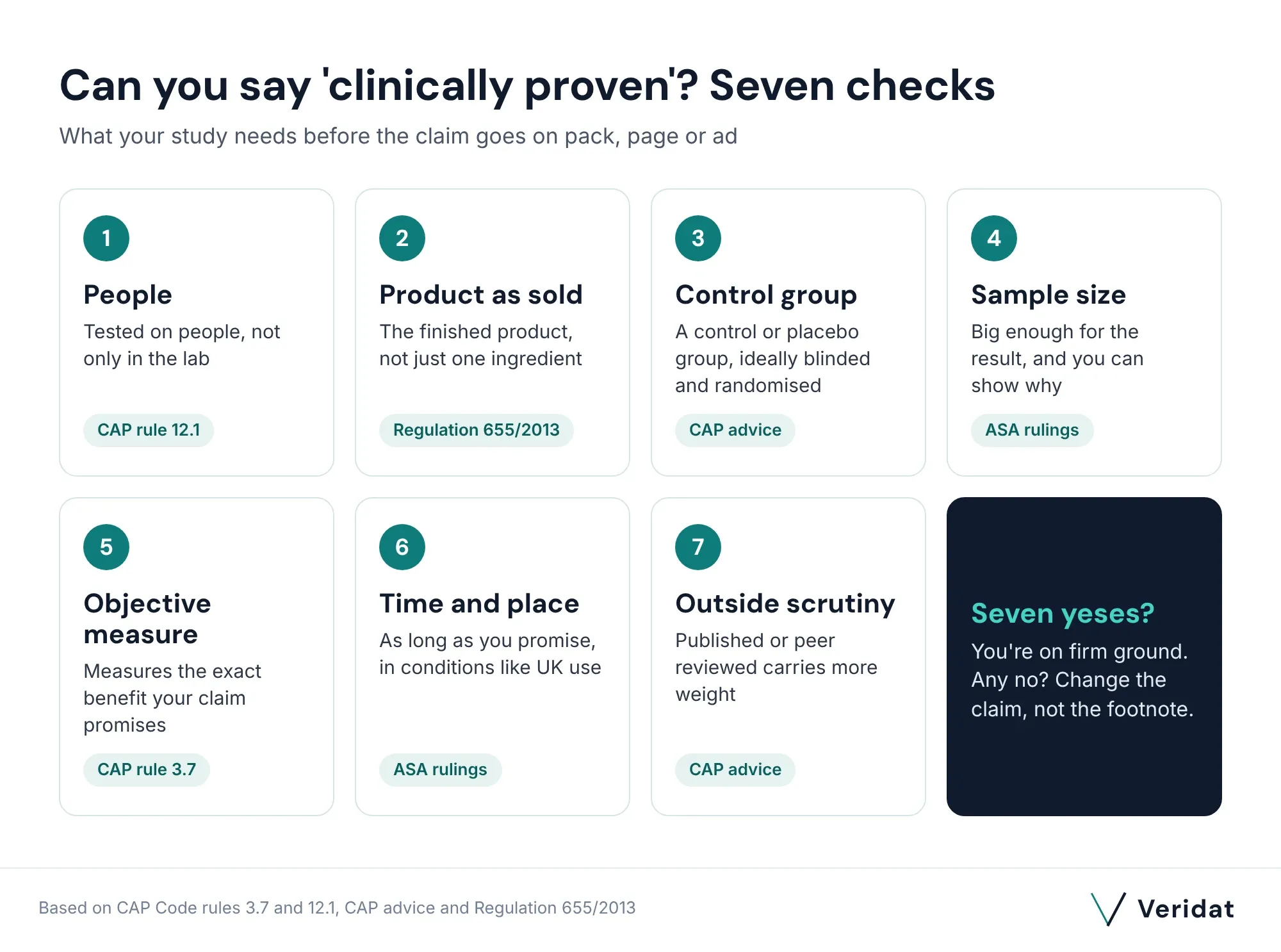
1. Did it test people?
Lab work can explain how an ingredient behaves, but rule 12.1 and CAP's advice both expect tests on people for efficacy claims. In the 111Skin case, a penetration test used one person and put the ingredients on the arm, not the face. It didn't help.
2. Did it test the product you sell?
Under the common criteria, studies must be relevant to the product. If you borrow an ingredient's results for the finished product, you need evidence for that leap, such as the ingredient being present at an effective concentration. The strongest study Beauty Pie relied on was double-blind and placebo-controlled, but it tested a different, clinic-based device, so on its own it wasn't enough.
3. Was there a control or placebo group?
Without one, you can't tell whether the product did the work or something else did. That gap hurt 111Skin, Eucerin and Beauty Pie. Clear randomisation matters too: Garnier's trial report didn't explain how people were split between groups.
4. Was it big enough, and can you show it?
There's no minimum in the CAP Code. What the ASA looks for is a sample you can justify. It called Beauty Pie's 28 participants "a relatively small sample", and for Garnier's trial it saw no evidence the sample was big enough.
5. Did it measure what you claim?
An objective claim needs an objective measure. 111Skin's 20% lift came from a dermatologist's grading on a 10-point scale, which the ASA treated as subjective. Its objective readings didn't show a 20% lift.
6. Did it run as long as you promise, in conditions like real UK use?
If the ad says four weeks, the study should show results at four weeks. Three of the studies Beauty Pie relied on, of a different device, ran for five. Garnier's trial and Eucerin's main study took place in hotter, sunnier countries than the UK, and the ASA weighed that against them.
7. Does it stand up to outside scrutiny?
CAP's advice gives weight to peer review, for example publication in a reputable journal. Neither of Beauty Pie's own studies had been published or peer reviewed.
Our CAP Code substantiation checklist covers the same ground for every kind of claim, not just health and beauty.
Pro tip: Write the claim from the study, not the study from the claim. If your trial ran for eight weeks, your ad says eight weeks. If it measured hydration, don't let the headline drift to wrinkles.
Why '87% of women agreed' isn't 'clinically proven'
Consumer perception studies are useful. Ask 100 women how their skin feels after four weeks and you'll get a figure you can use. CAP's advice on creams says a line such as "80% of women said it reduced the appearance of their wrinkles" needs exactly that: consumer use or perception tests.
A perception figure supports a perception claim, though, and nothing more. In the Garnier case, 82% of participants agreed their dark spots looked less visible after two weeks. To the ASA, that was a subjective, self-reported result that couldn't substantiate the claim. With Eucerin, it said the self-reported results "were not sufficiently robust to substantiate a 'clinically proven' claim."
Here's how the main types of evidence line up with the wording each can carry.
| Type of evidence | What it can support | Example wording (made up) |
|---|---|---|
| Consumer perception study (self-assessment) | How people say the product looks or feels to them | "8 in 10 said their skin felt smoother after 4 weeks" |
| Expert grading, such as a dermatologist scoring skin | A visible change, worded with care and backed by a controlled study; on its own it isn't an objective measurement | "Fine lines looked reduced when graded by a dermatologist in a study of [n] people" |
| Instrumental measurement (device readings) | A measured change, in the property the device measured | "Skin hydration up [x]% after 4 weeks, measured by [device]" |
| Controlled study on people, using the product as sold | "Clinically proven", if it matches the benefit and the timescale | "Clinically proven to reduce the look of fine lines in 8 weeks" |
Claims about effects deeper in the skin, or effects that build up over time, need a much higher level of evidence again.
Four 2026 rulings where 'clinically proven' fell over
Each of these brands had studies. None had the right ones.
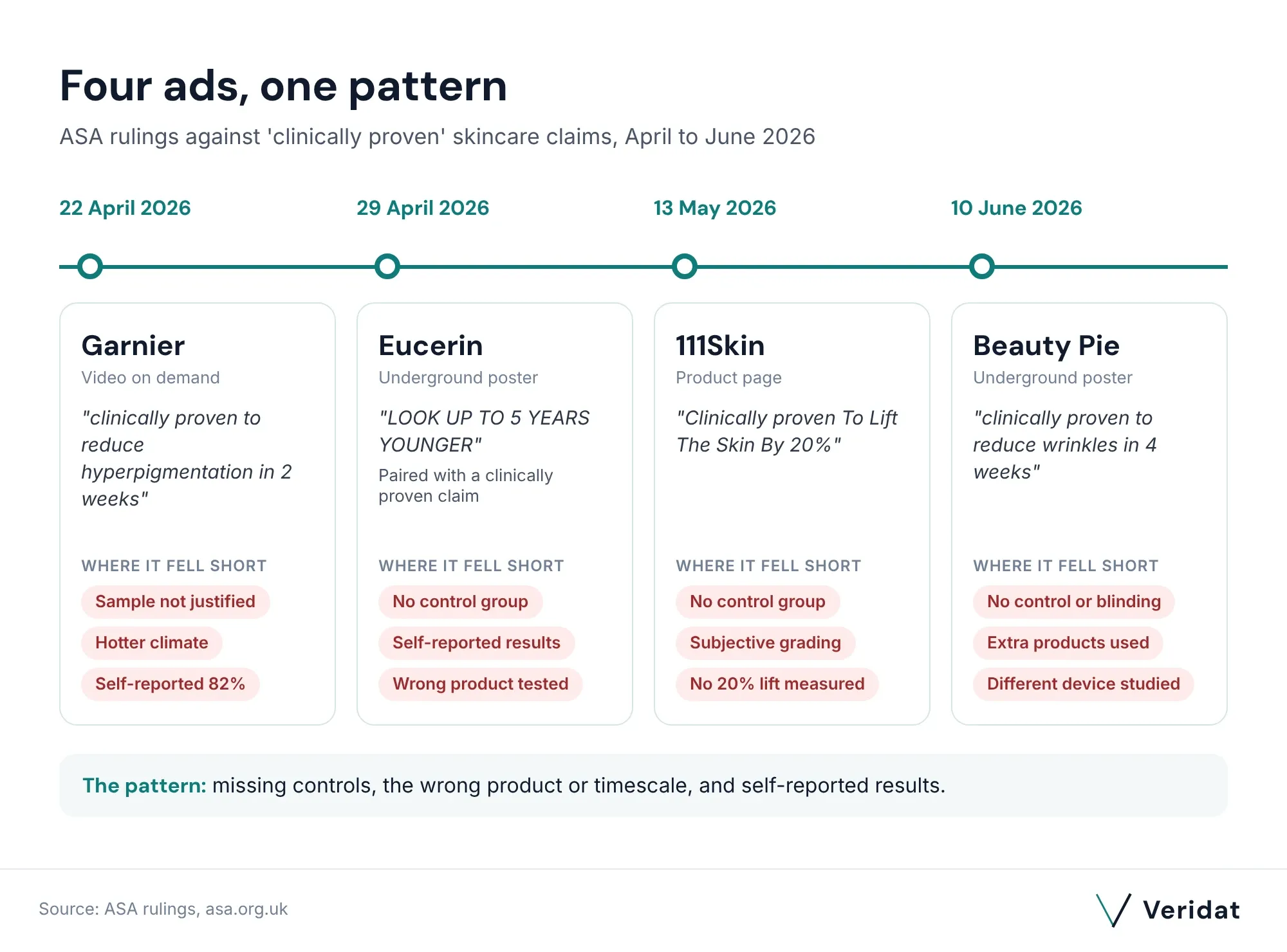
Garnier: two weeks, a sunnier country and an 82% that didn't count
In April, the ASA ruled against a Garnier video ad saying its Vitamin Cg serum was "clinically proven to reduce hyperpigmentation in 2 weeks". The trial had 44 people over 10 weeks, with device measurements and a control group. That's a decent start.
But nothing showed the sample was big enough, the randomisation was unclear, and the trial ran somewhere hotter and sunnier, with skin types that may not reflect UK shoppers. At two weeks, the changes were small and seen in only a minority.
Eucerin: 'up to 5 years younger' with no control group
A week later, a Eucerin poster at Balham Underground station went the same way. It promised shoppers could "LOOK UP TO 5 YEARS YOUNGER", alongside a "clinically proven" claim. Its studies lacked a control group and leaned on self-reported results, its main trial ran in a hotter climate than the UK, and one didn't include the advertised product at all. "Up to" claims carry their own risks, which we cover in our guide to Black Friday advertising rules.
111Skin: a 20% lift, graded by eye
In May, 111Skin's product page claimed its Exosome Face Lift was "Clinically proven To Lift The Skin By 20%". The footnote described a 10-point clinical grading of 30 people after four weeks, which reported a 20.42% average improvement in a "lifted aspect".
That didn't persuade the ASA. There was no control group, the score was subjective, and the objective measures didn't show a 20% lift. Adding "visibly" wasn't enough to qualify "rejuvenate", either.
Beauty Pie: a small study, extra products and a different device
Then came the June ruling on Beauty Pie's poster. Beyond the gaps you saw at the top, participants used a hydrogel mask and exfoliating pads that don't come with the product, so nobody could say the mask alone did the work. In a second study of 20 people, most (65%) neither agreed nor disagreed that their fine lines looked less visible; 20% agreed and 15% agreed somewhat.
Missing controls, the wrong product, the wrong timescale, self-reported results offered as proof: four brands, the same few gaps. We round up rulings like these every month in ASA rulings on product claims.
Could 'clinically proven' turn your cosmetic into a medicine?
There's a second trap, and it's an easy one to walk into. Under rule 12.1, only licensed medicines and medical devices with the right conformity marking may make medicinal claims, meaning claims to treat or prevent disease. Cosmetics are limited to secondary, preventative claims and can never claim to treat disease.
Whether something is a medicine is for the MHRA to decide, partly on what you claim it does, openly or by implication, and on how you present it. Its guide to what is a medicinal product lists "clinically proven" among the phrases that, in context, can read as a claim to treat, prevent or cure disease. It also says products to treat, prevent or fight spots and acne are medicines.
That's what caught Beautaholics in November 2025. Its ad promoted "clinically proven light therapy" targeting acne, for a device that wasn't registered with the MHRA, and the ASA found it in breach of rule 12.1.
Pro tip: If your copy names a condition, such as acne, eczema or dermatitis, pause before it goes anywhere: the MHRA treats these as medical conditions. CAP suggests checking with the MHRA's borderline section first for any claim that could read as medicinal, and the MHRA's borderline products guidance explains how to ask for an opinion.
Safer wording: before and after
These examples are made up, and every "after" still needs evidence that matches it. Fit the words to the proof, not the other way round.
| Before | After (only if your evidence matches) | Why |
|---|---|---|
| Clinically proven to reduce wrinkles in 4 weeks | Wrinkle depth reduced by an average of [x]% after 8 weeks in a placebo-controlled study of [n] people | The timescale and size come from the study, not the brief |
| Clinically proven to lift skin by 20% | Skin feels firmer: 8 in 10 of 100 women agreed after 4 weeks (self-assessment) | A perception study carries a perception claim |
| Clinically proven formula | Contains [ingredient] at [x]%, the level used in [study] | Regulation 655/2013 wants evidence before an ingredient's results are claimed for the product |
| Clinically proven to clear acne | Skin looks clearer and feels less oily | Keeps to appearance, not a medicinal claim; still needs evidence |
| Rejuvenates skin cells | Revitalises the look of tired skin | CAP's Copy Advice team generally suggests "revitalise" and "refresh" |
| Dermatologically tested | Dermatologically tested on [n] people with sensitive skin | Says what was tested, and on whom |
Checking a whole campaign rather than one line? Our guide to checking advertising claims before launch takes you through it.
Selling in the US too? The FTC's test
The bar is much the same across the Atlantic. Published in December 2022, the FTC's Health Products Compliance Guidance replaced its 1998 supplements guide and applies the same principles to any health-related product.
It asks for "competent and reliable scientific evidence", which for health benefits generally means randomised, controlled human clinical testing. Results must be statistically significant and clinically meaningful for consumers, and the FTC asks how the tested product's dosage and formulation compare with the one you sell. If you claim a level of proof, you need at least that level.
How do you keep 'clinically proven' claims approved and on record?
Knowing the rules is half the job. The other half is making sure nobody publishes "clinically proven" until the right study is on file and the right people have looked at it.
We built Veridat to give marketing, product, technical, compliance and legal teams one place to validate marketing and product claims. You create a claim and choose the Health and beauty claim type, and Veridat's engine works out what's needed to back it up. It asks for a study on people, plus a patch test or perception study where the wording calls for one.
Then it runs study-quality checks on the evidence: whether the study used people, whether it had a control group, and the sample size, among other things. An expert's statement on its own never counts as a study on people, and a lab's report counts only when its study design says the work was done on people. Anything missing becomes a task for the right person, so nobody's chasing evidence by email.
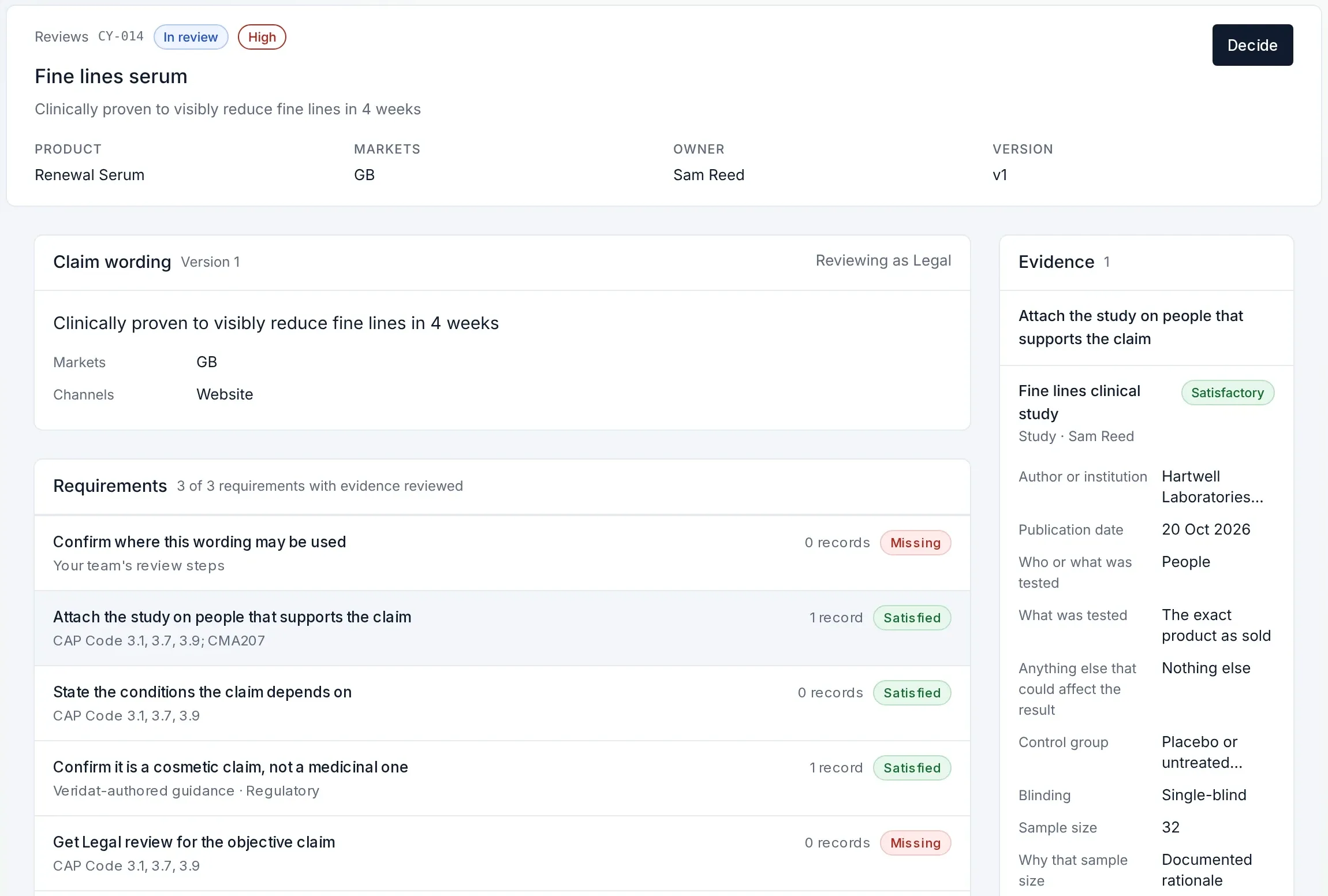
Nothing gets approved until the relevant reviewers, such as Regulatory, Product and Legal, have looked at the evidence and accepted it. If a reviewer approves with a gap, it's recorded as "approved with conditions", with the reason written down. Each sign-off records who decided, their review function, when, and which version of the claim. You can follow a claim from draft to approval on how it works.
Approved wording then goes into a library your team can reuse without restarting legal review. If evidence lapses, the claim stays in the library with a warning. Not ready for software yet? Our evidence-backed claims template is a good start, and our step-by-step claim validation process shows who does what.
You can try every feature free for 14 days. After that, plans start at £149 a month and go up to £899 a month, depending on your team size and needs.
Paste your product page, pack copy or ad into our free Claim Risk Checker and see which claims need proof behind them. It runs on Veridat's own engine, built for marketing copy. Your copy is never sent to an AI service, and the same copy always gets the same result.
Try it with this example (made up):
Our new Retinal Renew Serum is clinically proven to reduce wrinkles in 4 weeks. 87% of women saw firmer, younger-looking skin. Dermatologist approved and suitable for sensitive skin.
Frequently asked questions
What does 'clinically proven' actually mean in an ad?
It tells shoppers the product was tested on people and the test showed it works, usually within a time you state. In the UK, that means holding a solid study on people, using the product as sold, before the ad runs. The ASA judges the claim by what a shopper would take it to mean, not by your footnote.
Is 'clinically tested' safer than 'clinically proven'?
It promises less, so it's easier to back up, but it isn't a free pass. It still has to be true, and if the copy around it suggests the product works, you'll need evidence for that too. In the US, the FTC's guidance says a "clinically tested ingredient" claim implies the results prove a benefit, not just that testing happened.
Can I say 'clinically proven' based on a consumer perception study?
No. CAP's advice says objective claims can't be backed by subjective perception data, and the ASA rejected self-reported figures in both the Garnier and Eucerin rulings. Use the perception result for what it is, for example "8 in 10 said their skin felt smoother".
How many people does a study need?
There's no set number in the CAP Code. The ASA expects you to show the sample was big enough for the result, and it criticised the 28-person Beauty Pie study and the 44-person Garnier trial on that point. Ask whoever runs your study for a sample size calculation and keep it on file.
Can I use my ingredient supplier's study for my finished product?
Only with care. Regulation 655/2013 says studies must be relevant to the product, and that carrying an ingredient's properties over to the finished product needs evidence, such as the ingredient being present at an effective concentration. Both Beauty Pie and Eucerin had studies discounted because they didn't test the advertised product.
This is general information, not legal advice.
Spotted something out of date? Drop us a line and we'll put it right within five working days.