In the UK, beauty and cosmetics claims must meet the CAP Code and the common criteria of the UK cosmetics rules: you need evidence before a claim runs, efficacy claims usually need tests on people, and a cosmetic can't claim to treat a medical condition. In the US, the FDA and the FTC set similar limits.
Between April and June 2026, the ASA ruled against four "clinically proven" skincare ads from Garnier, Eucerin, 111Skin and Beauty Pie. We've told those stories in our guide to what a 'clinically proven' study must show.
Zoom out, though, and they're part of a bigger picture. Beauty claims go wrong in a handful of predictable ways: a customer survey used to prove a result, a filter doing the product's work, a "free from" that implies more than it should, or a moisturiser that starts to sound like a medicine.
This guide takes beauty and cosmetics claims one by one, with the rules behind each and the evidence you'll want on file. Want to test your own copy first? Paste it into our free Claim Risk Checker.
Which rules apply to beauty claims?
Three sets of rules meet on a beauty product page, and they mostly agree.
The CAP Code
Rule 3.7 of the CAP Code says you must hold documentary evidence for any claim people would read as objective before the ad runs. For beauty products, section 12 raises the bar. Rule 12.1 says objective claims must be backed by evidence, where relevant consisting of trials conducted on people.
Rule 12.7 allows claims about the superficial signs of ageing if you can substantiate them. But unqualified claims such as "cure" and "rejuvenation" aren't generally acceptable.
Cosmetics law
Cosmetics also answer to the Cosmetics Regulation as it applies in Great Britain. Article 20 bans wording, names or pictures that imply a product has characteristics or functions it doesn't have. It also requires every claim to meet the common criteria in Regulation 655/2013. In the EU, the same six criteria apply, so one set of evidence can serve both markets.
Medicines law
If a claim suggests a product can treat or prevent a disease, it's a medicinal claim, and only licensed medicines can make it. It's the MHRA that decides where that line falls, and its borderline products guidance looks at what you claim, explicitly and implicitly, and at how the product is presented. More on that below.
In the US
The FDA decides whether a product is a cosmetic, a drug or both by its intended use, and claims in labelling and advertising help establish that. The Modernization of Cosmetics Regulation Act also requires the responsible person to keep records supporting adequate safety substantiation.
Advertising claims are the FTC's job. Its Health Products Compliance Guidance, issued in December 2022, expects health benefit claims to be backed by competent and reliable scientific evidence, generally in the form of randomised, controlled human clinical trials.
The six common criteria, in plain English
Every cosmetic claim in Great Britain has to meet these six criteria from Regulation 655/2013.
- Legal compliance. Don't suggest a regulator has authorised or approved the product, or present something the law requires of every product as a special benefit.
- Truthfulness. Claims must be true. If you say a product contains an ingredient, it must be deliberately present.
- Evidential support. Claims need adequate, verifiable evidence. Studies must be relevant to the product and the benefit claimed, and use valid, reliable and reproducible methods.
- Honesty. How you present performance mustn't go beyond your evidence.
- Fairness. Claims must be objective and mustn't knock competitors or ingredients used legally.
- Informed decision-making. Claims must be clear and understandable for the average shopper.
Two of these do most of the work in practice: evidential support and honesty. Most rulings come down to a claim that went further than its study.
Claim by claim: the evidence each one needs
Here's the short version, so you can see at a glance what you'll need. Each row is explained underneath.
| Claim | Example | Evidence to hold |
|---|---|---|
| Efficacy and anti-ageing | Reduces the appearance of fine lines | Tests on people, using the product as sold |
| Clinically proven | Clinically proven to hydrate for 24 hours | A well-run study on people, ideally controlled, matching the claim's result and timescale |
| Consumer panel percentages | 8 in 10 said their skin felt smoother | A properly run perception survey; it supports feelings, not measured results |
| Natural and free from | Made with natural oils; PPD free | Proof of minimal processing; care that "free from" doesn't imply a safety benefit you can't show |
| SPF and sun protection | SPF 30 protection | Evidence for every objective claim; no absolute claims about preventing ageing |
| Before and after images | Photos of results | Images not retouched or filtered in ways that exaggerate the result |
| Not tested on animals | Not tested on animals on any of our products | No animal testing of the product or ingredients, or by ingredient suppliers |
| Green claims | Biodegradable packaging | A clear basis and evidence for the whole product, across its life cycle |
Efficacy and anti-ageing claims
"Reduces the appearance of fine lines" is a claim about what the product does, so rule 12.1 applies. CAP's beauty and cosmetics advice says efficacy claims for beauty products need to be supported by tests on people.
Watch the verbs. "Reduces the appearance of" stays on the cosmetic side of the line. "Rejuvenates" is one of the words rule 12.7 says isn't generally acceptable unqualified, and words like "heals" start to sound like treatment.
"Clinically proven" and "dermatologically tested"
"Clinically proven" is one of the strongest efficacy claims you can make, and it needs a well-run study on people, using the product as sold. We've covered exactly what that study must show, and four 2026 rulings, in our clinically proven guide.
"Dermatologically tested" says a test took place, not that it showed a result. Hold the test report, and don't let the copy around it imply more than the test found.
Percentages from consumer panels
"92% saw smoother skin" is one of the most common lines in beauty marketing, and one of the easiest to get wrong. What matters is what the percentage measures.
CAP's advice is that marketers should avoid trying to support an objective claim with subjective feedback. It even gives an example to avoid: "82% decrease in wrinkles", based on 52 customer responses. A result like reduced dark spots should be observed in a clinical setting, not reported in a survey.
So keep perception results as perception. "8 in 10 said their skin felt smoother" is honest about what you asked.
Pro tip: Write the claim from the question you asked. If the survey asked how skin felt, your claim is about how skin felt. If you want to claim how skin looks or measures, you need a study that looked or measured.
"Natural" and "free from"
"Natural" is a claim about how an ingredient is made. CAP's advice is to make sure the ingredient has been through minimal processing to justify the term.
"Free from" claims carry their own risk: shoppers often read them as safer. When a hair dye brand called its products "PPD FREE" while using a related chemical, the ASA said the ad implied a very low risk of allergic reaction. More on that ruling below.
SPF and sun protection
Every objective claim about a sunscreen needs evidence, says CAP's sunscreen advice. Don't make absolute claims that a sunscreen prevents ageing, and don't discourage safe practices in the sun.
In the US, sun protection changes a product's category. FDA rules treat moisturisers and make-up marketed with sun-protection claims as both cosmetics and drugs.
Before-and-after images, retouching and filters
Your pictures are claims too. CAP's advice says retouching photos after they're taken has been found to give a misleading impression of the results a product can achieve.
Social filters count as well. In 2021, the ASA ruled against Instagram stories for two tanning brands, Skinny Tan and Tanologist, where beauty filters made the influencers' skin look darker than it would have without them. In its note on the rulings, the ASA said the filters were likely to have exaggerated the efficacy of the products.
Animal testing and green claims
"Not tested on animals" is stricter than many brands assume. CAP's advice on animal testing claims says that marketers making it shouldn't have tested the product or its ingredients on animals, or sourced ingredients from suppliers who have.
Green claims on beauty products follow the same rules as any other product. "Sustainable", "biodegradable" or "plastic-free" packaging claims need a clear basis and evidence for the whole product. Our greenwashing examples show how those claims fall over, including Kit & Kin's "Biodegradable" wipes in February 2026.
When does a cosmetic claim become a medicinal one?
This is the line that catches beauty brands most often, because the language of skincare sits so close to the language of treatment.
Rule 12.1 of the CAP Code says only licensed medicines, and medical devices with the right conformity marking, can make medicinal claims: claims to treat or prevent disease. The MHRA treats conditions such as acne, eczema and dermatitis as medical conditions, so naming one in your copy is a red flag.
CAP suggests checking with the MHRA's borderline section first for any claim that could read as medicinal. In the US, the FDA's examples of claims that make a product a drug include restoring hair growth, reducing cellulite and treating varicose veins.
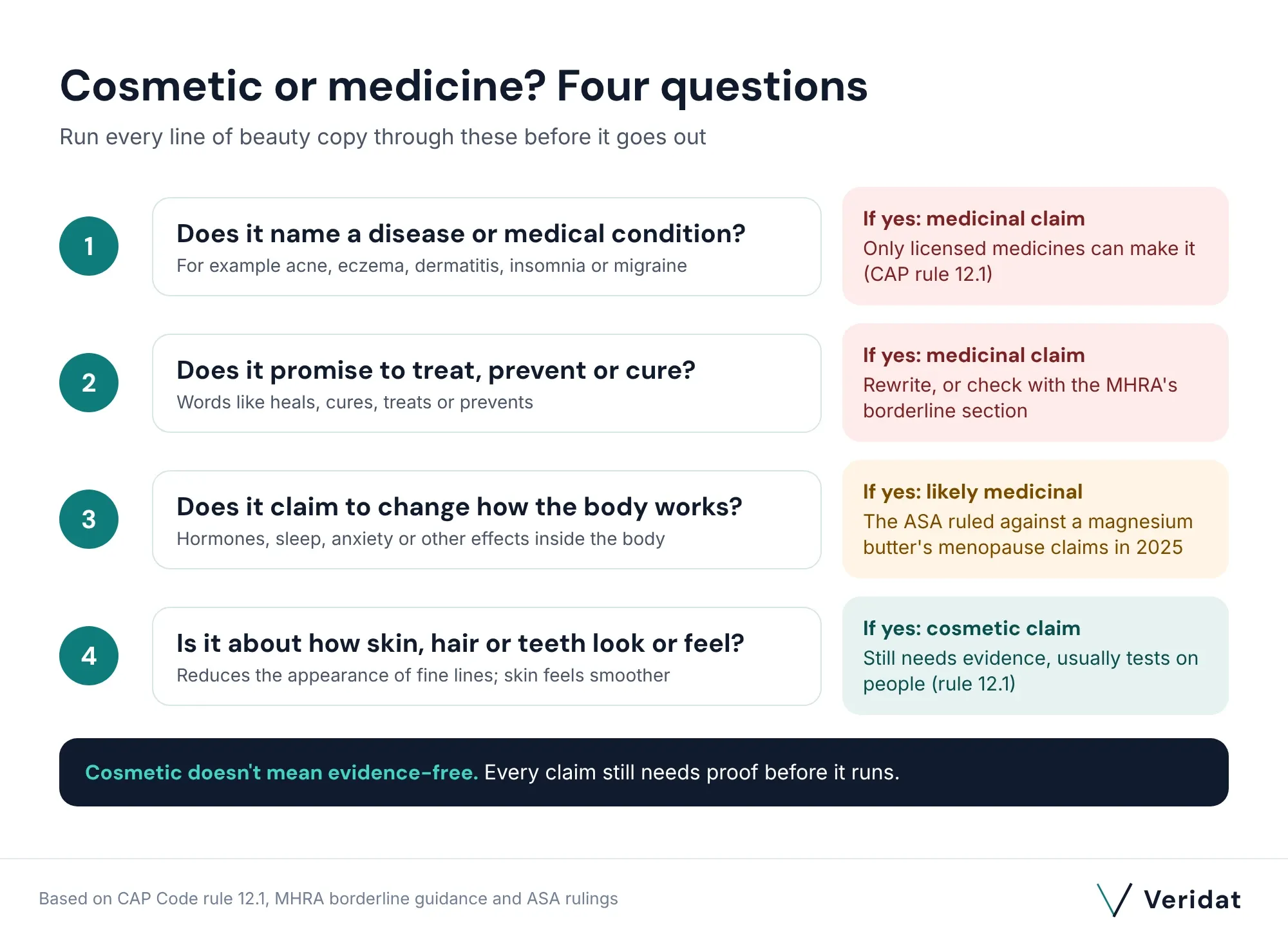
Pro tip: Read your copy as if you'd never seen the product before. If a sentence would make sense on a medicine's box, rewrite it or get advice before it runs.
Three rulings that show where the line is
Sweet Bee Organics: a moisturiser that sounded like a medicine (October 2025)
Sweet Bee sold its Sweet Sleep Magnesium Butter, a topical product, with a list of benefits: "Calms restless legs", "Soothes a migraine", "Reduces anxiety" and "Non-hormonal menopause solution". Its description promised to help "manage and reduce hot flushes" and talked about "tackling insomnia".
Sweet Bee argued some of these resembled permitted claims for magnesium supplements. According to the ASA, they were medicinal claims, which required the product to be authorised as a medicine, and it didn't have a marketing authorisation from the MHRA. It upheld the complaint.
Lesson: what's allowed for one product type doesn't carry over to another. A moisturiser can't make a medicine's claims, whatever's in it.
Natur Vital: "PPD free" hair colour (February 2025)
Natur Vital's website sold its permanent hair colour range as "PPD FREE", with "lessening the risks of allergic reactions". It was free from PPD, but it contained a related chemical, toluene-2,5-diamine sulfate.
In the ASA's view, the ad implied there was very little risk of an allergic reaction, including for people allergic to PPD. A linked page did say that around half of people with a PPD allergy react to the product and recommended a 48-hour patch test. But that wasn't clear or prominent enough to change the overall impression. In the end, the ASA upheld the complaint from the industry body, the CTPA.
Lesson: a "free from" claim is judged by what shoppers will think it means for them, not by whether the ingredient list is technically accurate.
Skinny Tan and Tanologist: filters on tanning ads (February 2021)
Two Instagram stories showed influencers promoting fake tan with beauty filters that made their skin look darker. According to the ASA, the filters were likely to have exaggerated what the products could do.
It advised influencers and brands to avoid filters that are directly relevant to the product being advertised. If a filter is used, it's the advertiser's job to show it doesn't exaggerate the effect.
Lesson: in a beauty ad, the image is evidence of a result. If the product didn't produce it, don't show it.
A claims process for a beauty brand
Most of these rulings weren't about bad products. They were about claims that ran ahead of the evidence, often because nobody checked the two against each other before launch. A simple process fixes most of that.
- List every claim, including headlines, product names, images and pack copy.
- Name the evidence each one needs, using the table above.
- Check the evidence says what the claim says, from the product as sold, over the timescale you state.
- Get the right sign-offs, from regulatory, product and legal, before anything goes live.
- Keep the record, so you can answer the ASA, a retailer or a customer with the evidence to hand.
Our step-by-step claim validation process covers who does what at each stage. For the wider rules beyond beauty, see our guide to marketing compliance.
We built Veridat to give marketing, product, technical, compliance and legal teams one place to validate marketing and product claims. You create a claim and choose the Health and beauty claim type, and Veridat's engine works out what's needed to back it up. It asks for a study on people, plus a patch test or perception study where the wording calls for one.
Then it runs study-quality checks on the evidence: whether the study used people, whether it had a control group, and the sample size, among other things. Anything missing becomes a task for the right person, so nobody's chasing evidence by email.
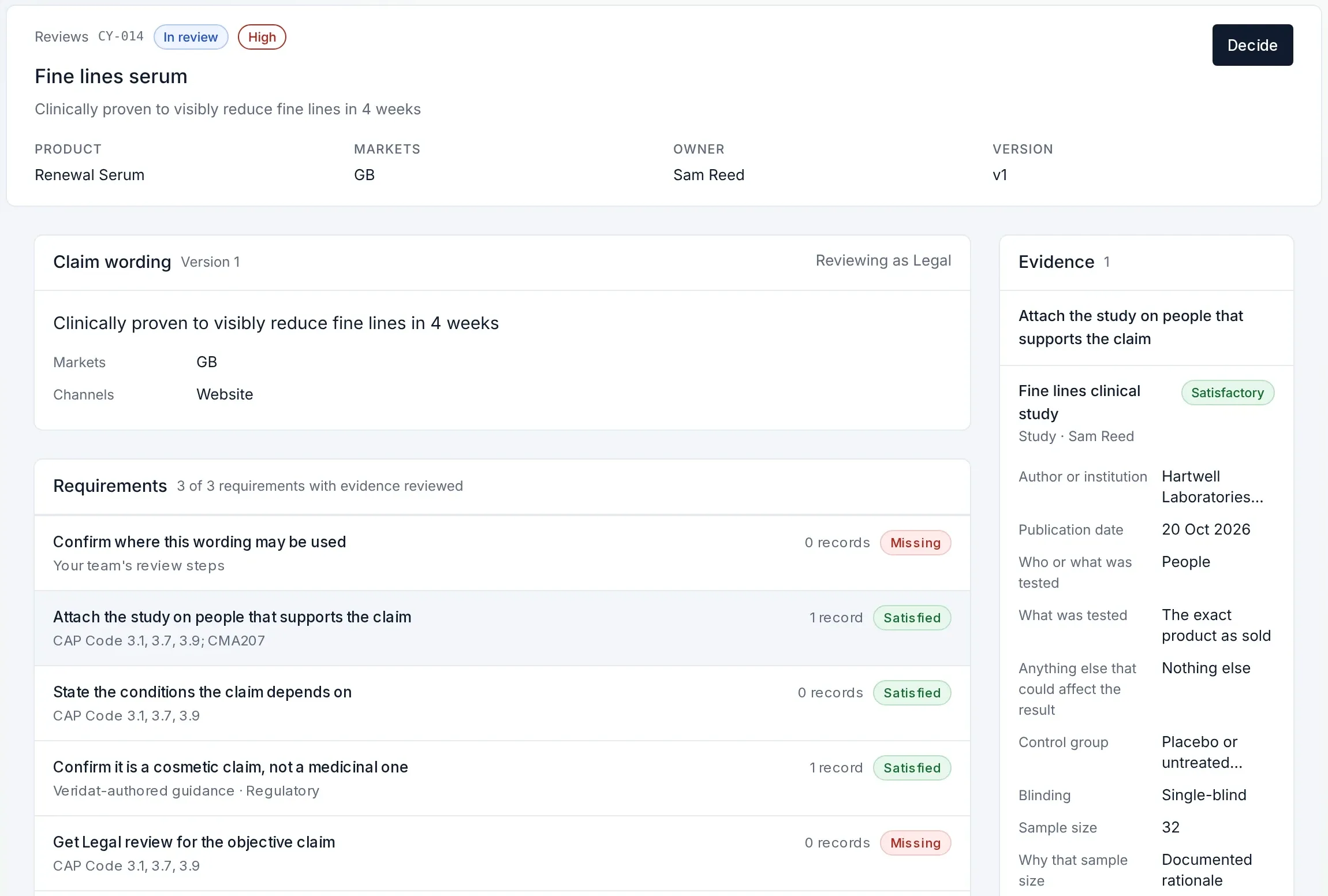
Nothing gets approved until the relevant reviewers, such as Regulatory, Product and Legal, have looked at the evidence and accepted it. If a reviewer approves with a gap, it's recorded as "approved with conditions", with the reason written down. Approved wording then goes into a library your team can reuse without restarting legal review. See how it works.
You can try every feature free for 14 days, no card needed. After that, plans start at £149 a month and go up to £899 a month, depending on your team size and needs.
Paste your product page, pack copy or ad into our free Claim Risk Checker and see which claims need proof behind them. It runs on Veridat's own engine, built for marketing copy. Your copy is never sent to an AI service, and the same copy always gets the same result.
Try it with this example (made up):
Our Overnight Renew Cream is clinically proven to reduce wrinkles by 40% in 2 weeks. 95% said their skin looked younger. Natural, hypoallergenic and calms eczema-prone skin.
Frequently asked questions
Do cosmetic claims need evidence in the UK?
Yes. You need evidence for objective claims before an ad runs under the CAP Code, and cosmetics law requires every claim to have adequate, verifiable evidence. For efficacy claims, that usually means tests on people.
Can I use a consumer survey to support a skincare claim?
Only for claims about what people perceived. CAP says you shouldn't use subjective feedback to support objective claims, so "92% said their skin felt smoother" is fine with a good survey, but "reduces wrinkles by 82%" needs a measured study.
What's the difference between a cosmetic claim and a medicinal claim?
A cosmetic claim is about how skin, hair or teeth look or feel. A medicinal claim says a product can treat or prevent a disease or medical condition, and only licensed medicines can make it. Naming a condition such as eczema or acne is usually a sign you've crossed the line.
Can beauty ads use filters?
Not if the filter is directly relevant to the product and exaggerates what it can do. In 2021, the ASA ruled against two tanning brands' Instagram ads for exactly that, and said it's the advertiser's job to show a filter doesn't exaggerate the effect.
Can I say 'cruelty-free' or 'not tested on animals'?
Only if it's true across the board. CAP's advice on "not tested on animals" claims says neither the product nor its ingredients should have been tested on animals, and ingredients shouldn't come from suppliers who have tested them on animals.
This is general information, not legal advice.
Spotted something out of date? Drop us a line and we'll put it right within five working days.