Greenwashing is when a brand makes a product or business sound greener than its evidence shows. In the UK, the ASA bans misleading green ads and the CMA can now fine firms directly. Most greenwashing examples share a pattern: a broad claim, missing detail about offsets or scope, and evidence that covers less than the ad implies.
On 11 November 2026, the ASA ruled against four retailers in one go. ProCook, SportsShoes.com, Who Gives A Crap and Grind had all promised some version of "carbon neutral delivery" in short online ads.
None of the four said whether that came from cutting emissions or from buying offsets. That was enough. In each ruling, the ASA found the basis of the claim unclear, and in three it said it was ambiguous whether the claim relied on offsetting credits or on actually removing sources of emissions.
It's the same mistake brands have been making for years, just in fewer words. Below are the UK greenwashing examples worth knowing, what each one teaches, and how to check your own copy before it runs. If you'd like a quick read on your wording first, paste it into our free Claim Risk Checker.
What counts as greenwashing in the UK?
There's no single greenwashing law. Two sets of rules do the work, and they point the same way.
The first is the advertising code. Section 11 of the CAP Code says the basis of an environmental claim must be clear, and that unqualified claims can mislead if they leave out material information. Absolute claims need a high level of substantiation, and the ASA has treated words like "eco" and "sustainable" as absolute. And unless the ad says otherwise, claims should be based on the full life cycle of the product.
The second is consumer law, which the CMA enforces. Its Green Claims Code, published in September 2021, sets out six principles. Claims must be truthful and accurate, clear and unambiguous, and must not omit or hide important information. Comparisons must be fair and meaningful, claims must consider the full life cycle, and they must be substantiated.
What changed recently is the penalty. Since 6 April 2025, under the Digital Markets, Competition and Consumers Act 2024, the CMA can decide for itself that consumer law has been broken and fine a business up to 10% of its global turnover, or £300,000 if that's higher. For the wider rules on product claims, see our guide to marketing compliance.
Greenwashing examples from the ASA
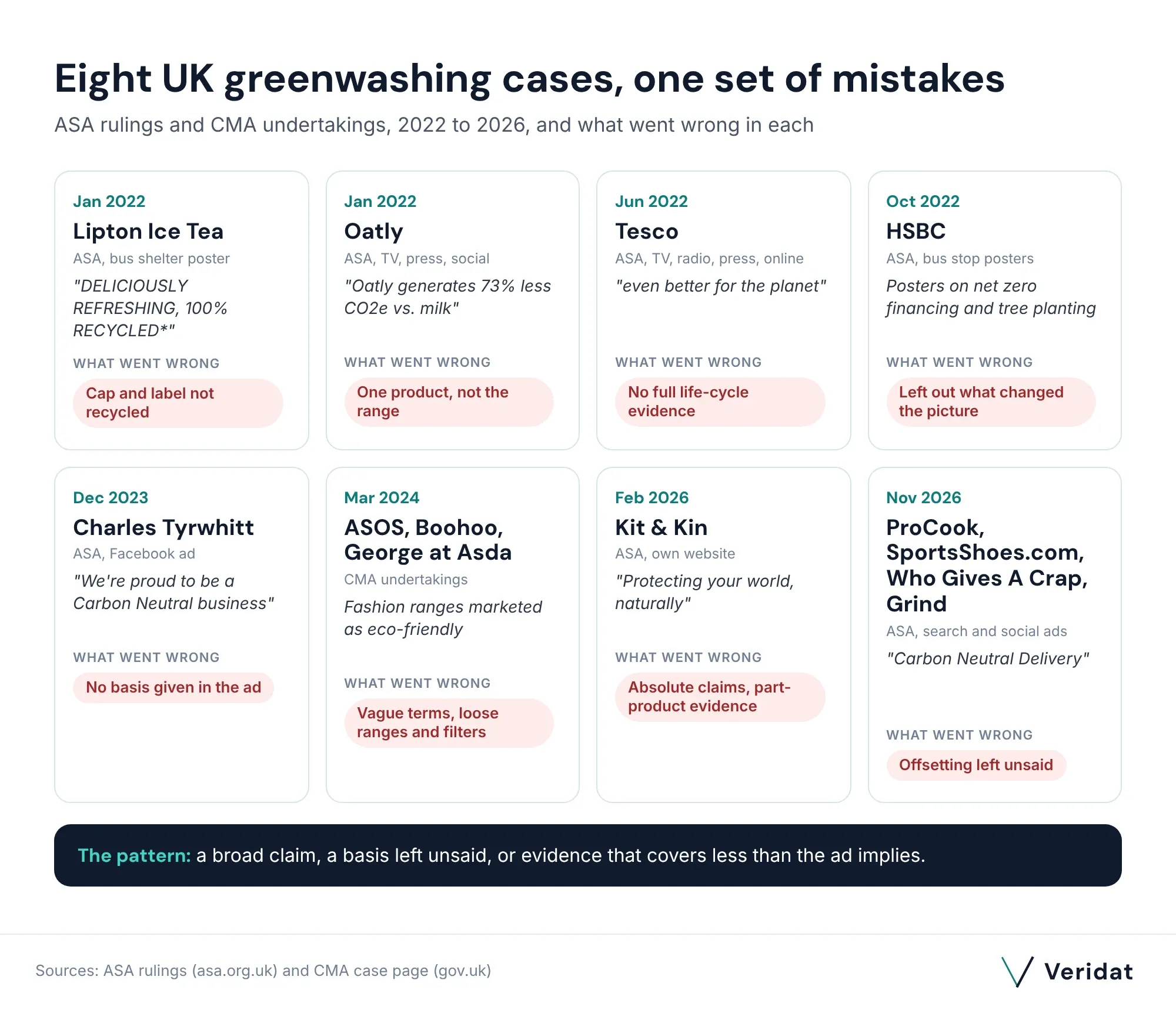
Four "carbon neutral delivery" ads (November 2026)
ProCook's Google ad offered "Next Day Delivery Available - Carbon Neutral Delivery". SportsShoes.com promised "Carbon Neutral Deliveries", Who Gives A Crap's Meta ad said "Carbon neutral shipping", and Grind went one further with "Carbon Positive Delivery".
Shoppers, the ASA accepted, would read each claim as being about delivery only, not the products' whole life cycle. The problem was the basis. Each claim depended on offsetting credits, and nothing in the ads or their landing pages said so.
Short ads didn't get a pass either. For SportsShoes.com and Grind, the ASA said the ads weren't so limited that the basis couldn't have been explained. All four rulings, against ProCook, SportsShoes.com, Who Gives A Crap and Grind, were upheld under rules 3.1, 3.3 and 11.1.
What it teaches: if "carbon neutral" rests on offsets, say so in the ad itself. CAP's advice on carbon neutral claims asks you to state whether a claim relies on offsetting or on cutting emissions, and to what extent.
Kit & Kin (February 2026)
Kit & Kin's website sold its nappies and wipes under the line "Protecting your world, naturally". The pages said its products were "better for our world", made from "sustainable, plant-based materials", and that the wipes were "Biodegradable".
All three issues were upheld. The ASA read the eco messaging as an absolute claim that the products would cause no environmental harm across their life cycle, which the evidence didn't show. It noted plastic-based tabs and leg cuffs in the nappies. And the biodegradability evidence covered only the viscose, not the wipes as a whole.
What it teaches: an absolute word like "sustainable" applies to the whole product. If one part isn't, the claim isn't true as written.
Charles Tyrwhitt (December 2023)
A Facebook ad for a cotton shirt ended with "We're proud to be a Carbon Neutral business". Charles Tyrwhitt said the claim rested on a sustainability consultancy's report.
That may well have been true, but the ad didn't say any of it. With no information in the ad explaining the basis for the claim, the ASA ruled it misleading.
What it teaches: holding evidence isn't enough. Your basis has to be clear to the person reading the ad.
Pro tip: Write the basis into the claim itself. "Carbon neutral delivery: we offset our delivery emissions through [named scheme]" fits in a search ad, and it's the detail the carbon neutral rulings in this list asked for.
Tesco (June 2022)
Tesco's Plant Chef campaign told shoppers that "a little swap can make a difference to the planet" and that its plant-based burger was "even better for the planet". Ads ran on TV, radio, in print and online.
In the ASA's reading, they promoted a swap from a meat burger to Plant Chef specifically. So it expected evidence based on the full life cycle of that burger. Tesco didn't hold any, and the ASA ruled against all six ads.
What it teaches: a comparison needs evidence for the exact things being compared, across their whole life cycle.
Oatly (January 2022)
Oatly's campaign drew 109 complaints. Its TV ads said "Oatly generates 73% less CO2e vs. milk", but the evidence compared only one product, Barista Edition, with whole milk. Shoppers would read it as covering all of Oatly against any cow's milk.
Another ad presented one climate expert's view as what "climate experts say", and dropped the word "probably" along the way. Four of the five issues were upheld. The fifth, a figure taken from a published scientific review, stood.
What it teaches: match the claim to what was measured. A result for one product is not a result for the range.
Lipton Ice Tea (January 2022)
A bus shelter poster read "DELICIOUSLY REFRESHING, 100% RECYCLED*". The asterisk led to small print in a corner: "Bottle made from recycled plastic, excludes cap and label".
Shoppers, said the ASA, would read "100% recycled" as covering the whole bottle, cap and label included. The small print could easily be missed, and even when seen, it didn't change that overall impression. That ruling went against Pepsi Lipton International.
What it teaches: a footnote can explain a claim, but it can't take back what the headline says.
HSBC (October 2022)
Two HSBC bus stop posters highlighted its net zero financing goal and a tree-planting project. According to the ASA, they gave the impression the bank was making a positive overall contribution to the environment.
It wasn't the whole picture. HSBC's own annual report showed it was still financing high-emitting industries, which the ASA called material information the ads should have included. Both ads were ruled against.
What it teaches: a true green claim can still mislead if it leaves out something that changes the picture.
Greenwashing examples from the CMA
Where the ASA polices ads, the CMA looks at the whole way products are marketed, including product pages, labels, search filters and ranges.
ASOS, Boohoo and George at Asda (March 2024)
In July 2022, the CMA opened an investigation into the three fashion retailers, concerned about how their products were marketed as eco-friendly. On 27 March 2024, it accepted formal undertakings and closed the case.
If you sell consumer products, the commitments read like a checklist you can use. Words like "eco", "responsible" or "sustainable" can't be used without further explanation. Recycled or organic percentages must be shown clearly. Products can't sit in a green range unless they meet all its criteria. Search filters must be accurate. And no green leaves or other natural imagery suggesting a product is greener than it is.
A few months later, the CMA published a compliance guide for fashion businesses drawn from the same case.
Unilever (November 2024)
In December 2023, the CMA began looking at sustainability claims on Unilever's household products. In November 2024, it closed the investigation, saying it had taken a range of factors into account, including changes Unilever had made to claims on some of its products.
What both teach: the CMA can close a case without a finding against you, as it did here, citing changes Unilever had made to some of its claims among other factors. Now that it can fine directly, the cost of getting there has gone up.
The five mistakes behind almost every case
Put the cases side by side and the same five mistakes keep coming up. Before your next launch, check your own copy against them.
| The mistake | Where it went wrong | What to do instead |
|---|---|---|
| A broad word with no basis | Kit & Kin's "sustainable"; Charles Tyrwhitt's "Carbon Neutral business" | Make the claim specific, or explain it in the ad itself |
| Offsetting left unsaid | ProCook, SportsShoes.com, Who Gives A Crap, Grind | Say whether it relies on offsets or cuts, and to what extent |
| Part of the product sold as the whole | Lipton's cap and label; Kit & Kin's wipes | Claim only what the evidence covers, in the headline |
| A comparison with the wrong evidence | Oatly's 73%; Tesco's Plant Chef swap | Compare like with like, across the full life cycle |
| Leaving out what changes the picture | HSBC's posters | Include material facts a shopper would want to know |
Greenwashing rules in the US and EU, in brief
Selling beyond the UK? You'll find the same habits serve you well, with a few differences.
In the US, the FTC's Green Guides say marketers shouldn't make unqualified general environmental benefit claims, because they're difficult to interpret. They also say it's deceptive to suggest a carbon offset represents emission cuts that have already happened, or will in the immediate future, when it doesn't.
In the EU, the rules got stricter on 27 September 2026, when the changes made by Directive (EU) 2024/825 started to apply. Generic claims like "eco-friendly" are banned unless backed by recognised excellent environmental performance, and so are product neutrality claims based on offsetting. Sustainability labels must come from a certification scheme or a public authority.
How to check your green claims before they run
You don't need a sustainability team to catch most of these. You need a few minutes per claim and a habit of asking the right questions.
- Write down what the claim means to a shopper. Not what you meant. "Sustainable nappies" means the whole nappy, every part.
- Find the evidence for that exact meaning. Which product, which part of the life cycle, measured how, and when?
- Say how you got there. If it's offsetting, name it. If it's one material, say which.
- Check comparisons line by line. Better than what, measured the same way?
- Look for what you've left out. Would a shopper think differently if they knew it?
- Keep the evidence where you can find it. If the ASA, the CMA or a retailer asks, you'll want it the same day.
Our green claims evidence checklist turns those questions into a form you can fill in per claim. For the bigger picture, our environmental claims assessment guide walks through the UK, EU and US rules in more depth.
We built Veridat to give marketing, product, technical, compliance and legal teams one place to validate marketing and product claims. You create a claim, and Veridat's engine works out what's needed to back it up. It creates the tasks, such as evidence to attach or wording to confirm, routes them to the right people and sends the claim to the right reviewers.
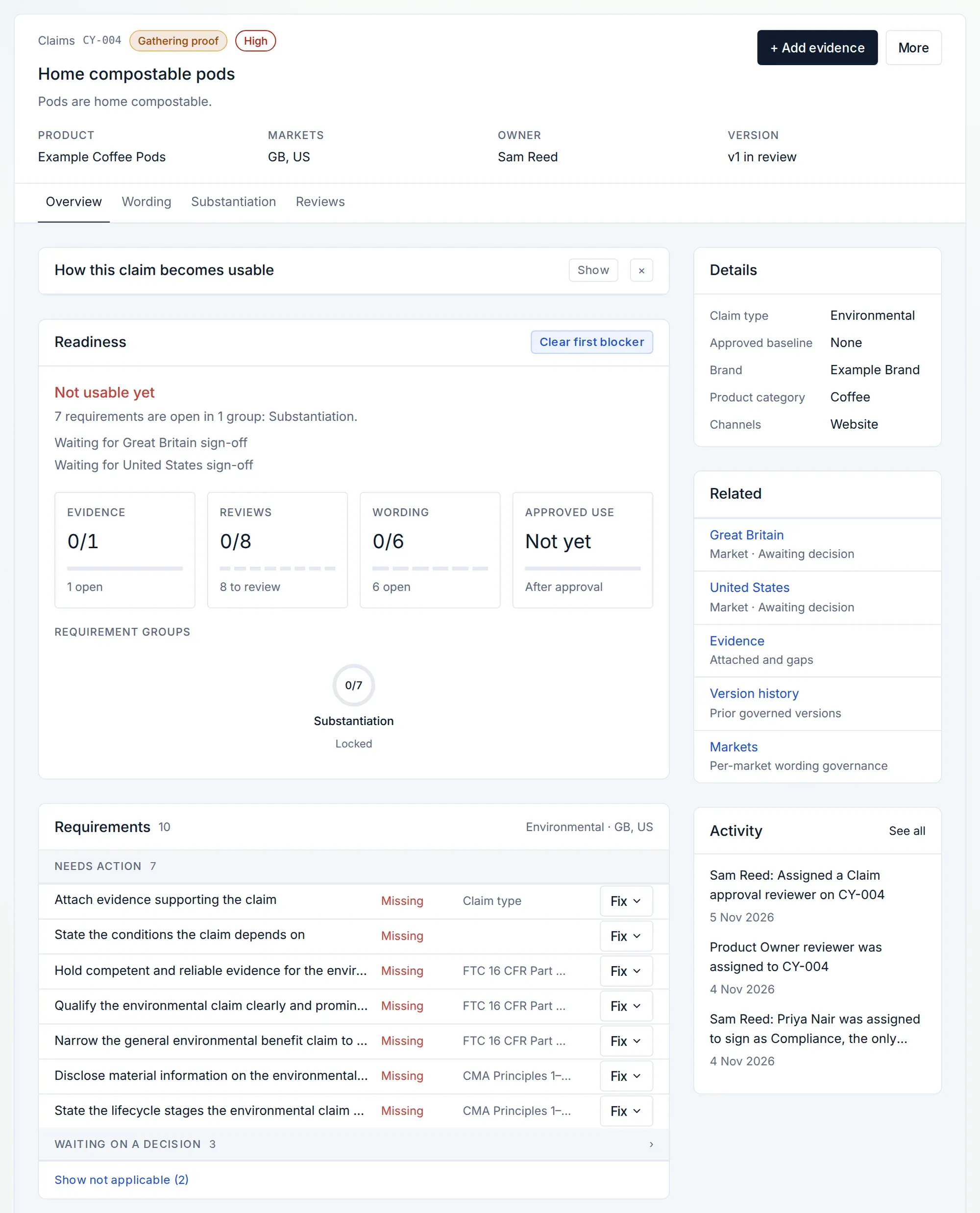
Nothing gets approved until the relevant reviewers, such as Legal, have looked at the evidence and accepted it. Each sign-off records who decided, their review function, when, and which version of the claim. Approved wording then goes into a library your team can reuse without restarting legal review, and if evidence lapses, the claim stays there with a warning. You can see the whole flow on how it works.
You can try every feature free for 14 days, no card needed. After that, plans start at £149 a month and go up to £899 a month, depending on your team size and needs.
Paste your product page, pack copy or ad into our free Claim Risk Checker and see which claims need proof behind them. It runs on Veridat's own engine, built for marketing copy. Your copy is never sent to an AI service, and the same copy always gets the same result.
Try it with this example (made up):
Our new range is eco-friendly and 100% sustainable. Every order ships with carbon neutral delivery, and our packaging is fully biodegradable.
Frequently asked questions
What is an example of greenwashing?
A clear recent one: in November 2026, the ASA ruled against four retailers whose ads promised "carbon neutral delivery" without saying the claim relied on offsetting. Another classic is Lipton's "100% recycled" bottle, where the cap and label weren't recycled and the small print said so.
Is greenwashing illegal in the UK?
Misleading green claims break both the advertising rules and consumer protection law. An ASA ruling can get ads withdrawn. Since April 2025, the CMA can also decide that consumer law has been broken and fine a business up to 10% of its global turnover.
Who regulates greenwashing in the UK?
For ads, it's the ASA, which enforces the advertising codes, including the environmental rules in section 11 of the CAP Code. For consumer protection law more widely, it's the CMA, which also wrote the Green Claims Code.
Can I say 'carbon neutral' if I offset?
Yes, if you're clear about it. CAP's advice is to avoid unqualified "carbon neutral" claims and to say whether the claim relies on offsetting or on cutting emissions, and to what extent. Four upheld rulings in November 2026 turned on exactly that point.
Are vague words like 'eco' or 'sustainable' banned?
Not banned in the UK, but risky. The ASA treats them as absolute claims, which the CAP Code says need a high level of substantiation, and the CMA's fashion undertakings require them to be explained. In the EU, generic claims like these are now banned unless backed by recognised excellent environmental performance.
This is general information, not legal advice.
Spotted something out of date? Drop us a line and we'll put it right within five working days.