Marketing compliance means making sure everything your business says to sell, from ads and packaging to product pages, emails, reviews and sales decks, is truthful, backed by evidence and allowed in every market where it runs. For UK and US brands, that mainly means the CAP Code, consumer protection law enforced by the CMA, and the FTC Act.
A £3 booking fee cost the AA £4.2 million. Learner drivers booking lessons with the AA and BSM driving schools saw a headline price, and a mandatory £3 booking fee only went into the total at checkout. That's drip pricing, and in April 2026 it earned the first fine the CMA has imposed for breaking consumer law under its new enforcement powers.
No court case came first, and nobody had made a bold product claim. That's marketing compliance in one story: what you leave out of a price breaks the same law as an inflated claim, and the regulator can now act directly.
Search the term and most guides are written for other industries, or are really about cookie banners. This marketing compliance guide is for brands that make and sell things: consumer products, beauty, manufacturing and software, in the UK and the US. It ends with a checklist you can run before anything goes out.
What is marketing compliance?
Put simply, it's being able to stand behind every word you use to sell. So what is marketing claims compliance? It's the core: each claim has to mean what a customer thinks it means, with the proof on file before it runs. How you sell (prices, reviews, emails) has rules too.
What it covers
- Product and performance claims: "lasts 48 hours", "clinically proven".
- Prices, offers and "free": the full price, up front.
- Comparisons with competitors: like for like, and checkable.
- Reviews and influencer posts: genuine, with paid links disclosed.
- Environmental claims: "recycled", "carbon neutral", "eco".
- Marketing emails and data: who you can email, and on what basis.
Marketing compliance vs brand compliance vs claim substantiation
Brand compliance is following your own guidelines on logos and tone. Nobody fines you for the wrong shade of teal. Marketing compliance is following the law and the advertising codes.
Claim substantiation is the evidence part of marketing compliance: holding proof that supports each objective claim, as a customer would read it.
Why marketing compliance matters more now
Since 6 April 2025, the CMA has been able to decide for itself whether a business has broken certain consumer laws, without first going to court. Penalties can reach 10% of global turnover or £300,000, whichever is greater.
It's using the power. After the AA fine in April, Marks Electrical was fined £720,000 in June for adding paid extras to orders without customers' express agreement.
In October it fined three more firms: Wayfair £4.8 million for false time-limited offers, Appliances Direct £1.2 million for false offers and automatic opt-ins to paid extras, and Gold's Gym £45,000 for not showing the total price, joining fee included, clearly and in good time.
None was about a product performance claim. But the same law covers what your pack and product page say.
The ASA's sanctions bite too. It can ask search engines to pull your paid search ads and name you on its website, with Trading Standards as its legal backstop.
In the US, the FTC's rule on fake reviews lets it seek civil penalties against knowing violators. Need to put this risk to a budget holder? Here's how to build the business case for Legal and Finance.
Marketing compliance rules in the UK
The CAP Code and the ASA
The CAP Code covers paid ads and, since 1 March 2011, marketing on your own website and in other non-paid space you control, such as your social accounts. Rule 1.8 puts primary responsibility for following it on the marketer. Packaging is generally outside the Code, unless it appears in an ad or carries a promotion; consumer law still covers it.
Most rules you'll meet are in section 3. Ads mustn't materially mislead (3.1) or leave out material information (3.3). You must hold documentary evidence before you publish (3.7) and mustn't hide significant limitations (3.9).
Comparisons with an identifiable competitor sit in rules 3.32 to 3.36, and testimonials must be genuine, with evidence on file (3.47). Environmental claims have section 11; health and beauty claims, section 12.
The Code was updated from 7 April 2025 to reflect the DMCC Act, and some rule numbers moved. Our CAP Code substantiation checklist walks through rule 3.7 claim by claim.
Consumer protection law: the DMCC Act 2024 and the CMA
The unfair commercial practices rules in the Digital Markets, Competition and Consumers Act 2024 apply to practices from 6 April 2025. They ban misleading actions and omissions and aggressive practices, plus anything short of professional diligence.
On top of those sit 32 practices banned in all circumstances, listed in Schedule 20. These include new, more detailed bans on fake consumer reviews. Drip pricing, where a mandatory charge appears after the headline price, is also prohibited.
They reach well beyond ads, to website listings and to problems before, during or after the sale.
The CMA's Green Claims Code
For environmental wording, the CMA's Green Claims Code sets six principles. Claims must be truthful and accurate. They must be clear and unambiguous, and mustn't omit or hide important information. Comparisons must be fair and meaningful, claims must consider the full life cycle, and they must be substantiated.
Our environmental claims assessment guide turns them into a six-step method, and we've listed the evidence green claims need by claim type.
Selling to businesses
B2B marketing isn't exempt. Under regulation 3 of the Business Protection from Misleading Marketing Regulations 2008, "Advertising which is misleading is prohibited", and it protects traders. Nor does the CAP Code's scope carve out B2B ads.
That covers a machine maker's spec sheets as much as a SaaS homepage; here's how it works for software companies.
Marketing emails and data
Under PECR, enforced by the ICO, you mustn't send marketing emails or texts to individuals without specific consent. A "soft opt-in" may let you email your own customers. Any corporate body can be emailed, but sole traders and some partnerships count as individuals.
UK GDPR covers the personal data behind it. The ICO's guidance is under review after the Data (Use and Access) Act 2025, so check it before relying on an old consent policy.
Marketing compliance rules in the US
The FTC Act and the reasonable-basis rule
The FTC's advertising basics come down to three things: ads must be truthful and non-deceptive, advertisers must have evidence to back up their claims, and ads can't be unfair.
Its 1984 policy statement on substantiation says you need a reasonable basis for a claim before it's disseminated. Without one, the claim breaks Section 5 of the FTC Act.
The FTC's guides and the reviews rule
The Green Guides (16 CFR Part 260) say marketers shouldn't make unqualified general environmental benefit claims. They don't bind the FTC, but they show how it reads green claims.
The Endorsement Guides (16 CFR Part 255, revised in July 2023) require any material connection the audience wouldn't expect to be disclosed clearly and conspicuously. An advertiser can be liable for a deceptive endorsement even when the endorser isn't.
From 21 October 2024, the Consumer Reviews and Testimonials Rule (16 CFR Part 465) has banned fake reviews and buying reviews for a set sentiment. It also covers undisclosed insider reviews and review suppression, plus fake social media indicators.
CAN-SPAM
The CAN-SPAM Act makes no exception for business-to-business email. Headers and subject lines must be accurate, the email must say it's an ad and give your location, and opt-outs must be honoured promptly. You're also responsible for what others send on your behalf.
UK and US marketing compliance rules in one table
| Area | UK rule (who enforces) | US rule (who enforces) | What it means for your copy |
|---|---|---|---|
| All marketing claims | CAP Code rules 3.1 and 3.3 (ASA); DMCC Act 2024 unfair commercial practices (CMA) | FTC Act Section 5 (FTC) | Nothing may mislead, by what it says or omits |
| Evidence before publishing | CAP Code rule 3.7 (ASA) | 1984 substantiation policy: a reasonable basis (FTC) | Hold the proof before launch, not after a complaint |
| Comparisons | CAP Code rules 3.32 to 3.36 (ASA) | FTC Act Section 5 (FTC) | Like for like, on checkable features |
| Prices and "free" | CAP Code rules 3.17 and 3.23 (ASA); drip pricing banned under the DMCC Act (CMA) | FTC Act Section 5 (FTC) | Show every unavoidable charge in the headline price |
| Reviews and endorsements | CAP Code rules 3.45 to 3.47 (ASA); fake review bans in DMCC Act Schedule 20 (CMA) | Endorsement Guides, 16 CFR Part 255; Consumer Reviews and Testimonials Rule, 16 CFR Part 465 (FTC) | Genuine reviews only; disclose paid or insider connections |
| Environmental claims | CAP Code section 11 (ASA); Green Claims Code (CMA) | Green Guides, 16 CFR Part 260 (FTC) | Name the specific benefit; absolute claims need strong proof |
| Advertising to businesses | Business Protection from Misleading Marketing Regulations 2008 (Trading Standards and the CMA); CAP Code (ASA) | CAN-SPAM covers B2B email (FTC) | B2B copy needs evidence too |
| Marketing email | PECR and UK GDPR (ICO) | CAN-SPAM Act (FTC) | Check consent in the UK; give a working opt-out in both |
Selling into the EU?
Since 27 September 2026, Directive (EU) 2024/825 has applied. It bans generic environmental claims unless you can show recognised excellent environmental performance, and "neutral" or reduced impact claims based on offsetting.
Who is responsible for marketing compliance?
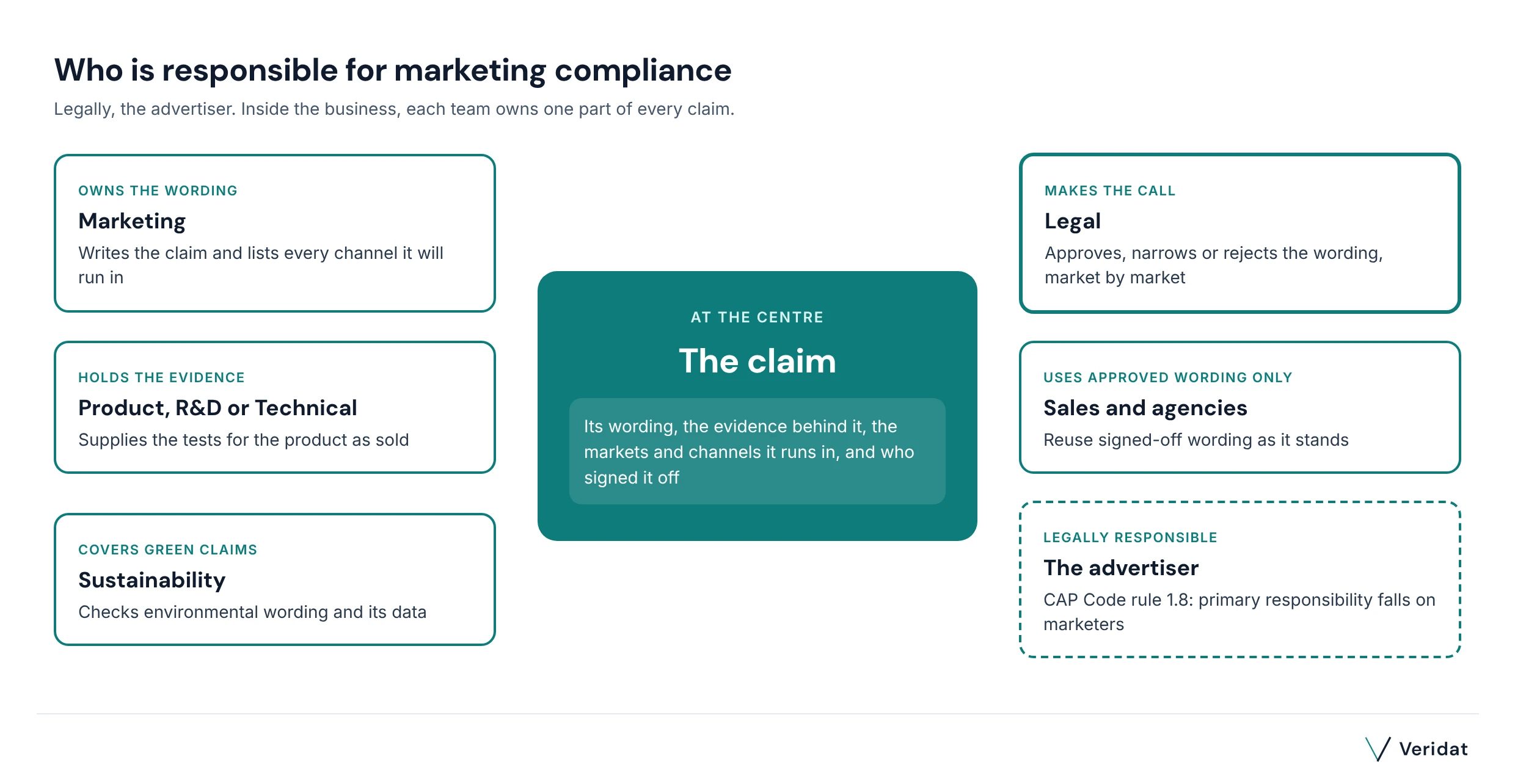
Legally, the advertiser. CAP rule 1.8 puts primary responsibility on marketers. Agencies and publishers must follow it too. In the US, the Endorsement Guides say endorsers and intermediaries such as agencies may be liable for their part, but that doesn't move yours.
Inside the business, it's usually split like this:
- Marketing or product marketing owns the wording and the list of channels.
- Product, R&D or Technical holds the test evidence.
- Legal makes the call.
- Sustainability covers green claims.
- Sales and agencies use only approved wording.
Our guide to approval and sign-off covers who signs what, and when.
How to make sure your marketing claims are compliant: six steps
If you're working out how to ensure marketing claims are compliant, the method is the same for a pack as for a sales deck. Start from the claim, not the channel.
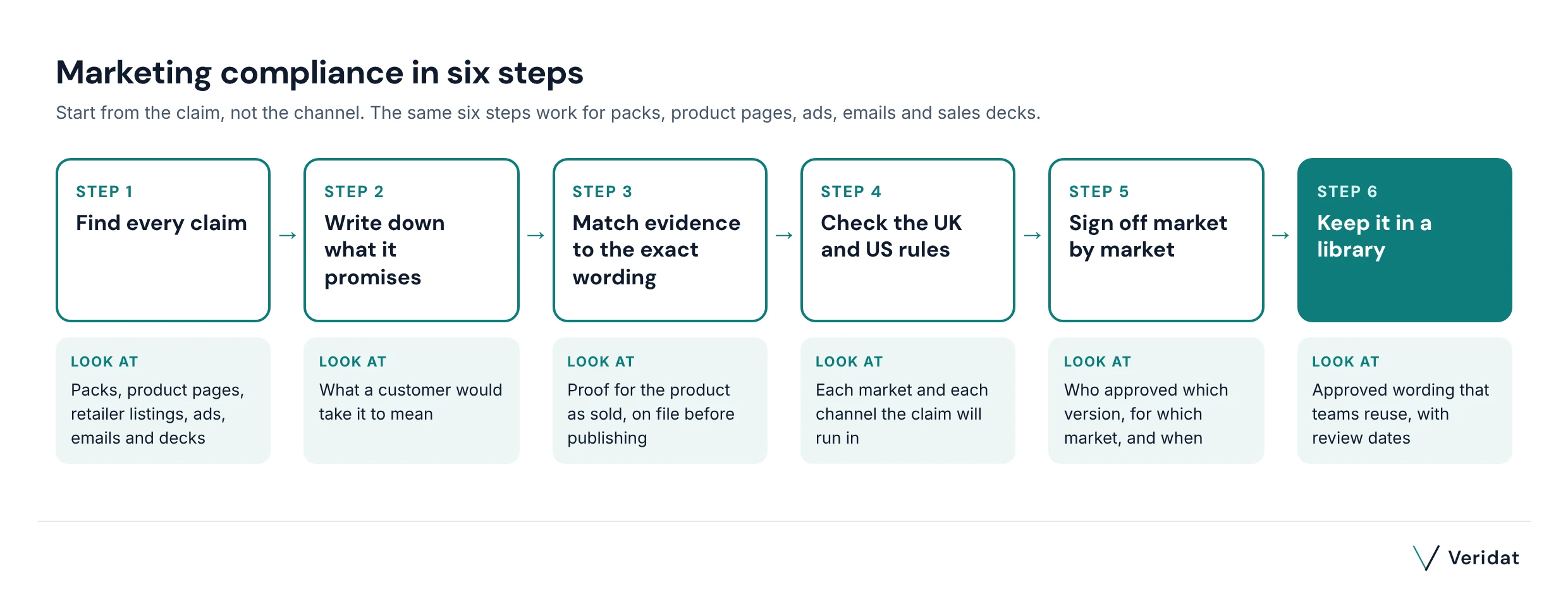
1. Find every claim
Check packs and product pages first, then listings and ads, plus the emails and decks sales send. Pictures and product names count. For a first pass, paste a page of copy into our free claim checker. It runs on Veridat's own engine, built for marketing copy. Your copy is never sent to an AI service, and the same copy always gets the same result.
2. Write down what each claim promises
Read it as a customer would. "Lasts all day" promises a number of hours, so write the number down. Here's how to validate marketing and product claims step by step.
3. Match evidence to the exact wording, before publishing
The test has to cover the product as sold. Our marketing claims template has a field for everything a reviewer asks.
4. Check the rules in each market and channel
A line that's fine on a UK pack may need a qualifier on a US retailer listing. For the campaign view, see how to check advertising claims before launch.
5. Get sign-off from the right people, market by market
Bring in Legal, plus Product or Technical when there's a test and Sustainability for green wording. Record who approved which version, for which market, and when.
6. Keep approved wording in one library, with review dates
Approved wording should be reused, not rewritten. An approved claims library gives sales and agencies the wording they're allowed to use.
Marketing compliance checklist: 12 checks before you publish
Run this before anything goes live. Can't tick a line? Fix it or drop the claim.
Claims and evidence
Comparisons and prices
Reviews and endorsements
Green claims
Email and data
Sign-off
Pro tip: Start with the 20 claims your team repeats most. Clear each one once, with its evidence and sign-off, and reuse the approved wording everywhere.
Where brands most often get it wrong
"Clinically proven" and beauty claims. Beauty Pie had studies behind its "clinically proven to reduce wrinkles in 4 weeks" Tube poster, but the ASA still ruled against it in June 2026: the studies weren't blinded or weren't of the advertised mask. Under CAP rule 12.1, objective claims need evidence, including trials on people where relevant.
Green claims. A Google ad for adidas "Recycled Running Shoes" breached five rules, including 3.7, 11.1 and 11.3. People would read it, the ASA said, as every shoe in the range being made from 100% recycled material, and adidas didn't show that. Greenwashing doesn't need a lie; one broad word can do it.
"Free" and prices. Rule 3.23 says you can't call something free if the customer pays anything beyond the unavoidable cost of responding.
Star ratings and reviews. Under rules 3.45 and 3.46, incentivised reviews must be flagged and review information mustn't be shown misleadingly.
By industry
- Beauty and personal care: section 12 of the CAP Code and human trials for objective claims.
- Household products and consumer electronics: performance claims and comparisons, tested on the model you sell.
- Manufacturers selling to businesses: the 2008 B2B regulations, so check spec sheets as carefully as ads.
- Software: uptime and security claims, and anything about saving time, need evidence too.
There's more on how consumer product teams use Veridat for product claims.
Pro tip: If a claim needs a footnote to be true, the footnote is part of the claim. It needs evidence too, and it mustn't contradict the headline.
Do you need marketing compliance software?
A spreadsheet works for a few claims and one reviewer. It creaks once several teams edit it and nobody can say which version Legal approved. Here's signs you've outgrown a claims spreadsheet.
We built Veridat to give marketing, product, technical, compliance and legal teams one place to validate marketing and product claims.
You add the claim: its wording and product, and the markets and channels it's for. Veridat builds a checklist for it from 26 UK and US advertising rules, works out the substantiation needed, and turns each gap into a task with a due date, chased by reminder emails. Then it sends the claim to the right reviewers, such as Legal, Product or Compliance.
Each market is signed off separately, so wording can be approved for Great Britain while the United States is still in review. Nothing is approved until reviewers have accepted the evidence; approving with a gap is recorded as "approved with conditions", with the reason.
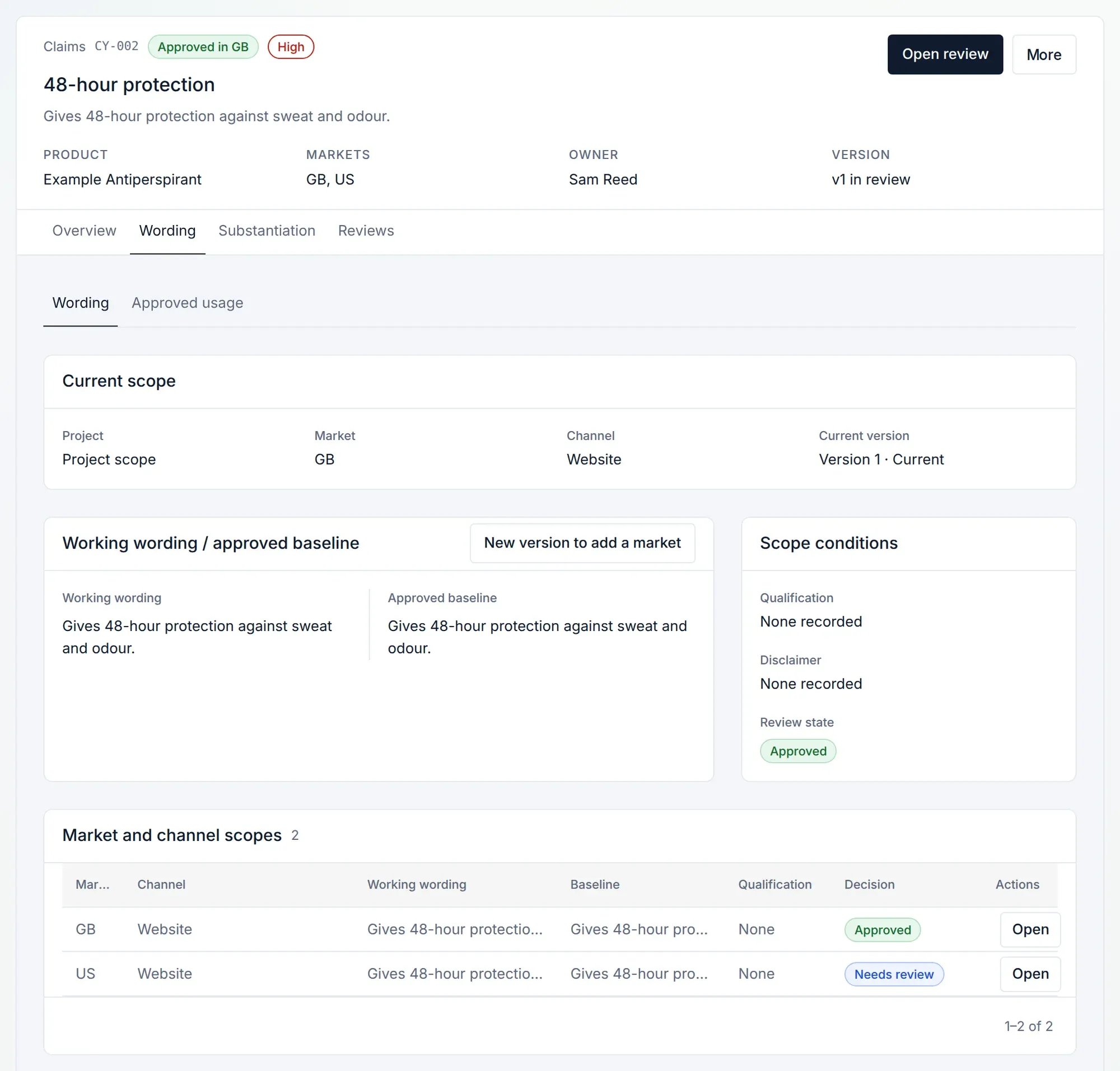
Every sign-off records who decided, their review function, when and on which version, and can't be edited afterwards. Approved claims go into your approved claims library. The Approved view lists them with their status and proof, and each claim's Wording tab shows the markets and channels it's cleared for and its conditions. Sales teams join free as viewers: they see approved wording but can't approve, edit or export it. Evidence expiry shows on the evidence record and as a warning.
You can try every feature free for 14 days. After that, plans start at £149 a month and go up to £899 a month, depending on your team size and needs. See how a claim gets from draft to approved.
Comparing options? Read our buyer's guide to marketing compliance software, then the marketing compliance tools worth a look and tools for verifying advertising claims before launch. Take our list of questions to ask before you buy into every demo.
Marketing compliance FAQs
What is marketing compliance?
It's making sure everything you say to sell is truthful, evidenced and allowed in each market. In the UK that's mainly the CAP Code and consumer law enforced by the CMA; in the US, the FTC Act.
Who is responsible for marketing compliance in a company?
Legally, the advertiser, even when an agency or influencer made the content. Day to day, marketing owns the wording, technical teams hold the evidence and legal decides.
What's the difference between marketing compliance and brand compliance?
Brand compliance is following your own guidelines; marketing compliance is following the law and the advertising codes. A brand and marketing compliance guide usually needs both, but only one can get you fined.
Does the CAP Code apply to our own website and social media?
Yes. Since 1 March 2011 it has covered your own website and other non-paid space you control, such as social media accounts.
Do UK advertising rules apply to B2B marketing?
Yes. Misleading advertising to traders is prohibited under the Business Protection from Misleading Marketing Regulations 2008, and the CAP Code doesn't exclude B2B ads.
Can software make our marketing compliant?
No tool makes the legal call. Good software organises the evidence and decisions so you can show your working; the free claim checker is an easy first look at a page of copy.
This is general information, not legal advice.
Spotted something out of date? Drop us a line and we'll put it right within five working days.
Paste a page of copy into the free claim checker. It runs on Veridat's own engine, built for marketing copy. Your copy is never sent to an AI service, and the same copy always gets the same result.