Marketing compliance software helps you check what your marketing says before it goes out. For consumer brands and software companies, that means spotting each marketing claim, linking it to evidence, checking it against UK and US advertising rules and recording who approved it, so you can stand behind every word if a regulator, retailer or rival asks.
Picture a poster on the London Underground promising that your LED face mask is "clinically proven to reduce wrinkles in 4 weeks". You've got studies. Then the ASA rules against you anyway. That's what happened to Beauty Pie in June 2026, and it's why having evidence is only half the job. You also need the right evidence, for the exact words, on file before the ad runs.
One note on scope: this guide is about marketing claims, not the data and privacy tools some lists also call "marketing compliance".
Marketing compliance software worth a look
Here are the marketing compliance tools worth a look if you're a consumer brand or software company, starting with ours. They range from advertising compliance software built around claims to proofing tools built around creative files, so it pays to know which job you're hiring for. For prices side by side, see our guide to the best marketing compliance software.
Veridat
We built Veridat to give marketing, product, technical, compliance and legal teams one place to validate marketing and product claims. It's focused on claims rather than files, and made for the statements consumer brands and software companies make every day, from "clinically tested" to "cuts onboarding time in half".
The automation does the chasing for you. Create a claim and Veridat's engine works out what's needed to back it up, drawing on a checklist of 26 UK and US advertising rules. It then creates the tasks (evidence to attach, wording to confirm), routes each one to the right person and sends the claim to the right reviewers. Fewer long email threads, and no guessing who still needs to sign.
Nothing gets approved until the relevant reviewers, such as Legal, have looked at the evidence and accepted it. Missing proof is flagged as missing, and any gap a reviewer accepts keeps its reason. Each sign-off records who decided, their review function, when, and which version of the claim, and decisions can't be edited or deleted. So when a retailer or regulator asks what you held and who agreed, the answer's already there.
Approved wording then goes into a library your team can reuse without restarting legal review.
You can try every feature free for 14 days. After that, plans start at £149 a month and go up to £899 a month, depending on your team size and needs. Larger teams can talk to us about a custom plan.
IntelligenceBank
IntelligenceBank is an AI marketing operations platform whose modules include digital asset management and marketing compliance [1]. Its compliance product uses AI to flag legal and regulatory risk in content before and after it goes live [2]. Approval workflows send content to the right reviewers at each stage, and every action is logged and time-stamped [2]. The base asset management package starts at $567 a month, billed annually, with compliance quoted to your set-up [3].
Filestage
Filestage is online proofing software for review and approval [4]. You set up separate reviewer groups, share new versions until you get the nod, and bring compliance and legal reviewers in automatically [5]. Its Review Agents check creative assets for errors and compliance risks before anyone starts reviewing [5]. There's a free plan, and paid plans start at $199 a month with 10 seats included [6].
Leah
Leah's Marketing & Promotions Legal Guardrail reviews marketing content against your jurisdictional rules, matching every quantifiable, comparative or superlative claim against a live evidence library [7]. It names the CAP Code and ASA rulings for the UK, and the FTC's advertising and endorsement guides for the US [7]. Clean assets are approved automatically; flagged ones go to the right owner with the rule, evidence and a suggested fix attached [7]. Leah sits within a wider legal AI platform, so it'll feel most at home where Legal runs the process [7].
Aprimo
Aprimo is an agentic digital asset management and content operations platform [8]. For regulatory and compliance teams, content moves through defined review and approval stages with sign-off records captured, and approved claims stay connected to the content they support [9]. It boasts five AI agents, including a Critic and a Compliance agent, that apply brand and compliance policies at scale [8]. Pricing depends on the products you choose and your number of users, quoted on request [10].
PageProof
PageProof is online proofing software that helps marketing and creative teams review and approve work in one place [11]. It uses AI to suggest markup right on the proof, and you can build custom AI agents that check proofs against your brand guidelines [11]. Plans start at $249 a month with unlimited reviewers [12]. If your team lives in design files and review rounds, PageProof will feel natural; if you need the evidence behind each claim on record, you'll want something built around claims.
Lytho
Lytho is marketing compliance software that brings creative workflow and AI review together with marketing asset management in one platform [13]. Its AI Teammates review content as it's created, flagging brand and regulatory issues in real time, and reviews then move into a tracked workflow [13]. Pricing is tailored to each organisation, based on team size and the products you need [14]. It's a good match if your main need is review inside creative production.
Ziflow
Ziflow is an online proofing platform that guides projects through each review stage automatically [15]. ReviewAI, its automation engine for creative reviews, verifies checklist items and upholds brand standards [15]. Legal and compliance teams get standardised checklists, and every decision, comment and revision is recorded [16]. There's a free plan for two users, and paid plans start at $199 a month, billed annually [17].
If you need the evidence itself
Some firms produce the proof rather than manage it: HarrisX offers statistical and legal vetting of advertising claims [18], Highlight runs consumer claims testing [19] and Provenance reviews evidence for sustainability "Proof Points" [20]. Our guide to the best tools for verifying advertising claims covers them.
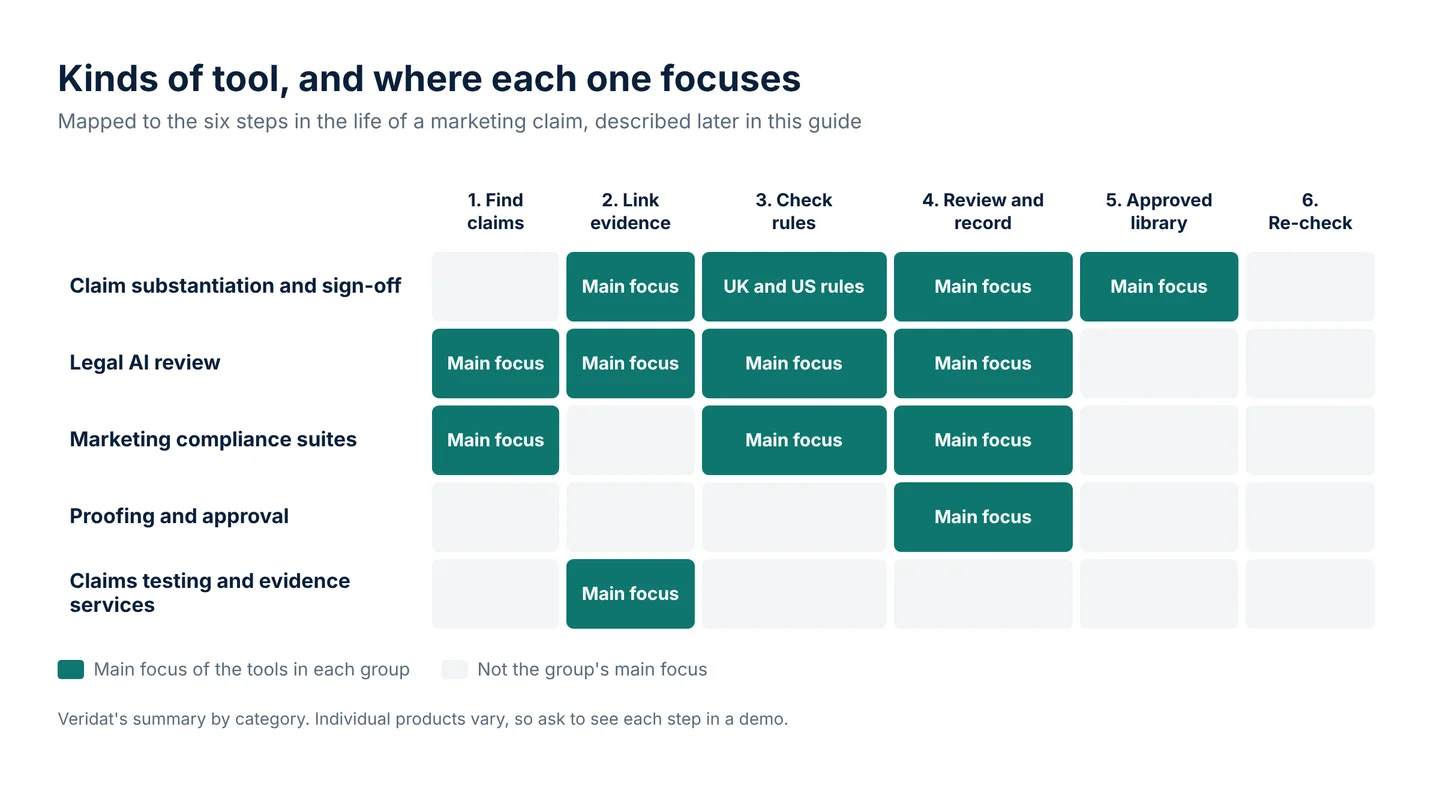
Put together, the market splits into five kinds of tool, each built around different steps in a claim's life.
Built for financial firms? Not covered here
Some ad compliance software you'll meet in searches, such as PerformLine, Sedric and Warrant, is built for banks and other financial firms [21][22][23]. We've left it out of this guide.
Do you need it yet? Signs you've outgrown the spreadsheet
If you sell skincare, trainers or software, what keeps your lawyer up at night is a marketing claim you can't prove, such as "clinically proven" or "saves teams 10 hours a week". Marketing claims compliance simply means each one has evidence behind it before it's published, plus a record of who said yes.
Plenty of small teams don't need software yet. If one person writes the copy, one person checks it and you sell in one country, a tidy spreadsheet will do. Things change when:
- several people write marketing claims in different places, and nobody sees all of it;
- you sell in more than one market, so the same claim has to hold up under UK and US rules;
- retailers, enterprise buyers or a regulator ask for proof, and finding it takes days;
- Legal approves by email, so a year later nobody can show which version they approved.
That last one matters most. Under the CAP Code, the evidence has to be in your hands before the ad goes out, and a thread of "looks fine to me" replies won't show what you held, or when.
Pro tip: Pull up the last three claims Legal approved by email. From the threads alone, can you show which version they approved and what evidence they saw? If that takes more than a few minutes, you've outgrown the inbox.
The rules good software should help you meet
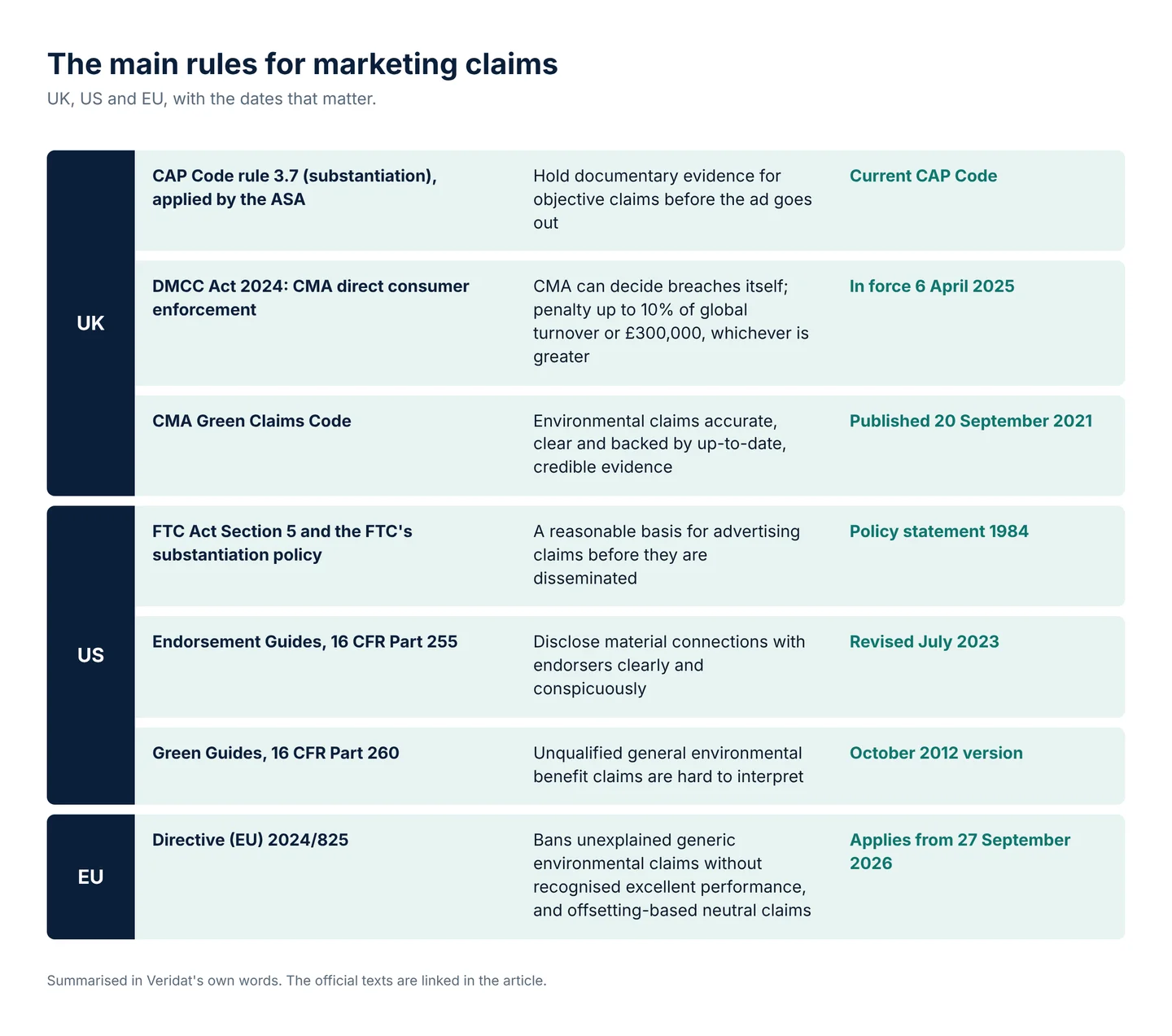
Anyone choosing marketing compliance software in the UK should start with two regulators: the ASA and the CMA. US sales bring in the FTC, and EU green claims face new bans. No software makes the legal call for you, but the right tool makes the rules easy to apply, and easy to prove you applied.
UK: the CAP Code and the ASA
The Advertising Standards Authority is the UK's independent advertising regulator. For most brands the code that counts is the non-broadcast CAP Code, written by the Committee of Advertising Practice (CAP), and it reaches claims on your own website and on social media accounts you control, as well as paid ads.
Everything turns on rule 3.7, on substantiation. Before an ad goes out, you must hold documentary evidence for claims that consumers are likely to see as objective and that can be proved objectively. Without adequate evidence, the ASA may treat the claim as misleading. And it reads a claim the way consumers would, whatever you meant.
Two rulings from June 2026 show how strictly that's applied.
Take Beauty Pie first. Its Tube poster said "CLINICALLY PROVEN TO REDUCE WRINKLES IN 4 WEEKS", and the brand had studies. Trouble was, its own product studies had no blinding and no control or placebo group. Another, a double-blind placebo-controlled trial, wasn't about the advertised product at all. In its ruling on Beauty Pie, the ASA found breaches of rules 3.1 (misleading advertising), 3.7 and 12.1, and the ad must not appear again in its current form.
Then adidas. A Google ad offered "Recycled Running Shoes", which consumers would take to mean every shoe in the range was made from recycled materials. That's an absolute claim needing a high level of substantiation, and adidas didn't show that all those shoes were made from 100% recycled material. Its ruling lists five rules breached, including 3.7.
Both brands lost on the same point. Evidence has to support the exact words, for the exact product, and good software makes that gap visible before the poster goes up.
UK: the CMA's new powers under the DMCC Act
The consumer enforcement parts of the Digital Markets, Competition and Consumers Act 2024 (the DMCC Act) have been in force since 6 April 2025. Under section 226, giving false or misleading information about a product is a misleading action.
What's new is who decides. Under its direct enforcement powers, the CMA can now rule for itself that a business has broken certain consumer laws, rather than having to ask a court. Penalties can reach 10% of global turnover or £300,000, whichever is greater. So a misleading claim now risks far more than a withdrawn ad.
US: the FTC Act and the FTC's guides
Software companies, take note of DoNotPay. It promoted its subscription service as "the world's first robot lawyer", yet according to the FTC it hadn't tested whether its "AI lawyer" worked to the level of a human lawyer. In February 2025 the FTC finalised an order requiring DoNotPay to pay $193,000 in monetary relief. It also can't claim its service performs like a real lawyer unless it has sufficient evidence.
The FTC's advertising guide for small businesses says advertisers must have evidence to back up their claims. Its 1984 policy statement on advertising substantiation adds the timing: you need a reasonable basis for a claim before it's disseminated, and objective claims without one breach Section 5 of the FTC Act.
Two sets of guides come up again and again. Under the Endorsement Guides (16 CFR Part 255, revised July 2023), a material connection between brand and endorser that the audience wouldn't expect, influencers included, has to be disclosed clearly and conspicuously. The Green Guides (16 CFR Part 260, October 2012) warn that unqualified general environmental benefit claims are hard to interpret and likely to convey a wide range of meanings.
Green claims: the CMA's code and the EU's new bans
The CMA launched its Green Claims Code in 2021 to tackle greenwashing. Its checklist for businesses opens with two plain tests: the claim should be accurate and clear for everyone to understand, and there should be up-to-date, credible evidence that it's true.
Across the Channel, EU countries have applied the rules in Directive (EU) 2024/825 since 27 September 2026. They add outright bans on:
- sustainability labels that aren't based on a certification scheme or set up by public authorities;
- generic environmental claims (ones not spelled out in clear and prominent terms on the same medium) where you can't show recognised excellent environmental performance relevant to the claim;
- claiming, on the basis of offsetting greenhouse gas emissions, that a product has a neutral, reduced or positive impact on the environment in terms of greenhouse gas emissions.
Pro tip: Search your site and packs for "climate neutral" and "carbon neutral" before anything else. If you sell into the EU and those claims rest on offsetting, they now fall straight into a ban.
What good marketing compliance software should do
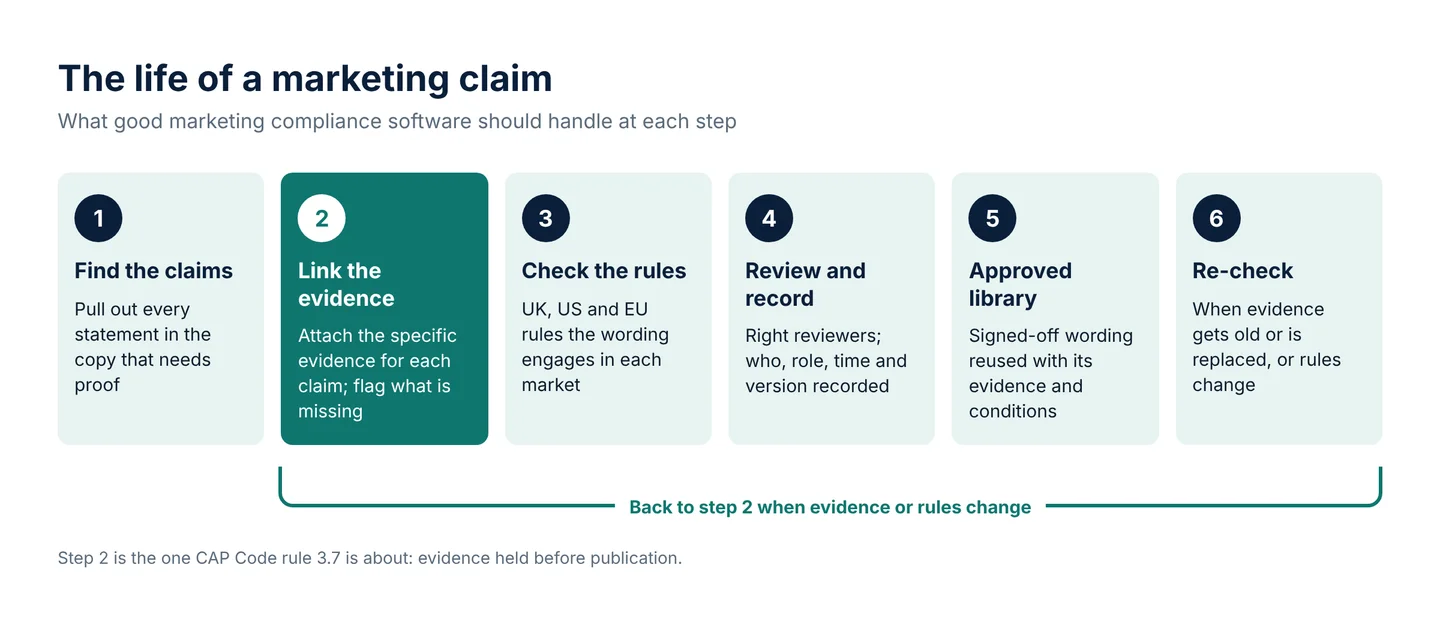
Here's the life of a marketing claim, and what good software does at each stage.
1. Find the claims in the copy
A single product page can carry a dozen marketing claims, and the risky ones rarely sit in the headline. "Up to 40% less plastic" can hide in the small print. Good software pulls out each statement that needs proof, so reviewers work from a list rather than a hunch.
2. Link each claim to its evidence
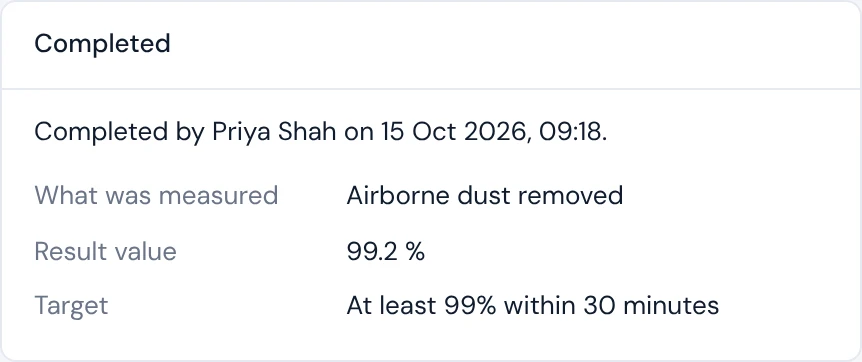
Push hardest here in a demo, because this is the step rule 3.7 is about. Each claim should point to the specific study, test report or certificate behind it, with a note on what that evidence actually covers. Nothing should get through with a gap nobody has explained.
3. Check the wording for each market
An unexplained "eco-friendly" was already risky under the CMA's code and the FTC's Green Guides; in the EU it now needs recognised excellent environmental performance behind it. Your software should tell a reviewer which rules a claim engages in each market and what evidence they expect. It shouldn't pretend to hand down a verdict. That's the reviewer's job.
4. Route it to the right reviewers and lock the decision
A skin-results claim may need regulatory and legal sign-off, while a price claim might only need marketing and legal. Each decision should record who made it and their role, plus the time and the exact version of the wording. That's your audit trail. If the copy changes after sign-off, the approval mustn't quietly carry over to the new words.
5. Keep an approved claims library
Most teams say the same twenty things in two hundred places. An approved claims library (some call it a claims register) holds signed-off wording with its evidence and conditions, so a copywriter can reuse it without another legal review. This is where the first four steps pay you back.

6. Re-check when evidence or rules change
Approval isn't for ever. When evidence is superseded or rules change, you should be able to find every approved claim resting on it and send it back for review.
How to choose marketing compliance software
Take these questions into every demo, and ask to see each answer working on your own copy.
- Evidence per claim. Can a claim be approved with no evidence and no recorded reason?
- Approved library. Can your team search approved wording and reuse it, with its conditions?
- Named rules. Does it name the CAP Code and the FTC's guides, or only "regulations" in general?
- A locked sign-off record. Does each decision record who made it, when, and against which version? Can anyone edit it afterwards?
- Price model. Is it per seat, per plan or by quote? What happens to the bill when ten more people need access?
If a price is quote-only, ask whether it means an annual contract or a set-up project, and what a team of five would actually pay. Our own prices sit openly on our pricing page.
Pro tip: If a vendor answers the first question with "it depends on configuration", ask them to configure it there and then, on one of your own claims. Ten minutes of that will tell you more than any feature sheet.
Getting started: a one-week marketing compliance audit
You don't need a big rollout to find out where you stand. A small marketing compliance audit tells you most of it, software or not.
- Day 1: pick 20 live marketing claims from your busiest pages and current ads. Include the awkward ones.
- Days 2 and 3: gather the evidence for each. Note where it lives, what it actually shows and how old it is.
- Day 4: run the copy through our free claim checker and mark each claim supported, weak or unsupported.
- Day 5: agree who signs off what.
The checker runs on Veridat's own engine, built for marketing copy. Your copy is never sent to an AI service, and the same copy always gets the same result.
Free help is on hand too: CAP's Copy Advice team answers a standard enquiry free within 3 to 5 working days. For green claims, try the ASA's one-page environmental claims checklist alongside our green claims evidence checklist and environmental claims assessment guide. Our ASA CAP Code substantiation checklist and walkthrough on how to check advertising claims before launch cover everything else.
By Friday you'll know which claims to fix and whether a spreadsheet will hold up. If it won't, start a free trial of Veridat and load those 20 claims first. Or, if you'd like a direct say in what we build next, become a design partner and get 30 days' free access.
Frequently asked questions
What is marketing compliance software?
Software that helps you check your marketing before it's published: finding each claim, linking it to evidence, checking the rules and recording who approved it. It organises the evidence and the decisions, while the legal call stays with people.
Do small marketing teams need it?
Not always. If one person writes the copy, one person checks it and you sell in one country, a spreadsheet plus the free ASA and CMA resources can work. Software earns its keep once several people write claims or customers keep asking for proof.
Is it the same as proofing software?
No. Proofing software manages comments and approvals on creative files. Claim substantiation software manages the evidence behind what the copy says, and the decision to approve each claim. The two can work side by side.
Which UK rules apply to marketing claims?
For most non-broadcast ads, the CAP Code, applied by the ASA, and rule 3.7 on substantiation in particular. Consumer law applies too, and since 6 April 2025 the CMA can enforce certain consumer laws directly under the DMCC Act. For green claims, follow the CMA's Green Claims Code.
How much does marketing compliance software cost?
It varies a lot, and many vendors only quote on request. Veridat's plans start at £149 a month, after a 14-day free trial of every feature.
This is general information, not legal advice.
Spotted something out of date? Drop us a line and we'll put it right within five working days.
Veridat builds a checklist of the evidence each claim needs, holds the proof against each item, and records who signed off and why. 14 days free, no card needed.
Start free trial →References
- [1] IntelligenceBank, homepage, accessed 26 October 2026
- [2] IntelligenceBank, Marketing Compliance Software page, accessed 26 October 2026
- [3] IntelligenceBank, Pricing page, accessed 26 October 2026
- [4] Filestage, homepage, accessed 26 October 2026
- [5] Filestage, Marketing Compliance Software page, accessed 26 October 2026
- [6] Filestage, Pricing page, accessed 26 October 2026
- [7] Leah, Marketing & Promotions Legal Guardrail page, accessed 26 October 2026
- [8] Aprimo, homepage, accessed 26 October 2026
- [9] Aprimo, Regulatory and Compliance Teams page, accessed 26 October 2026
- [10] Aprimo, Pricing page, accessed 26 October 2026
- [11] PageProof, homepage, accessed 26 October 2026
- [12] PageProof, Pricing page, accessed 26 October 2026
- [13] Lytho, homepage, accessed 26 October 2026
- [14] Lytho, Pricing page, accessed 26 October 2026
- [15] Ziflow, homepage, accessed 26 October 2026
- [16] Ziflow, Marketing Compliance page, accessed 26 October 2026
- [17] Ziflow, Pricing page, accessed 26 October 2026
- [18] HarrisX, Ad Claims page, accessed 26 October 2026
- [19] Highlight, Claims Testing page, accessed 26 October 2026
- [20] Provenance, Solutions page, accessed 26 October 2026
- [21] PerformLine, homepage, accessed 26 October 2026
- [22] Sedric, homepage, accessed 26 October 2026
- [23] Warrant, Pricing page, accessed 26 October 2026