What's the best tool for verifying advertising claims before launch? For most consumer brands and software companies, it's a pairing: a claim checker to catch risky wording early, and software that ties each marketing claim to its evidence and a recorded sign-off. When the proof doesn't exist yet, a claims testing service fills the gap.
It's Thursday afternoon. The campaign goes live on Monday, the paid social is booked, and someone in product has just added "clinically proven" to the headline. Nobody's sure where the study is.
Even the best advertising claims checker can't produce that study. What it can do is tell you that you need one while there's still time to find it.
How to verify an advertising claim before launch: the five steps
Whichever tool you pick, the job breaks into five steps. Our article on how to check advertising claims before launch goes into more depth.
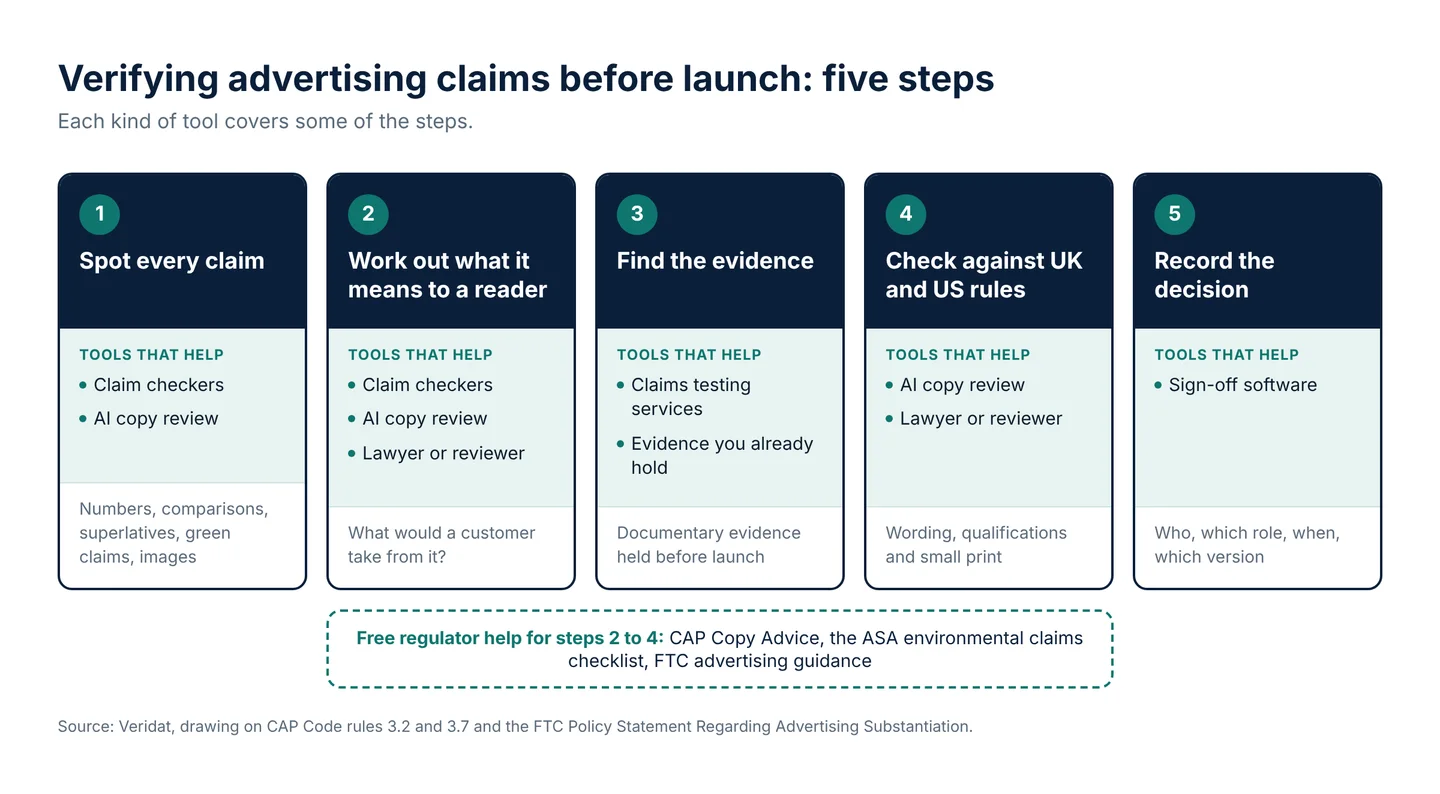
1. Spot every claim
Mark anything a customer could check: numbers, comparisons, superlatives such as "No.1", green claims, health benefits, the word "free". A before-and-after photo makes a claim too. Obvious exaggeration nobody would take literally is fine under rule 3.2 of the CAP Code, as long as it doesn't materially mislead. "The best coffee in Cambridge" is probably puffery; "Rated the best coffee in Cambridge" isn't.
Pro tip: Read the copy as the most sceptical customer you know. Anything they'd answer with "says who?" needs evidence.
2. Work out what it means to a reader
Regulators judge a claim by what people take from it. What your team meant hardly counts.
Persil found this out in 2022. Its TV ad said the products were "kinder to our planet". In its ruling, the ASA said the basis of that comparison was likely to be ambiguous to viewers. Without a clear basis, and without evidence of less impact over the products' full life cycle, the claim was likely to mislead, and the ad can't appear again in its current form. A safer line could have used a figure already on screen: "Bottle made with 50% recycled plastic (excluding cap and label)." That's our suggestion, not the ASA's, but it's a specific claim you could back with evidence.
Pro tip: Before anyone books time with Legal, paste the copy into our free claim checker. You'll walk into the meeting with the risky claims already marked.
3. Find the evidence
Rule 3.7 of the CAP Code says you must hold documentary evidence for objective claims before the ad goes out. In the US, the FTC's policy statement on advertising substantiation asks for a "reasonable basis" first. Match the proof to the exact claim: a lab result on the concentrate won't back a claim about the diluted product. Our ASA and CAP Code substantiation checklist turns rule 3.7 into questions you can answer.
4. Check the wording against UK and US rules
Look hard at the small print. Under CAP Code rules 3.9 and 3.10, qualifications can clarify a claim but mustn't contradict it. An asterisk leading to "in selected stores" sits badly under "available everywhere".
5. Record the decision
Note who approved the claim and when, and keep the exact version of the wording they saw. Six months on, "Legal said it was fine" won't help whoever has to answer the complaint.
Which is the best tool for verifying advertising claims before launch?
Here are the tools worth a look if you're a consumer brand or software company, starting with ours. If you came for the top tools for testing and vetting product claims, read Highlight and HarrisX. Our buyer's guide to marketing compliance software covers the wider category.
Veridat

We built Veridat to give marketing, product, technical, compliance and legal teams one place to validate marketing and product claims. It's made for consumer brands and software companies.
The easiest first step is our free claim checker. Paste in your copy or a web address (no account needed) and each marketing claim comes back with a risk level and a note of the evidence it seems to lack. It runs on Veridat's own engine, built for marketing copy. Your copy is never sent to an AI service, and the same copy always gets the same result.
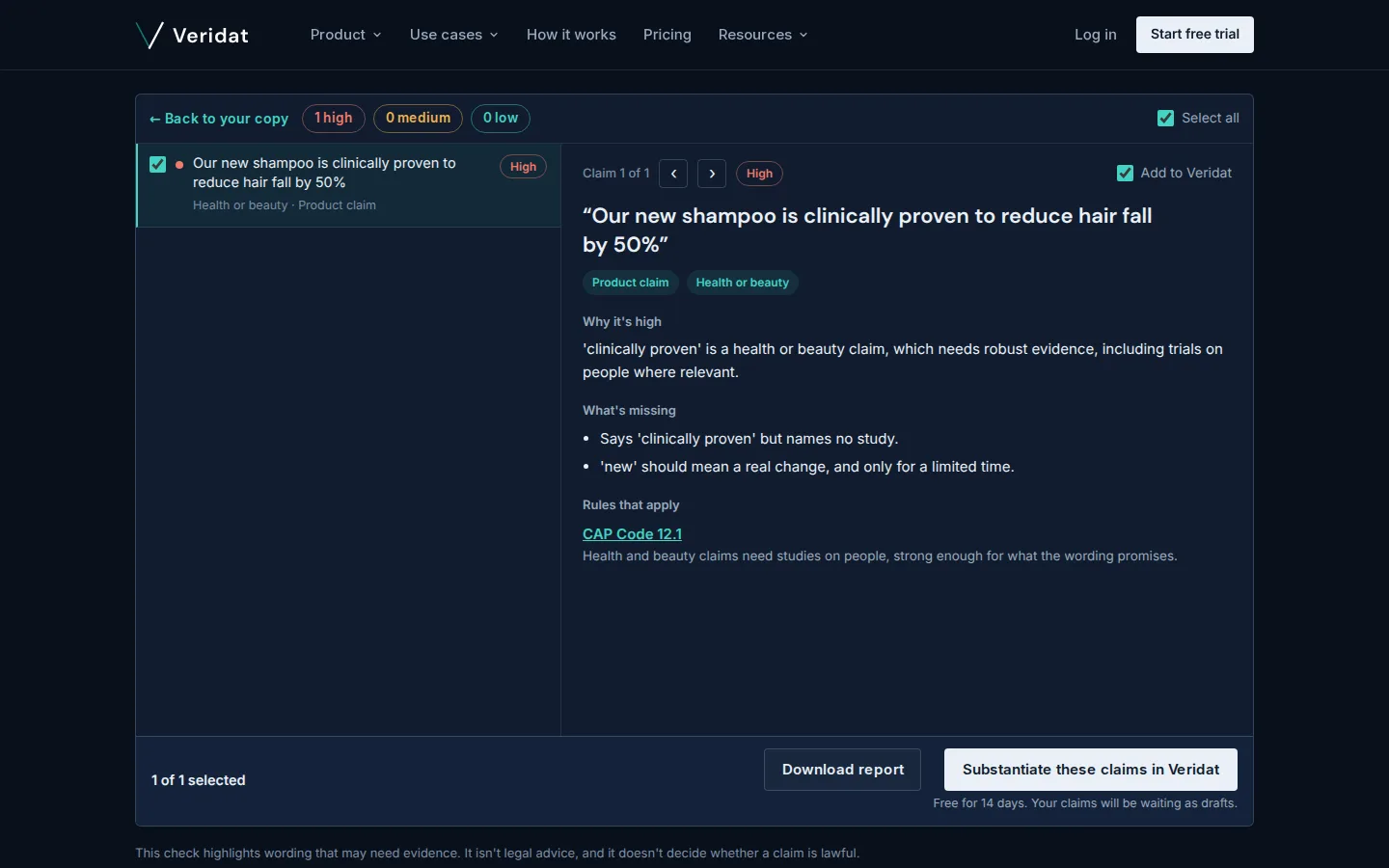
From there, the app does the legwork. You create the claim, and Veridat's engine works out what's needed to back it up, drawing on a checklist of 26 UK and US advertising rules. Next it creates the tasks, such as evidence to attach and wording to confirm, routes them to the right people and sends the claim to the right reviewers. Nothing gets approved until the relevant reviewers, such as Legal, have looked at the evidence and accepted it. Missing proof is flagged as missing, and any gap a reviewer accepts keeps its reason.
So there's no chasing evidence round the inbox, and you've a clear answer when a retailer or regulator asks. Each sign-off records who decided, their review function, when, and which version of the claim. Approved wording then goes into a library your team can reuse without restarting legal review.
You can try every feature free for 14 days. After that, plans start at £149 a month and go up to £899 a month, depending on your team size and needs. Larger teams can talk to us about a custom plan.
Highlight
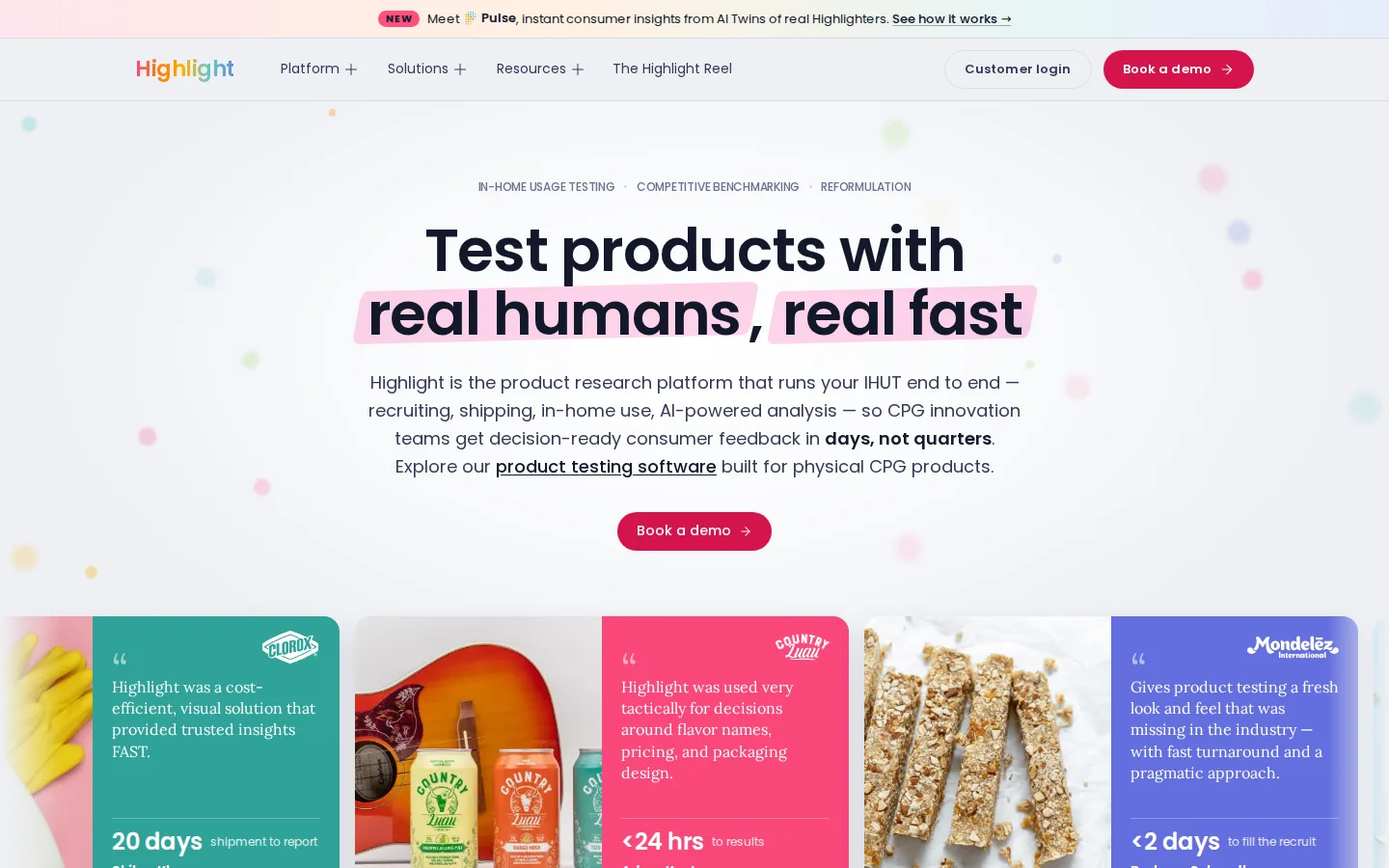
Highlight is an in-home product testing platform for CPG brands [1]. Its claims testing service puts products in consumers' homes so you can validate claims "before you print packaging or run ads" [2], across categories from food and beverage to pet care.
The protocols are designed to line up with the FTC's "Competent and Reliable Scientific Evidence" requirement and follow ASTM standards [2], handy if the US is a big market for you. UK sellers should check the study design against ASA expectations too.
Highlight suits consumer goods brands with a product they can put in people's hands, and you can book a demo to see how a study runs [2]. Once the results are in, Veridat lets you attach them to the exact claim they support.
Leah
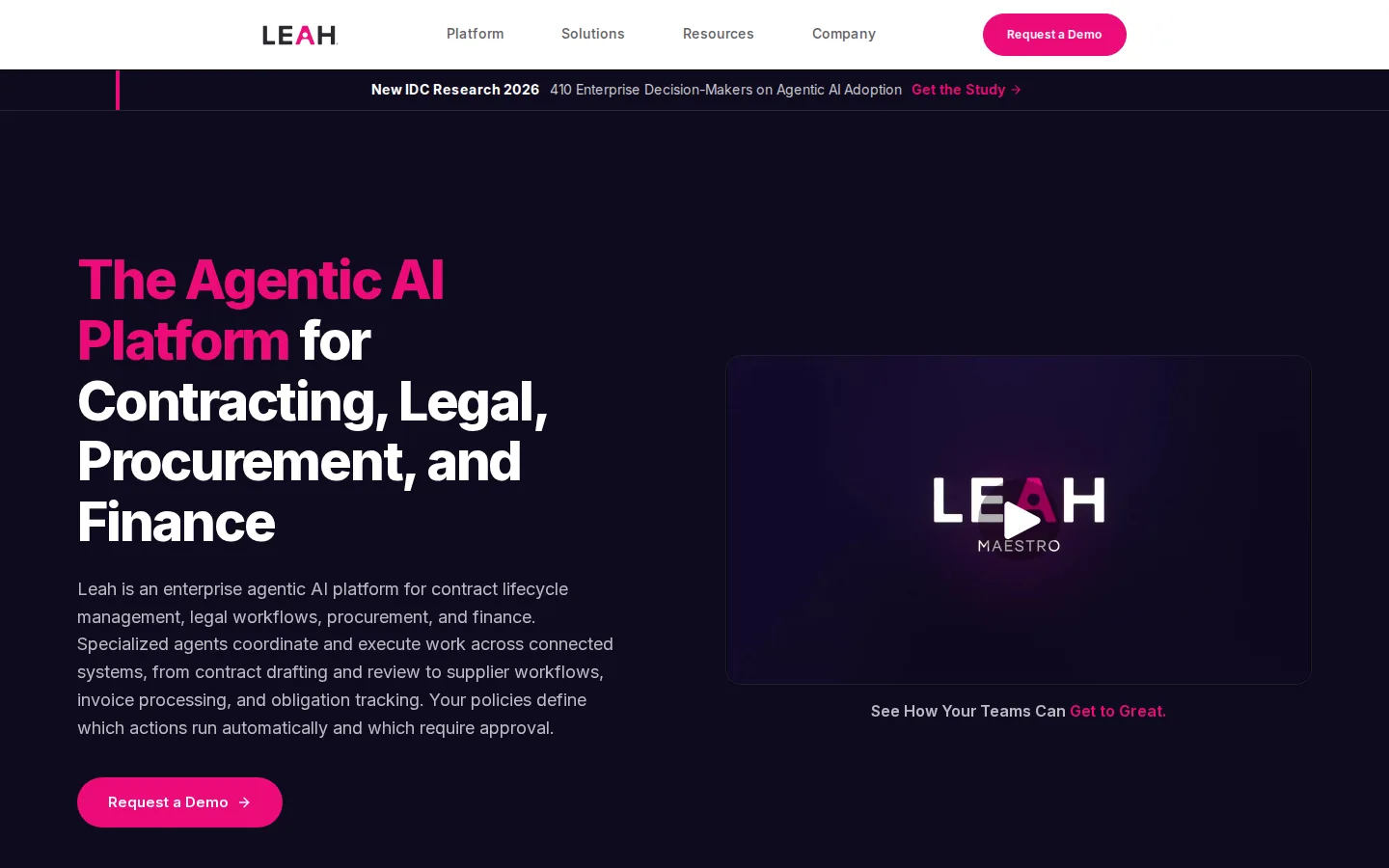
Leah's Marketing & Promotions Legal Guardrail, from ContractPod Technologies, reviews every piece of marketing content against your jurisdictional rules [3]. It flags substantiation gaps and comparative claim risk, approves clean content automatically and sends edge cases to counsel.
It covers both sides of the Atlantic: the CAP Code, the BCAP Code and ASA rulings for the UK, and the FTC's advertising and endorsement guides for the US [3]. Studies and certifications go into an evidence library once, with their scope and validity window, and a flagged asset reaches its owner "with rule, evidence, and suggested fix attached" [3].
It's a good fit for brands with counsel on hand who want AI doing the first pass. You can request a demo [3].
Not a product in this list: Anthropic's free marketing-claims-review skill for Claude
Anthropic has published a free, open-source skill for Claude called marketing-claims-review, part of its Claude for Legal plugins and released under the Apache 2.0 licence [4]. It reviews "marketing copy for claims that need substantiation, reframing, or cutting" [5]. Each factual, comparative or promissory claim is pulled out, sorted into one of five types (from vague to absolute) and reviewed one by one, with a suggested revision [5].
It installs as a plugin for Claude and Claude Code [4]. The standards it gives as examples are mainly American, such as the FTC and the NAD [5], so a UK team will want to read its output against the CAP Code as well.
What AI review can and can't do
AI review is good at wording. It'll tell you a claim is comparative, or that a footnote fights the headline. What it can't do is supply the proof: nothing it writes is the documentary evidence rule 3.7 asks you to hold. Anthropic says as much. The skill "doesn't substantiate claims. It identifies which ones need it and who has the data." [4] Every output is "a draft for attorney review" [4], so treat it as a first pass and keep a copy of what it flagged alongside your decision.
HarrisX Ad Claims AI
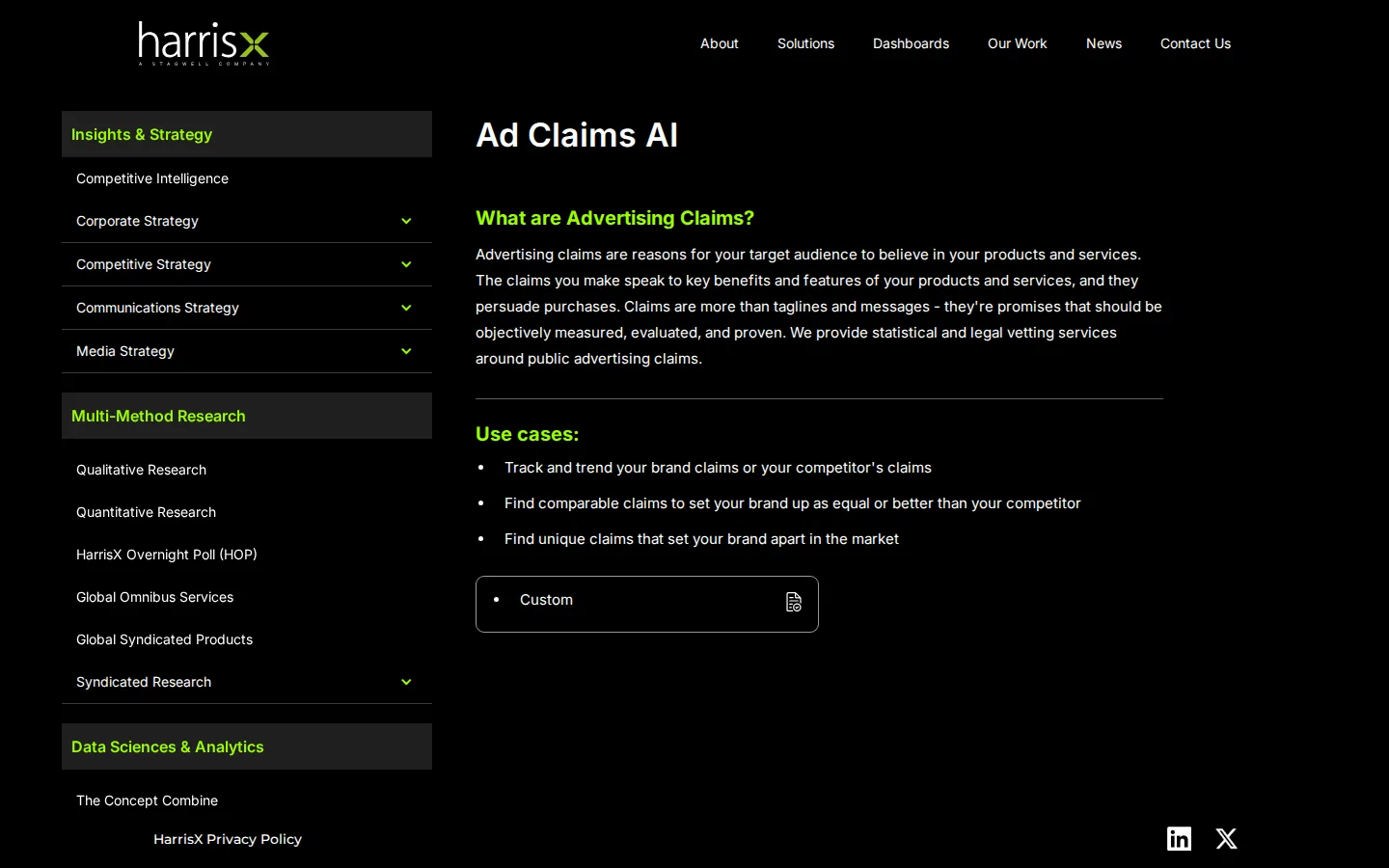
HarrisX is a global market research, data analytics and strategy consulting company [6], and Ad Claims AI points that research muscle at advertising claims. It offers statistical and legal vetting of public advertising claims [7]. That helps most when a claim stands or falls on its numbers, and you want both the maths and the legal reading checked before launch.
You can also track and trend your brand's claims, or a competitor's, over time [7]. That's handy when a rival's claim is the reason you're making yours.
If you've a research budget and claims that need hard data behind them, it's worth a conversation. Pricing is custom [7].
Provenance
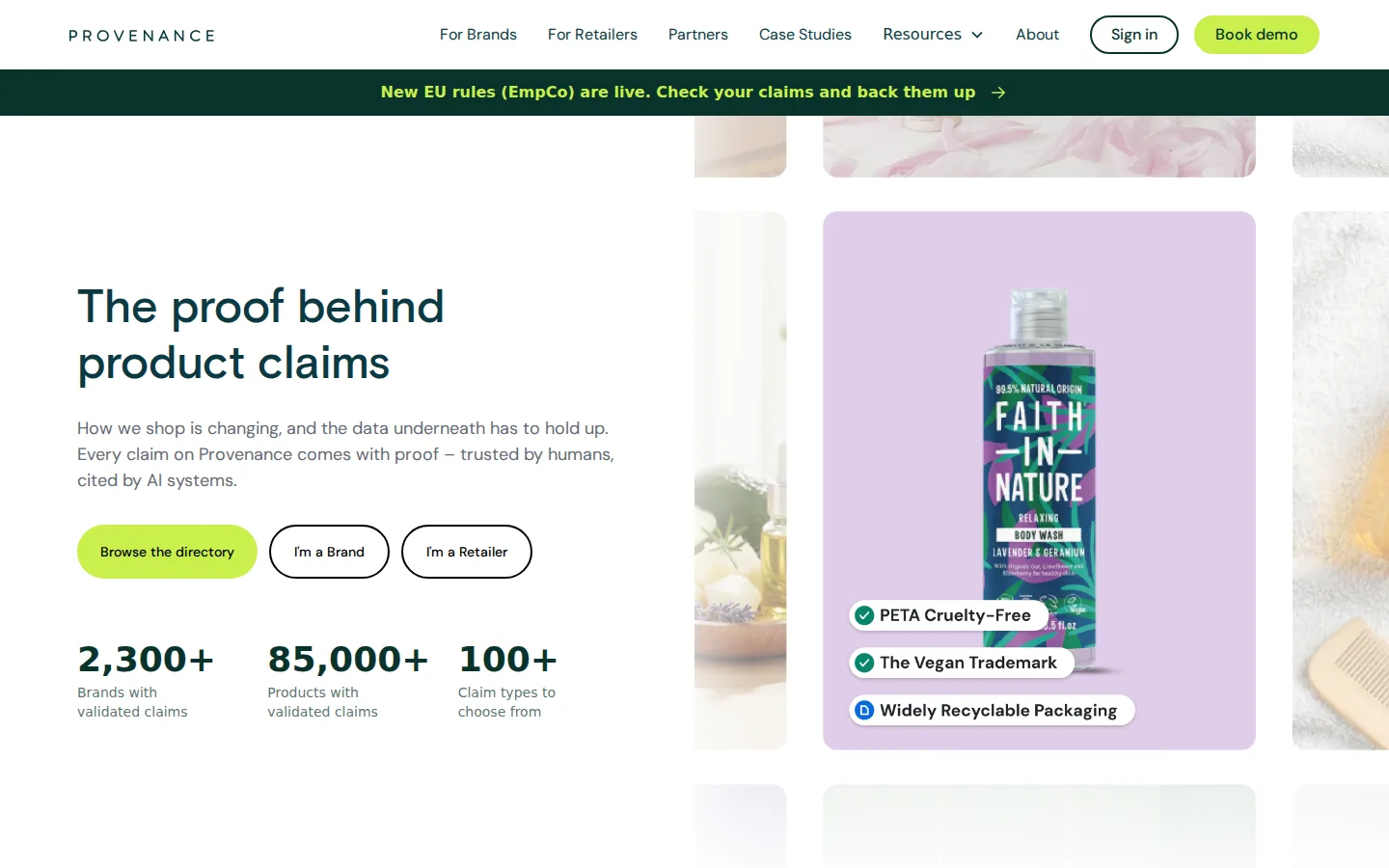
Provenance makes sustainability communications technology that helps brands and retailers "manage and publish claims shoppers can trust" [8]. You choose from more than 125 Proof Points in the Provenance Framework and submit your evidence for each. Provenance then checks it and puts the claims live on your chosen channels [8].
If green claims are a big part of your story, it's a tidy way to get them checked and in front of shoppers. Its case studies include beauty and wellness and food and drink brands, and there are discounts for brands with low annual turnovers [8]. Our green claims evidence checklist covers what to hold before you start.
IntelligenceBank
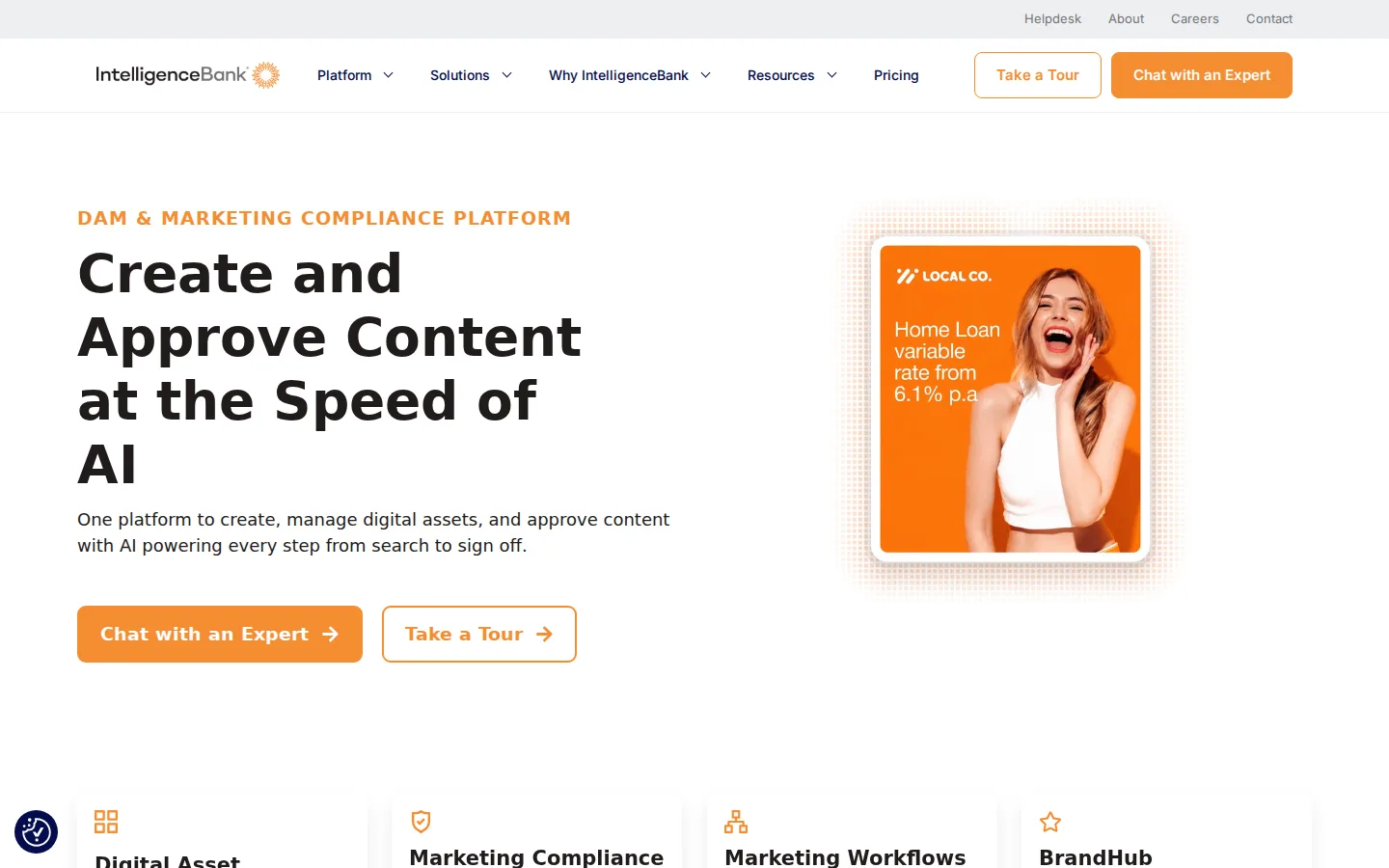
IntelligenceBank's marketing compliance software uses AI to flag legal, regulatory and brand risk in content before and after it goes live [9]. Reviews happen while content is being made in tools such as Word and Figma, picking up risks like implied claims and over-promissory language, and every flag goes to a human reviewer [9].
Approval workflows route content to the right reviewers at the right stage, with every action logged and time-stamped [9]. It suits marketing teams that want AI risk review and approvals alongside their digital asset management. The base Digital Asset Management package starts at $567 a month billed annually, with other packages quoted [10].
What about proofing tools?
Proofing tools such as PageProof and Ziflow do a different job. PageProof routes proofs to the right people at the right time, with audit trails that log every decision and action [11]. Ziflow guides projects through each review stage automatically, with a clear audit trail [12].
If your team lives in design files and review rounds, they'll feel natural. If you need the evidence behind each claim on record, you'll want something built around claims. Our guide to the best marketing compliance software puts them side by side.
Free help from the regulators
Before you spend a penny, use what the regulators give away. CAP Copy Advice gives pre-publication advice on non-broadcast ads in every sector. A standard enquiry is free and comes back in 3 to 5 working days, or you can pay from £150 including VAT for a 48-hour answer. The advice isn't binding, and TV and radio ads need a different route.
For green claims, the ASA's environmental claims checklist is a one-page sheet of five questions, based on CAP's "Greenspeaking with confidence" guidance. Our environmental claims assessment guide walks through a full review.
In the US, the FTC's guidance on advertising and marketing says ad claims must be truthful, evidence-based and not deceptive or unfair, and its 1984 substantiation statement is short enough to read over lunch.
Advertising claims checker tools compared
| Product | Type | Steps it covers | What stands out | Starting price |
|---|---|---|---|---|
| Veridat | Claim substantiation and sign-off, with a free claim checker | Checker: 1 and 2. App: 3 to 5 | Works out the evidence each claim needs, routes the tasks and reviewers, records each sign-off; approved wording library | 14-day free trial, then from £149 a month |
| Highlight | Consumer claims testing | 3 | In-home testing aligned with the FTC "Competent and Reliable Scientific Evidence" requirement | Demo on request |
| Leah | Legal AI review | 1 to 5 | Reviews content against the CAP Code, BCAP Code, ASA rulings and FTC guides; evidence library | Demo on request |
| HarrisX Ad Claims AI | Claims vetting | 3 and 4 | Statistical and legal vetting; tracks your own or competitors' claims | Custom |
| Provenance | Sustainability claims | 3, for green claims | Checks the evidence behind 125+ Proof Points, then publishes them for shoppers | On request; discounts for low-turnover brands |
| IntelligenceBank | Marketing compliance suite | 1, 2, 4 and 5 | AI risk review in Word and Figma; approval workflows with every action logged | DAM package from $567 a month, billed annually |
FAQ
Which kind of tool do I need?
Start with your weakest step. For a one-off green claim, the ASA's checklist, our free claim checker and CAP Copy Advice will usually do. If you need proof you don't have yet, claims testing from Highlight, or statistical and legal vetting from HarrisX, is the tool to verify advertising claims before launch. If you're making marketing claims every week, you need sign-off software with an approved library, which is what we built Veridat for.
Is there a free advertising claim checker?
Yes. Our free claim checker highlights the marketing claims in pasted copy or a web page and gives each a risk level, with no account needed. CAP Copy Advice also answers standard enquiries about non-broadcast ads free of charge.
Can AI verify an advertising claim?
It can flag wording that needs support, but it can't prove anything. The CAP Code asks for documentary evidence held before the ad runs, and the FTC expects a reasonable basis. That proof has to come from you.
What evidence does the ASA expect?
Documentary evidence that proves the claim as consumers are likely to understand it, held before the ad goes out. It has to fit the exact claim. If you're comparing yourself with a competitor, the products must meet the same needs or be intended for the same purpose (rule 3.33).
How do I keep a record of who approved a claim?
Note the person and their role, the date, the exact wording they approved and the evidence they saw. In Veridat that happens as you go, because every sign-off is recorded against the claim version it approves.
Do I need claims testing for every claim?
No. Check the copy first and cut or soften what you can't support. Then pay for testing or vetting only on the claims you keep and can't yet prove.
This is general information, not legal advice.
Spotted something out of date? Drop us a line and we'll put it right within five working days.
Veridat builds a checklist of the evidence each claim needs, holds the proof against each item, and records who signed off and why. 14 days free, no card needed.
Start free trial →References
- [1] Highlight, home page, accessed 26 October 2026
- [2] Highlight, Claims testing use case page, accessed 26 October 2026
- [3] Leah, Marketing & Promotions Legal Guardrail page, accessed 26 October 2026
- [4] Anthropic, claude-for-legal repository (marketing-claims-review skill, README and licence), accessed 26 October 2026
- [5] Tessl, marketing-claims-review skill listing page, accessed 26 October 2026
- [6] HarrisX, About HarrisX page, accessed 26 October 2026
- [7] HarrisX, Ad Claims AI page, accessed 26 October 2026
- [8] Provenance, Solutions page, accessed 26 October 2026
- [9] IntelligenceBank, Marketing compliance software page, accessed 26 October 2026
- [10] IntelligenceBank, Pricing page, accessed 26 October 2026
- [11] PageProof, home page, accessed 26 October 2026
- [12] Ziflow, home page, accessed 26 October 2026