The best marketing compliance software for a consumer brand or software company is the one that holds the evidence for each marketing claim, gets the right people to sign it off and keeps a record you can find a year later. Some tools are built around that job. Others are built around files and review rounds.
When Beauty Pie put "CLINICALLY PROVEN TO REDUCE WRINKLES IN 4 WEEKS" on a London Underground poster for its LED face mask, it had studies. The trouble was what they showed. The studies of the mask itself had no control or placebo group, and the double-blind trial it also cited wasn't of the advertised product. In June 2026 the ASA ruled that the ad must not appear again in its current form.
Beauty Pie had evidence and still lost. That's the gap good software should close. Under rule 3.7 of the CAP Code, you must hold documentary evidence for any claim consumers are likely to see as objective, and that can be objectively proved, before the ad goes out. In the US, the FTC's policy statement on advertising substantiation asks for a reasonable basis before ads run. And the CMA can now enforce consumer protection law itself, with penalties of up to 10% of global turnover or £300,000, whichever is greater.
Pro tip: Pull up your last ten approved marketing claims and ask where the evidence for each one lives today. If the honest answer is an email thread or someone's drive, that's the first thing your new tool has to fix.
The best marketing compliance software for consumer brands and software companies
Here are the marketing compliance tools worth a look if you're a consumer brand or software company, starting with ours. After Veridat you'll find a mix of asset management suites and proofing tools, plus a legal AI reviewer, each with what it does well and who it suits.
Veridat

We built Veridat to give marketing, product, technical, compliance and legal teams one place to validate marketing and product claims. It's made for consumer brands and software companies selling in the UK and the US, and it draws on a checklist of 26 UK and US advertising rules, with sources such as the CAP Code, CMA consumer protection law, section 5 of the FTC Act and the FTC Endorsement Guides.
The big win is less chasing. You create a claim, and Veridat's engine works out what's needed to back it up. It creates the tasks, such as evidence to attach or wording to confirm, routes them to the right people, then sends the claim to the right reviewers. Nothing gets approved until the relevant reviewers, such as Legal, have looked at the evidence and accepted it.
Missing proof is flagged as missing, and any gap a reviewer accepts keeps its reason. Each sign-off records who decided, their review function, when, and which version of the claim. So when a retailer or a regulator asks how you backed something up, the answer's already on file.
Approved wording then goes into a library your team can reuse without restarting legal review. Each wording keeps the markets and channels it was approved for, along with any conditions.
Want to test your copy first? Try our free claim checker. It runs on Veridat's own engine, built for marketing copy. Your copy is never sent to an AI service, and the same copy always gets the same result.
You can try every feature free for 14 days. After that, plans start at £149 a month and go up to £899 a month, depending on your team size and needs. Larger teams can talk to us about a custom plan.
We're also looking for design partners. You get 30 days' free access and a direct say in what we build next.
Aprimo
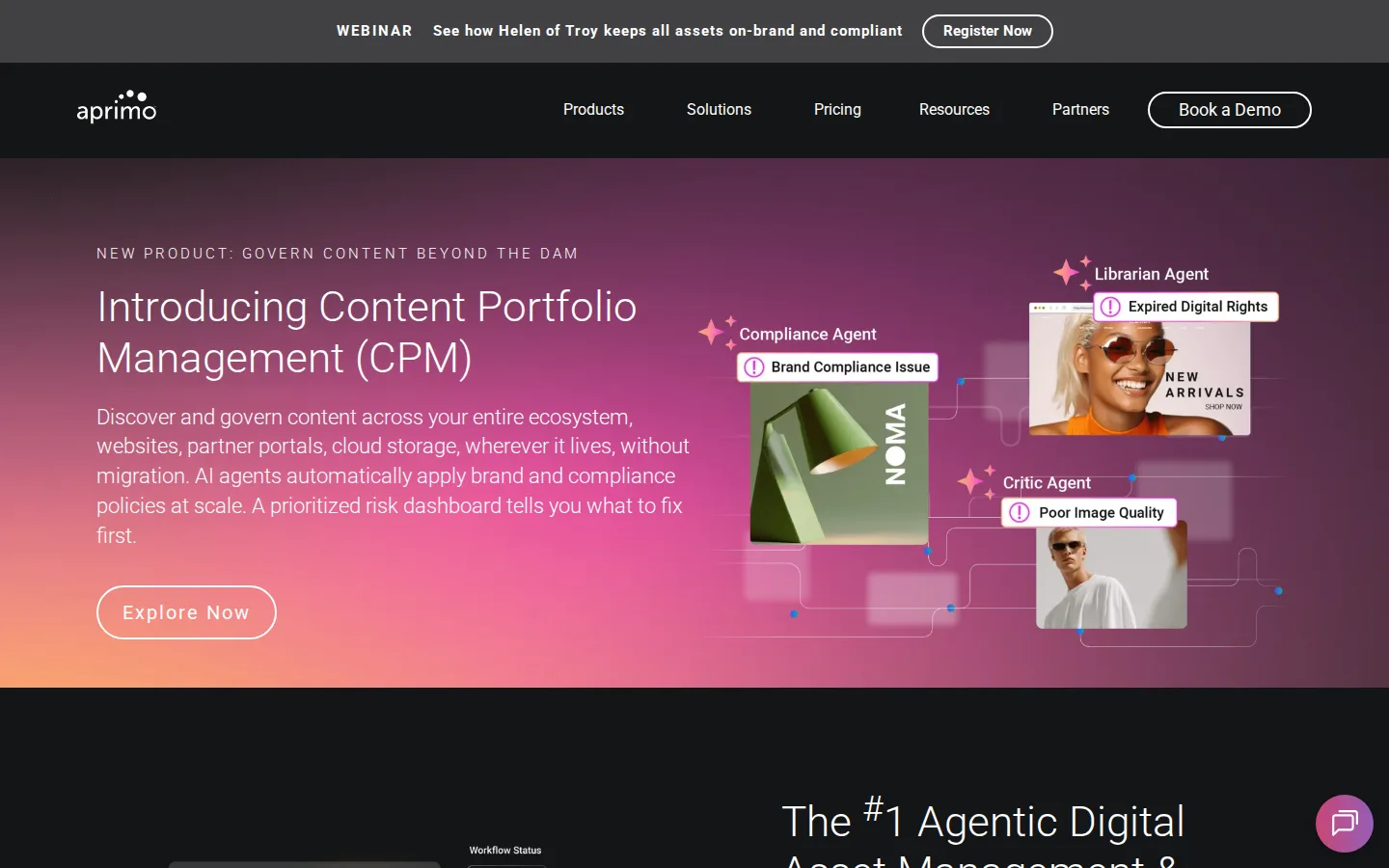
Aprimo is an agentic digital asset management and content operations platform that helps regulatory and compliance teams move content through defined review and approval stages [1][2]. It boasts five AI agents, including a Critic and a Compliance agent, that apply brand and compliance policies at scale [1].
The strength for compliance work is the paper trail. Version histories, reviewer actions, sign-off records and workflow activity are all captured, and approved claims and references stay connected to the content they support [2]. Those features are pitched at regulated content teams, so ask how they'd work for a consumer brand.
Aprimo suits content teams that want their assets and compliance review under one roof. Pricing depends on the products you choose and the number of users, so you'll need a custom quote [3].
If the evidence behind each marketing claim is your main worry, ask to see one claim traced from evidence to sign-off in Aprimo and in Veridat, side by side.
Ziflow
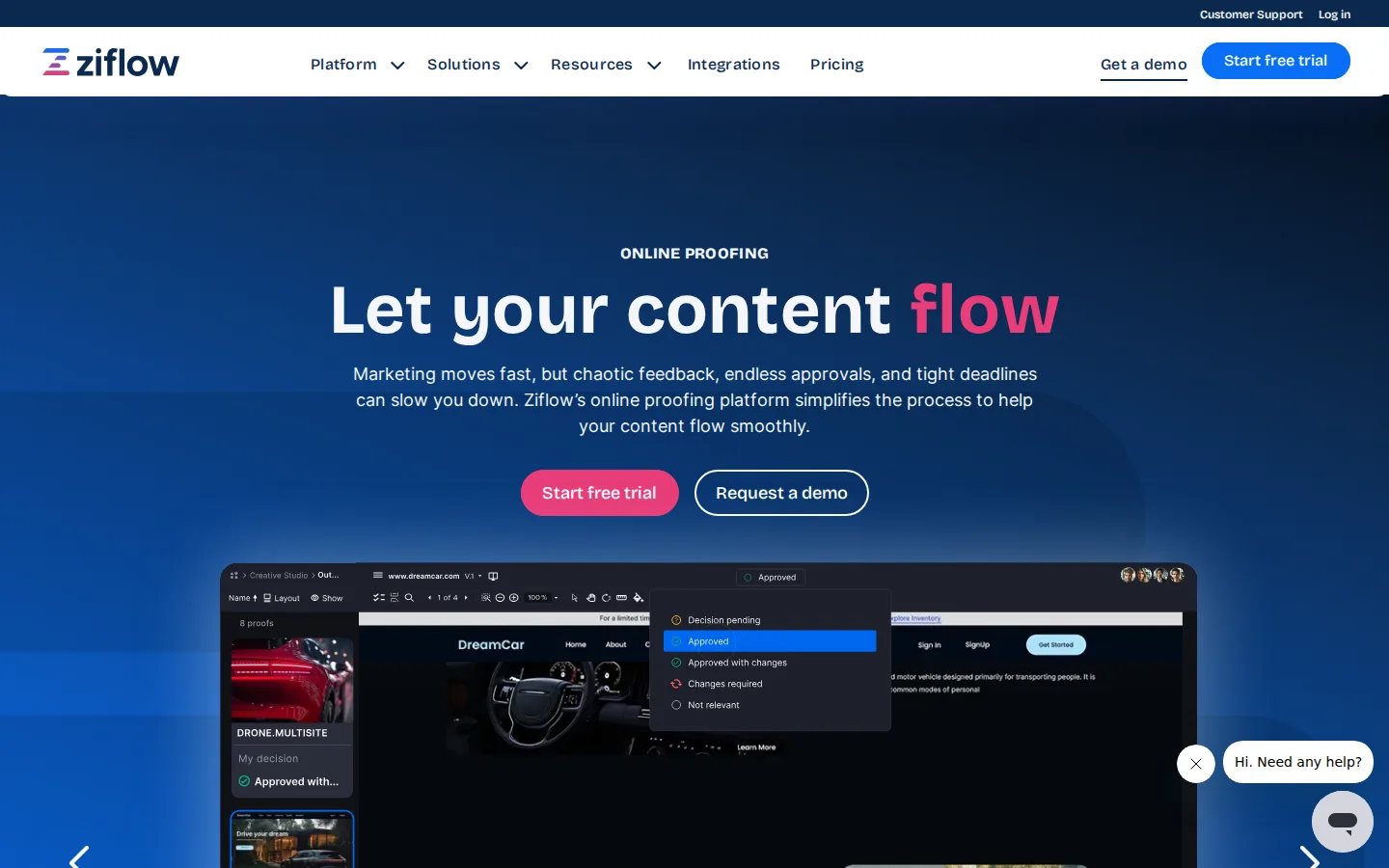
Ziflow is an online proofing platform that guides projects through each review stage automatically [4]. ReviewAI, its automation engine for creative reviews, verifies checklist items and upholds brand standards [4].
Legal and compliance teams get standardised checklists, and Ziflow automatically records every decision and comment, along with each revision [5].
It's a natural fit for creative and marketing teams pushing lots of work through review who want the routing done for them. There's a free plan for two users, and paid plans start at $199 a month, billed annually, with 15 free users on Standard [6].
When your reviewers are debating artwork and versions, Ziflow covers plenty of ground. When they're debating whether "twice as fast" can be proved, you'll want the evidence held against the claim itself, which is the job we built Veridat for.
IntelligenceBank
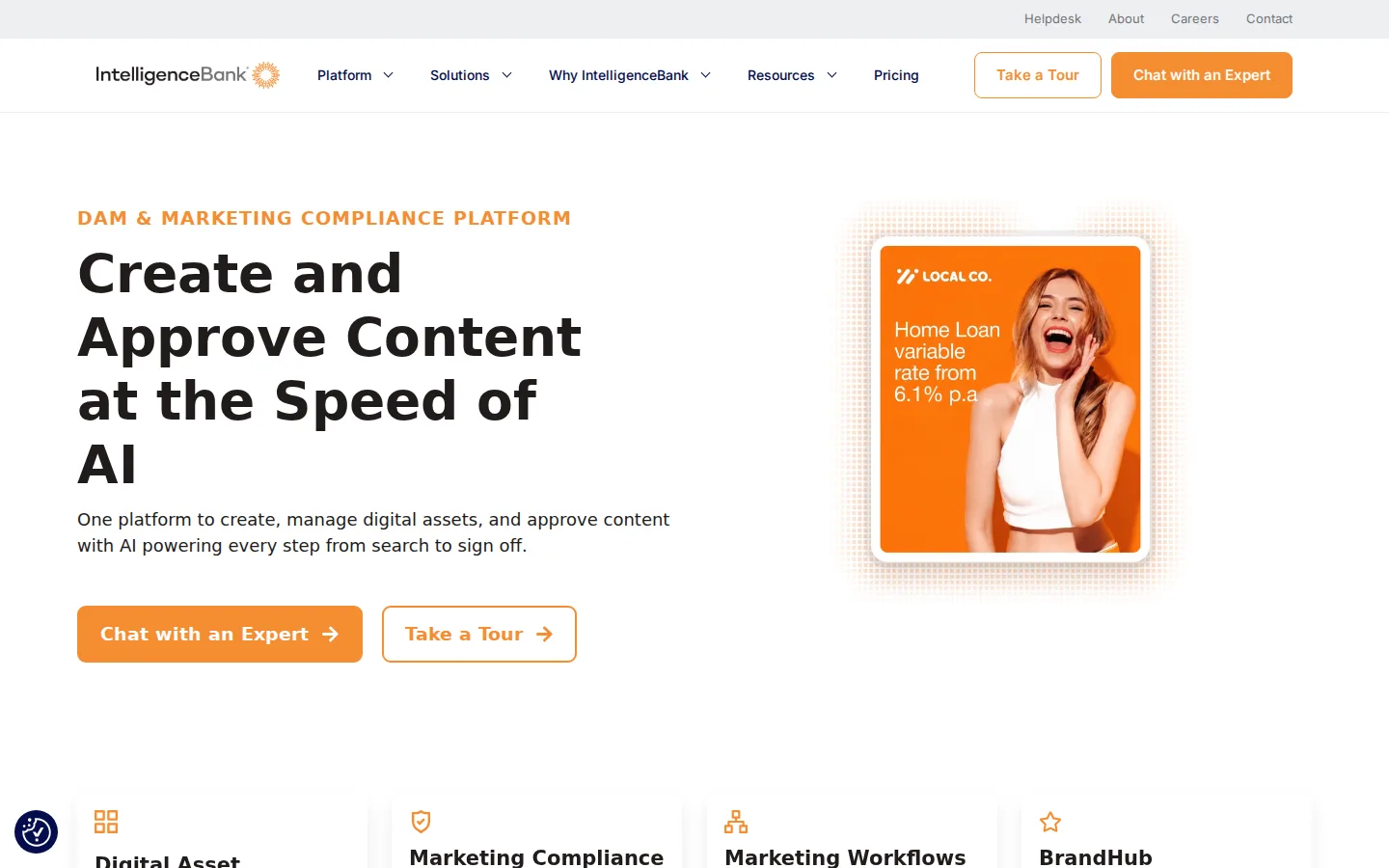
IntelligenceBank pulls digital asset management and marketing compliance into one AI marketing operations platform, alongside marketing workflows and brand management [7]. Its marketing compliance software uses AI to flag legal and regulatory risk in content, and brand risk too, before and after it goes live [8].
The neat touch is how early it steps in. AI risk reviews flag issues while content is still being created in tools such as Word and Figma, with risk ratings and suggested fixes [8]. Approval workflows route content to the right reviewers at the right stage, every action is logged and time-stamped, and there are ready-to-use rule libraries based on industry regulations [8].
It suits marketing teams that want asset management and AI risk review on one platform. The base digital asset management package starts at $567 monthly, billed annually. Marketing compliance is quoted to your setup [9].
Lytho
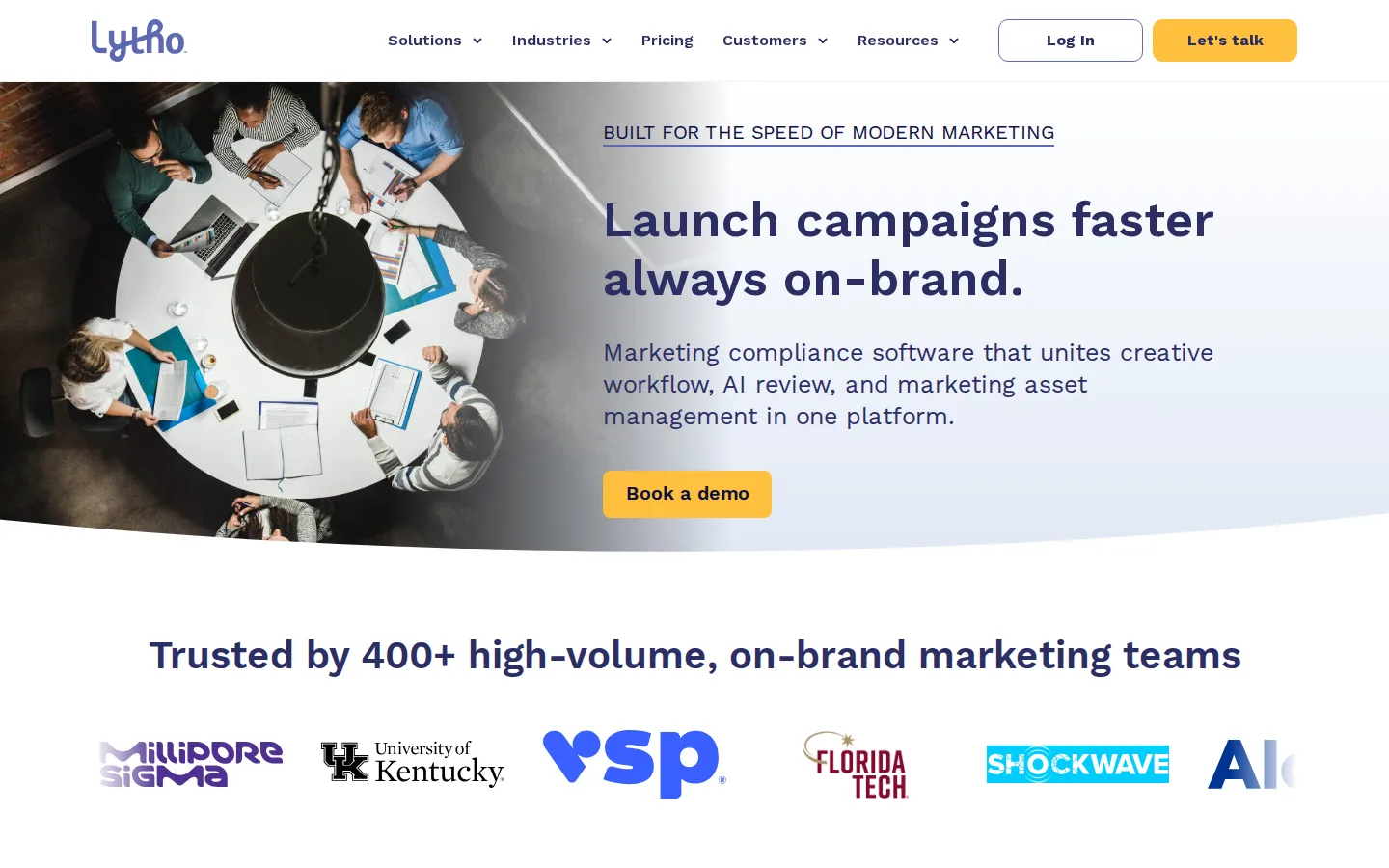
Lytho brings creative workflow and AI review together with marketing asset management, all in one marketing compliance platform [10]. Its AI Teammates flag brand and regulatory issues in real time as content is created, and reviews then move into a tracked workflow [10].
That pairing makes sense if you'd rather catch a problem while the copy's being written than in the third round of comments.
Lytho suits marketing teams that want creative workflow and AI review side by side. It offers three plans, with pricing customised to each organisation. Quotes reflect your team size, the products you need and your workflow set-up [11].
If your reviewers' real question is what evidence sits behind a claim and who accepted it, put that exact scenario to each vendor on your shortlist, Veridat included.
Filestage
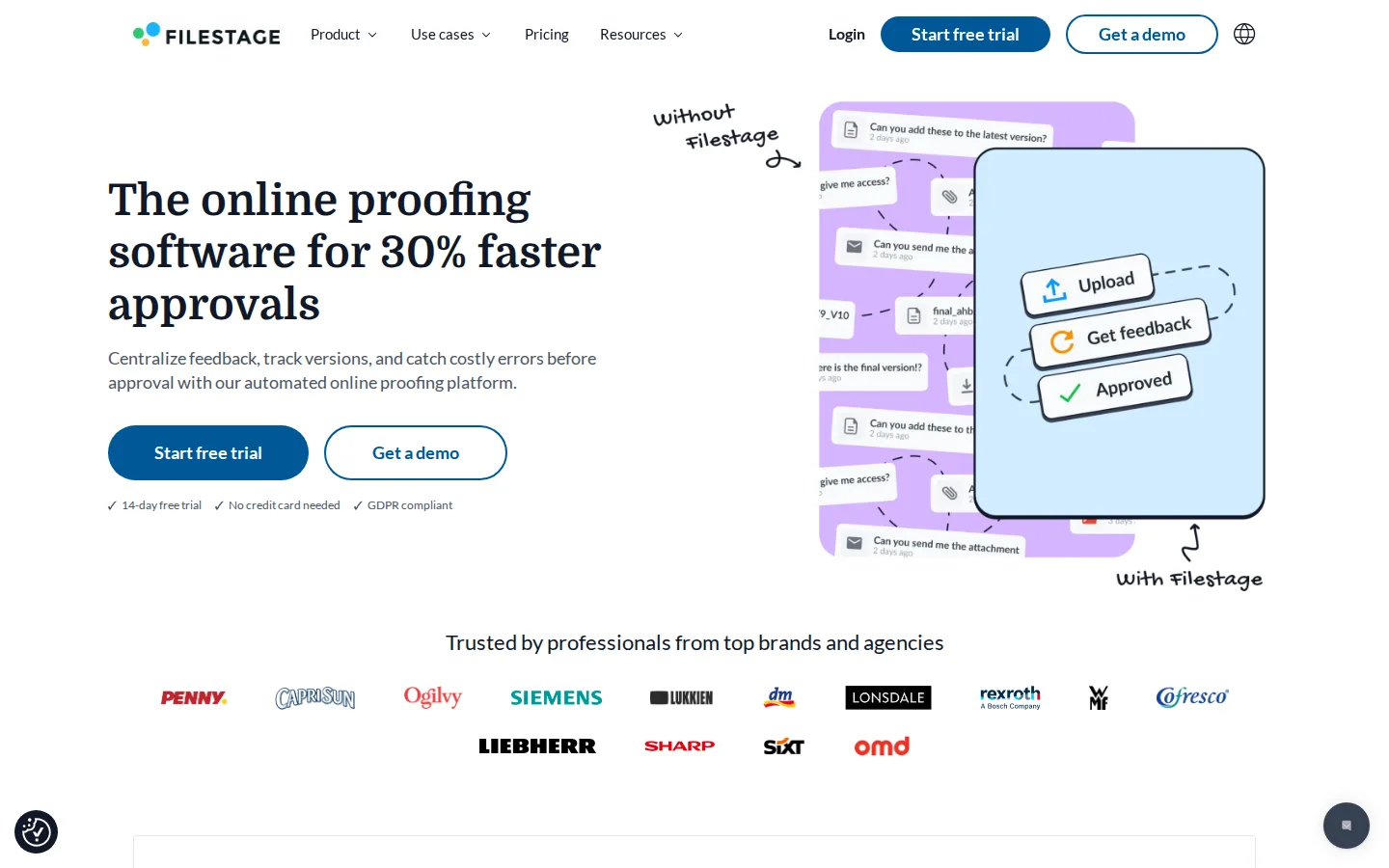
Filestage's online proofing software is built for review and approval [12]. You set up your workflow with separate reviewer groups, share new versions until you get approval, and bring compliance and legal reviewers in automatically [13].
Its Review Agents check creative assets for errors and compliance risks before reviewers start, with feedback based on your brand guidelines and industry regulations [12][13]. Consumer goods teams can use it to check that campaigns and packaging designs meet FDA, EFSA and FSA regulations [13]. Comments and approvals are kept with timestamps, and you can export file reports for auditing [13].
It suits teams reviewing lots of creative files in rounds. There's a free plan, paid plans start at $199 / month with 10 seats included, and you can test it free for 14 days with no credit card needed [14].
Pair it with a claims tool if you also need the evidence for each marketing claim on record.
Leah
Leah's Marketing & Promotions Legal Guardrail comes from legal tech and is built with marketing claims in mind. It reviews every piece of marketing content against your jurisdictional rules, and every quantifiable, comparative or superlative claim is matched against a live evidence library [15].
It names its rules: the CAP Code, the BCAP Code and ASA rulings for the UK, and the FTC's advertising and endorsement guides for the US [15]. Clean assets are approved automatically. Flagged ones go to the right owner with the rule and the evidence attached, plus a suggested fix [15].
Leah is part of a wider legal AI platform aimed at legal leadership and legal operations, among other teams [15], so it'll suit in-house counsel wanting AI to do the first pass. Before you buy, decide if you're comfortable with clean assets being approved without a named person signing. If you'd rather every marketing claim had a human decision on record, that's how Veridat works.
PageProof
PageProof helps marketing and creative teams review and approve work in one place, with online proofing software built around AI-powered markup [16]. It uses AI to analyse your creative and suggest markup directly on the proof. Its checks run from spelling and layout to brand and production rules. You can also create custom AI agents that check proofs against your brand guidelines [16].
Workflows route proofs to the right people, decision thresholds set how many approvals a proof needs, and audit trails log every decision and action [16].
Team costs $2,499 a year or $249 a month, Team Plus is $4,999 a year or $499 a month, and both include unlimited reviewers [17]. PageProof pitches Team as "perfect for a small design or marketing team starting out" [17].
If your team lives in design files and review rounds, PageProof will feel natural. If you need the evidence behind each claim on record, you'll want something built around claims.
A note on Veeva
Veeva PromoMats Claims Management keeps claims in a single digital library, each substantiated with linked references [18]. It sits inside Veeva's wider PromoMats system, and Veeva lists consumer packaged goods among its industries [18].
Working in financial services?
Some marketing compliance tools are built mainly for banks and fintechs. They're a different market with different rules, so we haven't covered them here.
Marketing compliance software comparison
Here's how the eight products line up on the points that matter most for marketing claims, in the same order as above.
| Product | Built around | How it handles marketing claims | Checks against | Starting price |
|---|---|---|---|---|
| Veridat | Marketing and product claims | Evidence attached to each claim; nothing approved until the relevant reviewers accept it; approved wording reusable from a library | A checklist of 26 UK and US advertising rules, including the CAP Code, CMA consumer protection law, FTC Act section 5 and the FTC Endorsement Guides | £149 a month, after a 14-day free trial |
| Aprimo | Digital asset management and content operations | Approved claims and references stay connected to content; sign-off records captured | Brand and compliance policies, applied by AI agents | Custom quote |
| Ziflow | Online proofing | Standardised checklists; records every decision, comment and revision | Checklist items and brand standards (ReviewAI) | Free plan; paid from $199 / month, billed annually |
| IntelligenceBank | AI marketing operations | AI risk reviews with risk ratings and suggested fixes; every action logged and time-stamped | Rule libraries based on industry regulations | Asset management from $567 monthly, billed annually; compliance quoted |
| Lytho | Creative workflow, AI review and asset management | AI Teammates flag issues as content is created; tracked review workflow | Brand and regulatory standards | Customised quote |
| Filestage | Online proofing | Review Agents check assets before review; comments and approvals kept with timestamps | Brand guidelines and industry regulations, including FDA, EFSA and FSA for consumer goods | Free plan; paid from $199 / month |
| Leah | Legal AI review | Each quantifiable, comparative or superlative claim matched against a live evidence library; clean assets approved automatically | CAP Code, BCAP Code, ASA rulings, FTC advertising and endorsement guides, EU UCPD | Not published |
| PageProof | Online proofing | AI markup suggestions; audit trails of every decision and action | Spelling, layout, brand and production rules | From $249 a month |
How to choose marketing compliance tools without regretting it
A demo will always look good. These five steps help you find out how a tool copes with your work, on your rules, before you sign.
Start with what your reviewers argue about. If it's the artwork (a logo in the wrong place, the wrong pack shot), a proofing tool solves most of it. If you came here for the best brand compliance software, you probably had the suites and proofing tools above in mind, as each now checks work against brand guidelines with AI. But if the arguments are about whether a claim can be backed up, you need evidence held against each marketing claim. Our guide to the best tools for verifying advertising claims goes deeper on that job.
Picture one claim from start to finish. Say your landing page promises "Cuts month-end close time by half". In a proofing tool, Legal pins a comment on the PDF asking for the source, then approves the file. In a claims tool, the product claim itself is the record: which study supports "by half", whether it tested the product as sold, and who accepted that study. The second is built around the question the ASA asks, which is whether you held the evidence before you published.
Write down the rules you answer to. A UK consumer brand answers to the CAP Code, which the ASA enforces, and to the CMA. A US software company selling into the UK answers to those and to the FTC. Ask each vendor to show you those rules by name, because "industry regulations" on its own tells you very little. Our guide to marketing compliance software sets out the rules in more detail.
Ask what a sign-off records. You want the person and their review function, plus the time and the version of the claim they approved. Then ask whether anyone can edit that record later. A record that can change after the event won't help much when a complaint lands.
Price it at your size. Aprimo and Lytho price on a quote, as does IntelligenceBank's compliance package, so leave time for that. Where prices are published, compare what's included and how it's billed, not just the headline figure.
Pro tip: Several published prices only apply when you pay annually. Ziflow's paid plans and IntelligenceBank's base package are both billed annually, so check the billing basis before you compare monthly figures side by side.
The quickest way to test all five is on your own copy. Start a free 14-day trial of Veridat and put one live claim through it, or run a few lines through the free claim checker first.
FAQ
What is the best marketing compliance software, or the best advertising compliance software, for my team?
It depends on what you need it to hold. For evidence and a recorded sign-off on each marketing claim, start with Veridat. For AI legal review against named rules, look at Leah. For review rounds on creative files, try Filestage, PageProof or Ziflow, and for asset management with approvals, Aprimo, IntelligenceBank or Lytho.
What's the difference between proofing software and marketing compliance software?
Proofing software manages review rounds on files, with markup and versions plus a record of approvals. Marketing compliance software looks at the content itself against rules and brand guidelines. Claim substantiation tools such as Veridat also hold the evidence against each marketing claim. Several proofing tools now add AI checks, so the line is blurring.
Which marketing compliance tools cover the UK CAP Code?
Veridat draws on the CAP Code alongside CMA consumer protection law, section 5 of the FTC Act and the FTC Endorsement Guides. Leah names the CAP Code, the BCAP Code and ASA rulings. For any other tool, ask the vendor to show you which rules its checks are built on.
Which marketing compliance tools publish their prices?
Veridat starts at £149 a month. Filestage's paid plans start at $199 / month, Ziflow's at $199 a month billed annually, PageProof's at $249 a month, and IntelligenceBank's base asset management package at $567 monthly, billed annually. Aprimo and Lytho price on a quote.
Do I need AI to review marketing claims?
Not necessarily. What the rules ask for is evidence held before you publish and a sound decision on each claim. AI can flag risky wording, but it won't hold your evidence or sign off for you, so treat it as help for your reviewers rather than a replacement.
This is general information, not legal advice.
Spotted something out of date? Drop us a line and we'll put it right within five working days.
Veridat builds a checklist of the evidence each claim needs, holds the proof against each item, and records who signed off and why. 14 days free, no card needed.
Start free trial →References
- [1] Aprimo, homepage, accessed 26 October 2026
- [2] Aprimo, Regulatory and Compliance Teams page, accessed 26 October 2026
- [3] Aprimo, pricing page, accessed 26 October 2026
- [4] Ziflow, homepage, accessed 26 October 2026
- [5] Ziflow, Marketing Compliance page, accessed 26 October 2026
- [6] Ziflow, pricing page, accessed 26 October 2026
- [7] IntelligenceBank, homepage, accessed 26 October 2026
- [8] IntelligenceBank, Marketing Compliance Software page, accessed 26 October 2026
- [9] IntelligenceBank, pricing page, accessed 26 October 2026
- [10] Lytho, homepage, accessed 26 October 2026
- [11] Lytho, pricing page, accessed 26 October 2026
- [12] Filestage, homepage, accessed 26 October 2026
- [13] Filestage, Marketing Compliance Software page, accessed 26 October 2026
- [14] Filestage, pricing page, accessed 26 October 2026
- [15] Leah, Marketing & Promotions Legal Guardrail page, accessed 26 October 2026
- [16] PageProof, homepage, accessed 26 October 2026
- [17] PageProof, pricing page, accessed 26 October 2026
- [18] Veeva, PromoMats Claims Management page, accessed 26 October 2026