A marketing compliance software ROI calculator is only worth showing Finance if it runs on your numbers: how many claims you sign off, the hours each one takes your team, what outside counsel costs and what the software costs. Our free Excel template does the sums, then lays the answer out as the business case Finance expects.
You've done the hard part. You read up on the tools worth shortlisting, booked two demos and narrowed it to one. Your Head of Legal likes it. Then Finance replies with one line: "What's the return, and why now?"
So you go looking for an ROI calculator, and most of the ones you'll find have the answer built in. Type in your review volume and it assumes the software cuts the work by a big round percentage, priced in dollars, for an industry that isn't yours. Finance won't sign that. They shouldn't.
What they will sign is a business case for marketing claim substantiation software built on your own claims, your own hours and the UK rules your brand actually trades under. That's what this page and the template give you. If you're earlier in the search, start with our buyer's guide to marketing compliance software.
Below: what each approver will ask, the case for change under UK rules, what to count (and what not to), and the template itself.
What Legal, Finance and Procurement will each ask
Three people usually have to say yes, each reading the same document for a different reason. Answer them in the order they'll ask.
Finance: is it affordable, and better than carrying on as we are?
Finance wants four numbers: the annual cost, whose budget pays, how long it takes to pay back, and how it compares with doing nothing. That last one matters most. A case that describes the software without pricing how you work today tends to come straight back.
So price today honestly first. Your team's hours on each claim are a real cost, even though nobody invoices for them.
Legal: does it lower our exposure, and does it leave a record?
Legal's question is about evidence. Under CAP Code rule 3.7, marketers must hold documentary evidence before an ad goes out for any claim consumers are likely to see as objective. Legal wants that evidence checked before sign-off, plus a record of who approved which wording, and when.
They'll also want to hear that software won't replace their judgement. It shouldn't. For a quick feel for how many of your current lines are claims that need evidence, paste a product page into our free claim checker.
Procurement: what are we committing to?
Procurement reads the small print: contract term, monthly or yearly billing, how many paid users you need, what the trial covers, where your data sits and how you'd leave. Most of that belongs in a vendor questionnaire, so send the questions to ask before you buy alongside your case rather than inside it.
The case for change: what UK regulators can do now
Every business case opens with "why now". For marketing claims, the answer changed in April 2025. Here's the short version; what marketing compliance covers has the full picture.
The CMA can fine you directly
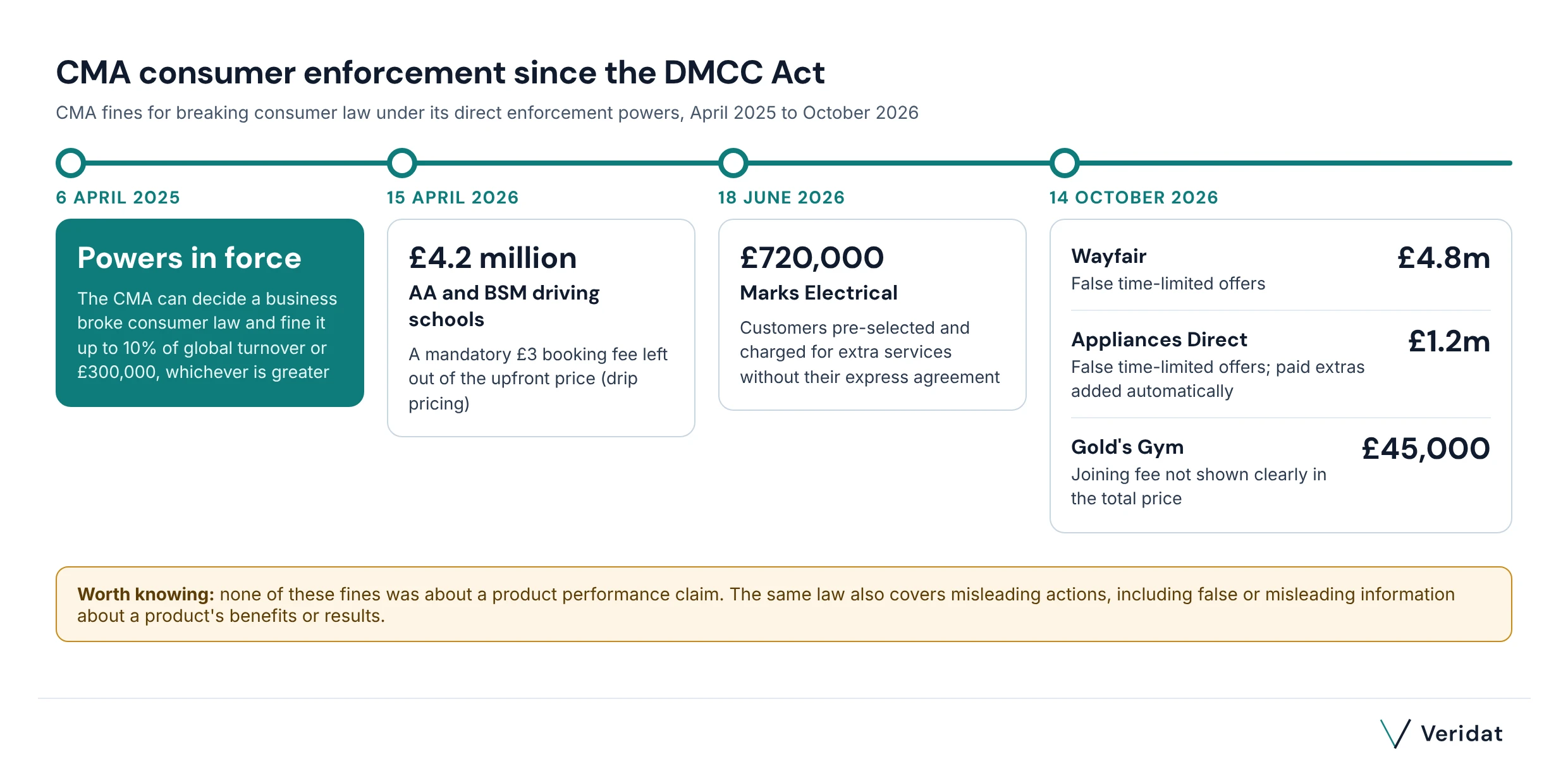
Since 6 April 2025, under the Digital Markets, Competition and Consumers Act 2024, the CMA can decide for itself that a business broke consumer law, and fine it up to 10% of its global turnover or £300,000, whichever is greater.
The first fines for breaking consumer law itself have landed. In April 2026, the AA and BSM driving schools were fined £4.2 million for leaving a mandatory £3 booking fee out of the upfront price. Marks Electrical was fined £720,000 in June for charging customers for extras they hadn't expressly agreed to.
In October, Wayfair, Appliances Direct and Gold's Gym were fined £4.8 million, £1.2 million and £45,000 between them for false time-limited offers, paid extras added automatically and a joining fee not shown clearly in the total price.
None of these was about a product performance claim. But the same law covers misleading actions, including false or misleading information about a product's benefits or the results to expect.
The ASA doesn't fine, but it does make you pull the ad
In 2025, 22,383 ads were amended or removed through the ASA's work. When it upholds a complaint, the advertiser is told to amend or withdraw the ad, and the published ruling is the main sanction: nobody wants their brand named on it.
Advertisers who don't comply face more: Ad Alerts asking media owners to refuse their ads, paid search ads removed, pre-vetting by CAP's Copy Advice team, or referral to Trading Standards. We've set out what the CAP Code expects you to hold, claim by claim.
How to structure the case: the five-case model in plain English
Many UK Finance teams will recognise the government's own business case method, set out in HM Treasury's Green Book and its guidance on developing business cases. It's written for public spending, and no company has to use it. But its five questions are the ones your approvers will ask anyway.
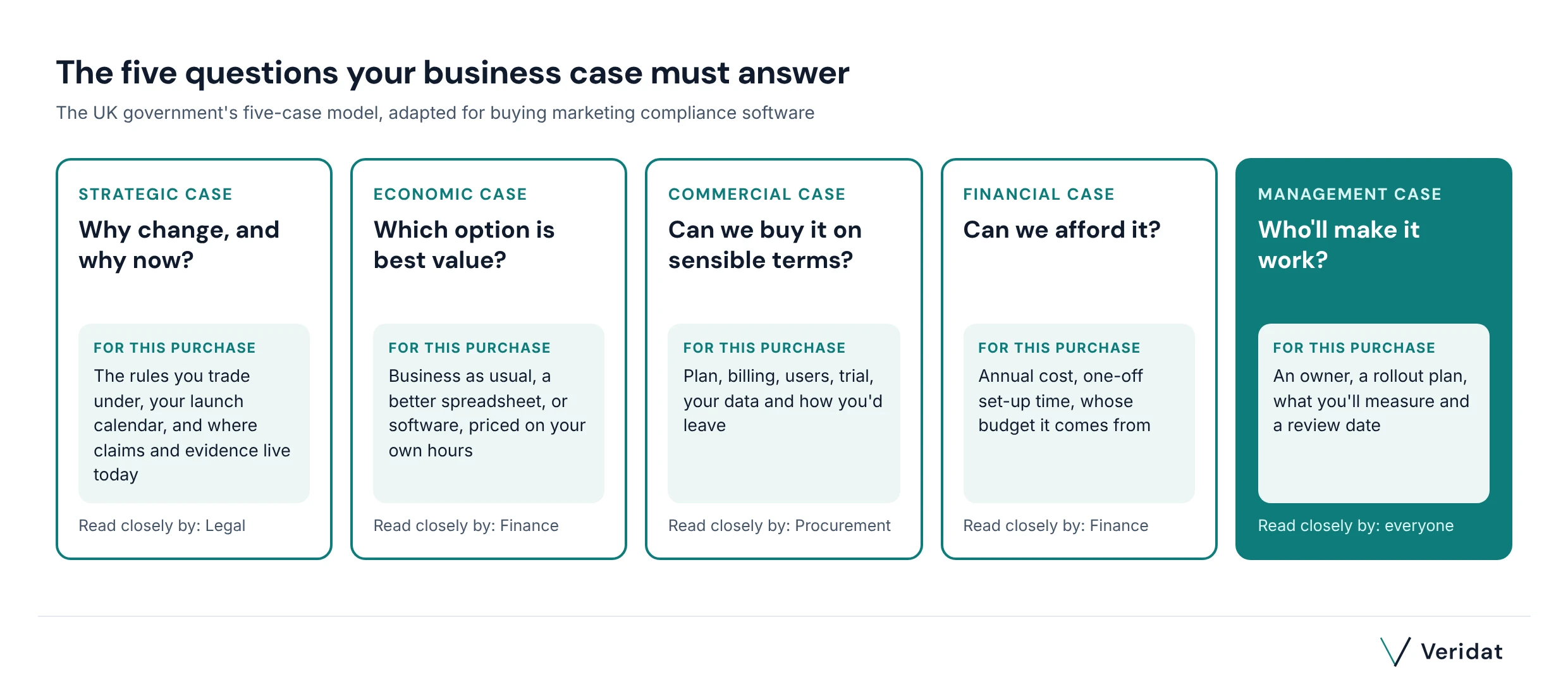
Strategic case: why change, and why now?
Start with the rules above, then add your own triggers: a busy launch calendar, a retailer asking for the evidence behind a pack claim, a range of green claims due for review, or approved wording scattered across decks and drives. Name the ones that are true for you.
Economic case: which option is best value?
This is your options appraisal. The Green Book says a shortlist should include a "do minimum" option, so compare at least three: carry on as you are, do the minimum (say, a tidier claims spreadsheet with a named owner) or buy the software. It also says "business as usual" must always be taken forward as the benchmark the others are measured against. Leave it out and Finance will add it for you.
Commercial case: how will you buy it?
This is where Procurement's answers go: what you're signing up to, and how you'd leave. Your vendor questionnaire does most of the work here.
Financial case: can you afford it?
Show the annual cost, the one-off set-up time and which budget pays. If the vendor offers yearly billing, show both. Veridat's prices sit openly on our pricing page, and paying yearly gets you two months free.
Management case: who'll make it work?
An owner, a rollout plan, what you'll measure and a date to review it. Six months in, you should be able to say whether the hours you measured in the trial held up.
Marketing compliance software ROI: what to count
There's no independent benchmark for how long a claim review takes. The figures you'll find quoted come from vendors, so the template asks for yours.
The cost of how you work today
Start with hours per claim, by role, from first draft to final sign-off, rework included. If you're unsure what your process looks like end to end, our guide to checking a claim before launch sets out the steps worth timing. Multiply by a loaded hourly cost from Finance or HR (salary plus employer costs).
Re-reviews are where hours hide. When your team re-approves the same lines for every deck and market, learning to reuse approved wording is a saving you can count.
Then add outside costs. External counsel is claims sent out, times hours, times your firm's rate. As a cross-check, the government's solicitors' guideline hourly rates run from £288 to £579 an hour for a solicitor with over 8 years' experience, depending on location and the work (from 1 January 2026). They're set for court costs assessments, not as a price list, so use your firm's quoted rate.
Last, the occasional costs: answering a regulator's or retailer's request, or reprinting a pack run because a claim didn't hold up. Use your own history, not a guess.
The full cost of the software
Total cost of ownership is more than the subscription. Add set-up (importing existing claims, setting up reviewers, training) and the admin hours to keep it running. Count paid users only for people who add claims, attach evidence or sign off. In Veridat, viewers who only read approved wording (your sales team, say) are free, with no limit on numbers.
What not to count
Leave three things out of the ROI. Fines "avoided": you can't show what a fine would have been or how likely it was, so they belong in the risk register. Headcount cuts: the software doesn't replace Legal. And any time saving you haven't measured.
That last trap has a name. The Green Book calls it optimism bias: "the proven tendency for appraisals to be over-optimistic about key assumptions". A smaller number Finance believes beats a big one they don't.
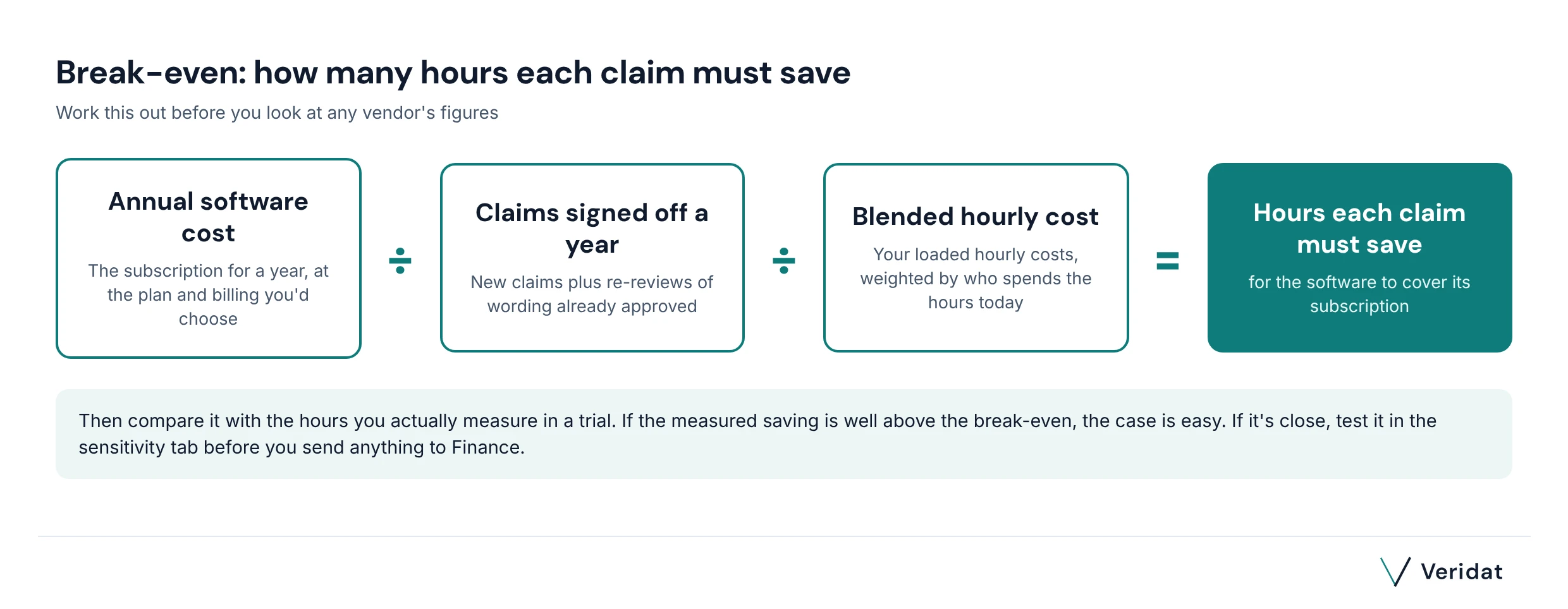
Pro tip: Work out the break-even before you look at any vendor's figures. Divide the annual software cost by the number of claims you sign off a year, then by your blended hourly cost. That's how many hours each claim must save for the tool to cover its subscription. If it's a fraction of an hour, the conversation with Finance gets short.
Inside the free template: what each tab does
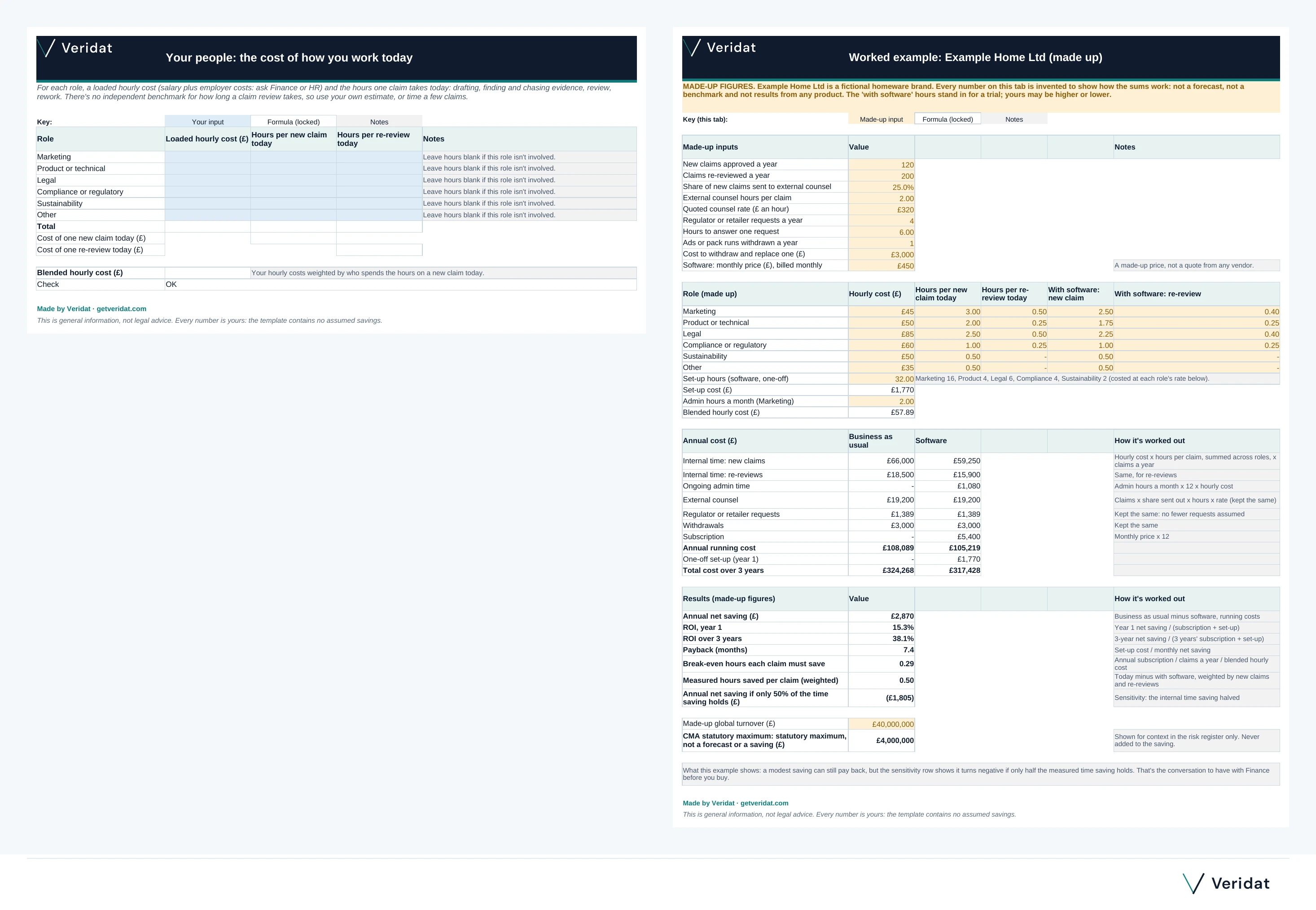
Think of it as a marketing compliance software ROI calculator that shows its working. It's a free Excel file with no email asked, and it ships blank: every input is yours, and it contains no assumed savings. A separate Worked example tab shows a made-up homeware brand, so you can see the sums working before you enter your own.
Four input tabs come first: your claims, your people, outside costs (with the guideline rates as a read-only cross-check) and the software. A Trial log takes one row per claim you time during a trial.
Options lays out the economic case over three years. Results gives ROI, payback, the break-even hours per claim and an optional net present value at your company's discount rate. Sensitivity shows what happens if only half or three-quarters of your measured saving holds, or if claim volume moves by a quarter either way.
A Risk register sits outside the ROI. It works out the CMA's maximum fine for your turnover, labelled "statutory maximum, not a forecast", and never adds it to the saving. Summary then pulls everything onto one A4 page under the five questions: your marketing claim substantiation software business case, ready for your three approvers to sign.
Business case template for marketing compliance software
Free, no email needed.
Get the "after" number from a trial, not a brochure
The one number you can't fill in from your desk is how long a claim takes with the software. So measure it.
Pick 5 to 10 real claims due for review in the next fortnight. Run them through Veridat during your 14-day free trial, and log each one's hours by role in the Trial log tab. Those averages feed the economic case, and you can override them if you've measured better.
Pro tip: Include at least one claim that needs evidence from someone outside Marketing, such as a test report from Product or a supplier's certificate. Chasing evidence across teams is where hidden hours tend to sit, and a trial made only of easy claims will flatter any tool.
Where Veridat fits in your case
We built Veridat to give marketing, product, technical, compliance and legal teams one place to validate marketing and product claims. You add the claim: its wording, product, markets and channels. Veridat builds a checklist from 26 UK and US advertising rules, works out the substantiation needed and turns each gap into a task with a due date, chased by reminder emails. Then it sends the claim to the right reviewers.
That's the part your Legal reader cares about. Nothing is approved until reviewers have reviewed and accepted the evidence, and a gap can only go through as "approved with conditions", with the reason recorded. Each market is signed off separately. Every sign-off records who decided, their review function, when and on which version, and it can't be edited afterwards.
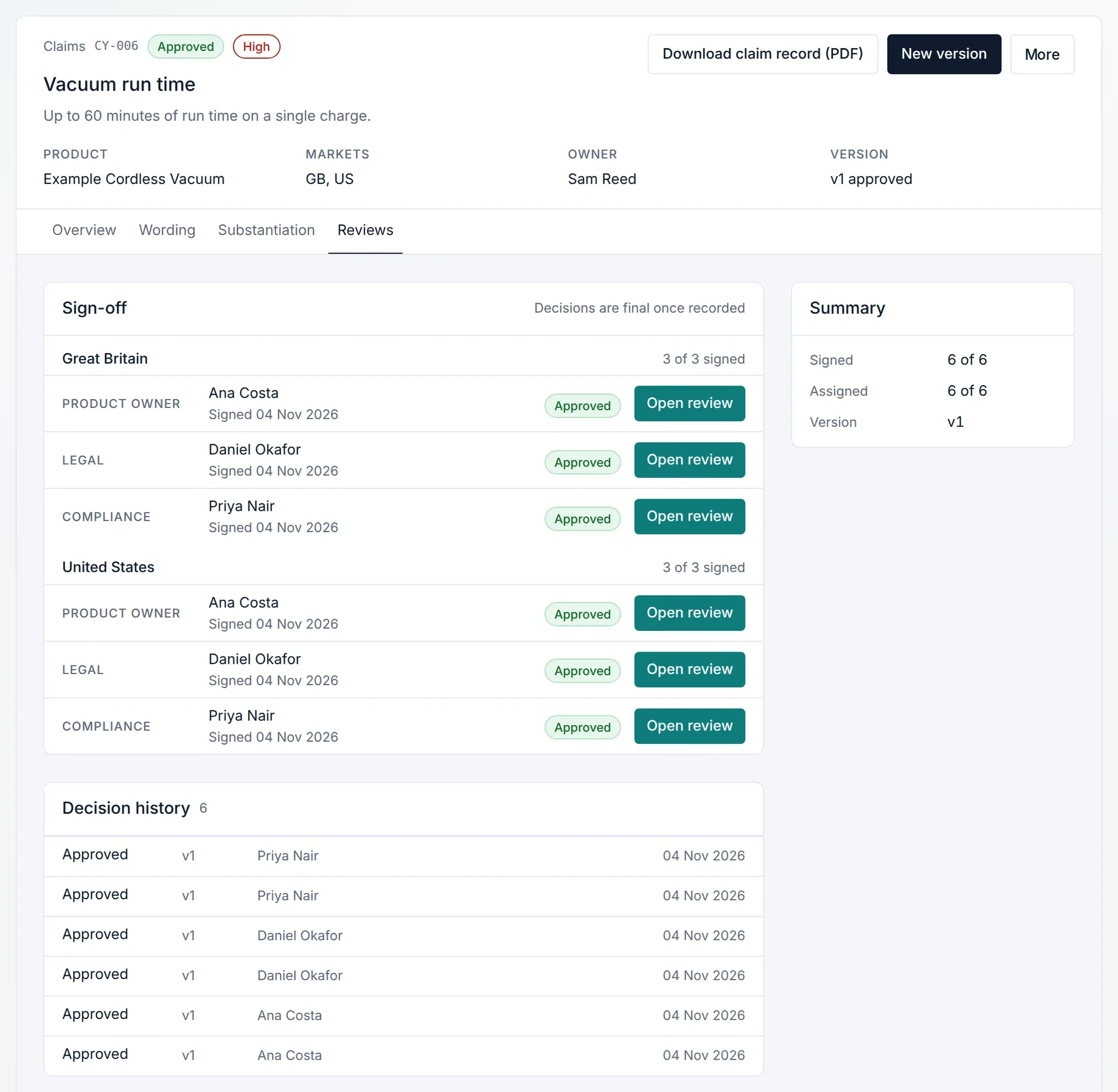
Approved wording goes into the approved claims library with its conditions and evidence, so your team can reuse it without restarting legal review. And Veridat doesn't replace your lawyer: final legal and commercial decisions stay with your reviewers. See how a claim moves from draft to sign-off.
You can try every feature free for 14 days, no card needed. After that, plans start at £149 a month and go up to £899 a month, depending on your team size and needs; see plans and prices. Larger teams can talk to us about a custom plan.
Want a bigger say in what we build? Our design partner programme gives you 30 days of free access and a direct line to Nuel.
Veridat works out the evidence each claim needs, turns each gap into a task with a due date and sends the claim to the right reviewers. Time your own claims through it and put the hours in your case. Try every feature free for 14 days, no card needed.
Questions
How do you calculate marketing compliance software ROI?
Work out what claim review costs you today (hours by role times hourly cost, plus external counsel and rework), then what it would cost with the software (the hours you measure in a trial, plus the subscription and set-up). ROI is the net saving divided by the software's own cost. A marketing compliance software ROI calculator should use your numbers, not a vendor's percentage.
What should a compliance software business case template include?
The five cases (why now, the options, the commercial terms, affordability and who delivers it), a "business as usual" option to compare against, the full cost of the software, a sensitivity check and a risk register. Our free Excel template has all of them.
Can I count avoided fines as a saving?
We'd advise against it. You can't show what a fine would have been or how likely it was, and Finance knows that. Show the CMA's statutory maximum for your turnover (10% of global turnover or £300,000, whichever is greater) in a risk register, and keep the ROI to costs you can measure.
What hourly rate should I use for legal review?
For in-house reviewers, a loaded hourly cost from Finance or HR. For outside counsel, your firm's quoted rate, with the government's guideline hourly rates as a cross-check: £288 to £579 an hour for a solicitor with over 8 years' experience, from 1 January 2026. They're court figures, not a price list.
How long does marketing compliance software take to pay for itself?
It depends on your claim volume and hourly costs, which is why the template works out a break-even: the hours each claim must save for the software to cover its subscription. Measure real claims in a trial, then let the template work out the payback period from your own numbers.
Can the CMA fine a brand for misleading advertising claims?
Yes. Since 6 April 2025 the CMA can fine a business directly for misleading actions and other unfair commercial practices. Its first fines for breaking consumer law itself, in 2026, were for drip pricing, false time-limited offers, pre-selected paid extras and a joining fee not shown clearly in the total price. As for the ASA, it can't fine, but it can tell you to withdraw the ad and apply other sanctions.
This is general information, not legal advice.
Spotted something out of date? Drop us a line and we'll put it right within five working days.