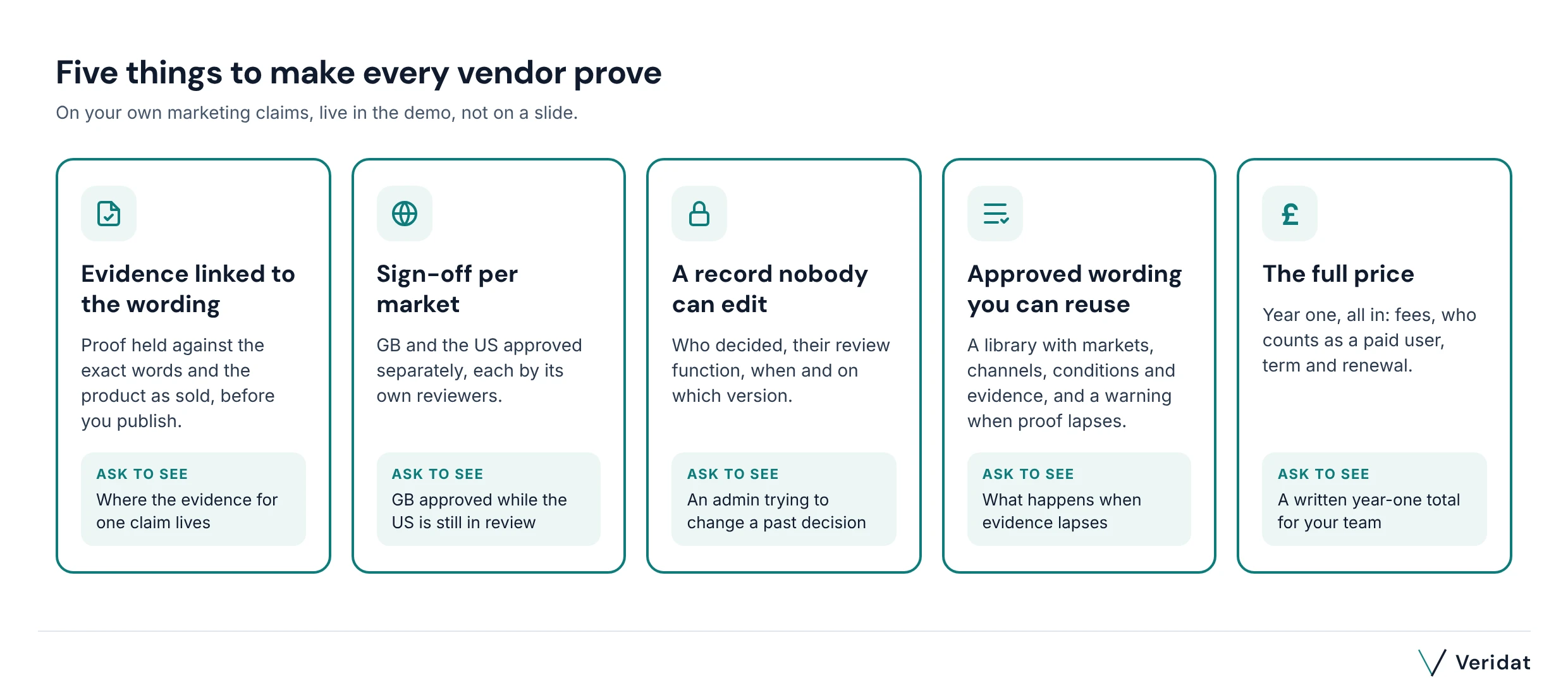
A good marketing compliance software RFP makes every vendor prove five things on your own claims: evidence linked to the exact wording, sign-off per market, a record nobody can edit, approved wording you can reuse with its conditions, and the full price. Our free Excel template has every question.
It's your third demo this week, and they're starting to blur. Every vendor has shown you a clean dashboard, a tidy approval flow and a satisfying green tick.
Then your lawyer asks the question that matters. "If the ASA writes to us next spring about 'clinically proven', what do we send them? And could anyone have changed it since?" The salesperson says "great question" and moves to the next slide.
That's the question this checklist is built around, with 39 more like it. Put your shortlist through the same test, on your own claims, before you sign anything.
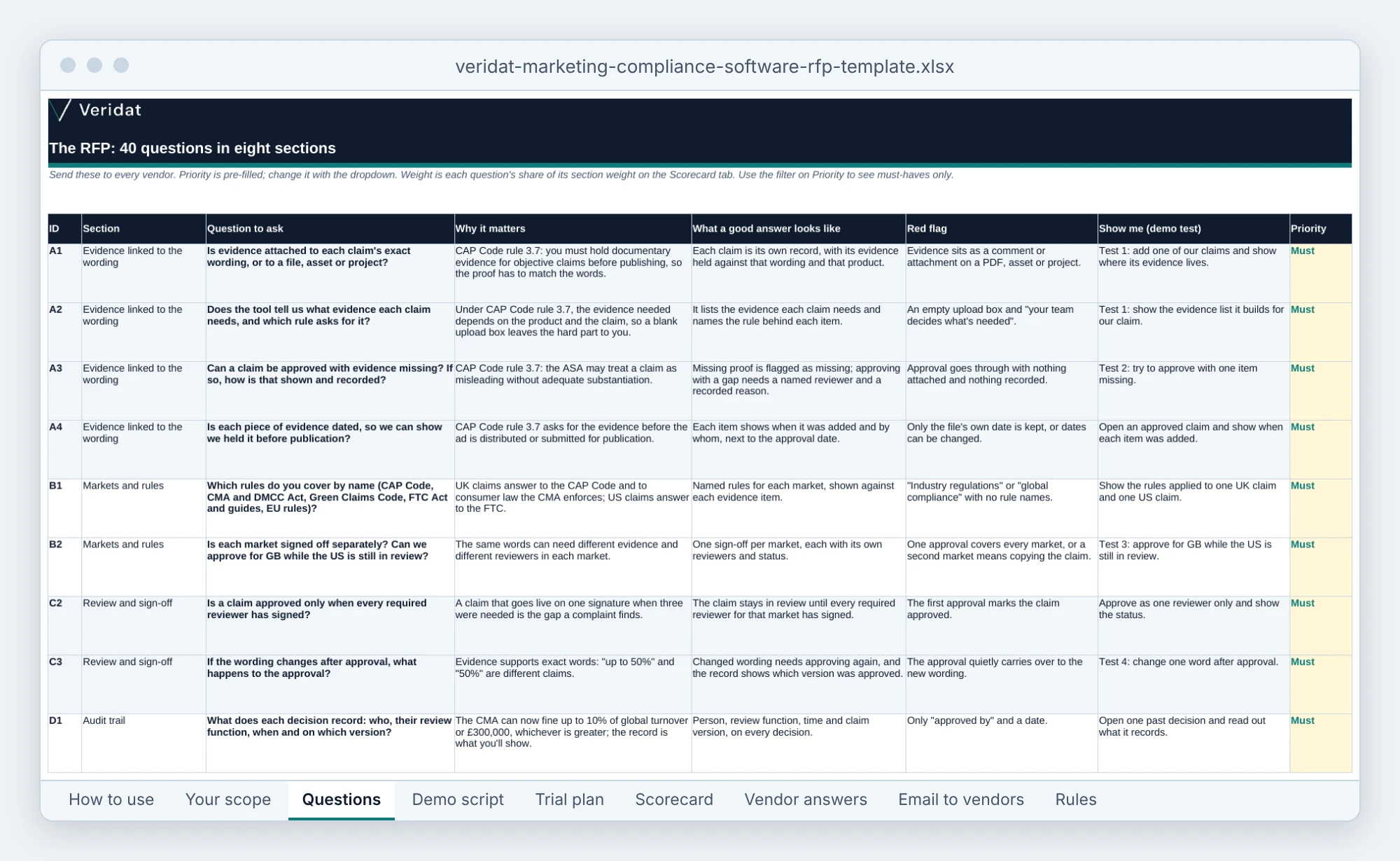
Free download: the marketing compliance software RFP template (Excel).
40 questions with good answers and red flags, a seven-test demo script, a 14-day trial plan and a scorecard for three vendors. No email needed.
Still building your shortlist? Start with our best marketing compliance software list.
Why buying for marketing claims is different
Most RFP templates are written for files, contracts or general compliance. With marketing claims, the regulator's question is much narrower: did you hold the evidence for these exact words before you published? If you're new to the subject, start with what marketing compliance covers.
In the UK, CAP Code rule 3.7 says you must hold documentary evidence for claims consumers are likely to see as objective, before the ad goes out. Since 6 April 2025, under the DMCC Act 2024, the CMA can also decide for itself whether you've broken consumer law, and fine you up to 10% of global turnover or £300,000, whichever is greater. In the US, the FTC expects a reasonable basis for advertising claims before they're disseminated.
So marketing claim substantiation software requirements start in one place: evidence tied to the wording, a decision you can prove and a record that holds up later. Our buyer's guide to marketing compliance software maps the kinds of tool on the market.
Before you send it: write down what you're buying for
Write your marketing compliance software requirements down before any vendor sees them, or the first demo will write them for you. Note:
- the products and brands in scope
- your markets (GB, US, EU) and channels (packs, product pages, retailer listings, ads, social)
- roughly how many claims you make a year
- who signs off, by function: Legal, Product or Technical, Regulatory, Sustainability, Brand
- how many people only need to see approved wording, such as sales teams and agencies
- where your evidence lives today
If the honest answer to that last one is spreadsheets and shared folders, that's the problem you're buying to fix.
Then split must-haves from nice-to-haves, with Procurement in the room. A must-have is something you'd walk away over, so five is plenty.
Pro tip: Agree the weights before the first demo, or the best presenter wins rather than the best tool. Our template puts evidence at 20 points out of 100 and pricing at 5. Change them by all means, but change them first.
The marketing compliance software RFP: 40 questions in eight sections
A request for proposal for this kind of tool works best in eight sections. Here are the questions that matter most in each, with a good answer and the red flag to listen for. All 40 are in the template.
Evidence linked to the wording
In June 2026 the ASA ruled against a Beauty Pie poster on the London Underground claiming an LED face mask was "clinically proven to reduce wrinkles in 4 weeks".
Beauty Pie had studies. But the two on the mask itself weren't blinded and had no control or placebo group, and the strongest study wasn't specific to the advertised product. The ASA found breaches of rules 3.1, 3.7 and 12.1.
Evidence has to fit the exact words and the exact product, and a tool that files PDFs against a campaign won't show you the gap. Our checklist on what rule 3.7 expects of your evidence goes deeper. Ask:
- Is evidence attached to each claim's exact wording, or to a file, asset or project?
- Does the tool tell you what evidence each claim needs, and which rule asks for it?
- Can a claim be approved with something missing, and how is that recorded?
Good answer: each claim is its own record, missing proof shows as missing, and approving with a gap needs a named reviewer and a reason.
Red flag: evidence lives as a comment on a PDF.
Markets and rules
A moisturiser sold in UK shops and on a US website answers to two sets of rules. Ask:
- Which rules does it name, and for which markets?
- Is each market signed off separately, so you can approve for GB while the US is still in review?
- Who keeps the rules up to date, and how will you know when one changes?
Good answer: named rules for each market, with a separate sign-off for each.
Red flag: "industry regulations" with no rule names.
Green claims need their own look. The CMA's Green Claims Code asks for up-to-date, credible evidence. In the EU, generic environmental claims are banned unless you can show recognised excellent environmental performance, under rules that have applied since 27 September 2026. Our guide to the evidence green claims need covers both.
Review and sign-off
Put this scenario to every vendor. A claim reads "up to 50% fewer breakouts" and gets approved. A week later someone tidies it to "50% fewer breakouts". That's a different claim. Ask:
- Can claims be routed to reviewers by function: Legal, Product, Compliance, Sustainability?
- Is a claim approved only when every required reviewer has signed?
- If the wording changes after approval, what happens to the approval?
Good answer: changed wording needs approving again, and conditions stay with the words they apply to.
Red flag: the approval quietly carries over to the new wording.
An audit trail nobody can edit
The CMA's guidance on unfair commercial practices says any factual claim a trader makes about a product should be supported by evidence. If you can't produce it, the CMA or the courts may find the claim false. So can you produce it quickly, and could anyone have changed it? Ask:
- What does each decision record: who, their review function, when and on which version?
- Can anyone, including an admin or the vendor's own staff, edit or delete a past decision?
- If the ASA, the CMA or a retailer asks, how do you pull one claim's evidence and sign-offs together?
Good answer: all four details on every decision, locked once it's made.
Red flag: "admins can tidy up the history".
Approved wording, reuse and expiry
Once wording is approved, other teams will want to reuse it without starting legal review again. That only works if its conditions and evidence travel with it. Ask:
- Is there a searchable approved claims library by product, market and channel?
- What happens to approved wording when its evidence expires or is replaced?
- Does it warn you when someone raises a claim you already have?
Good answer: lapsed evidence puts a visible warning on the wording. The Green Claims Code's "up-to-date" test makes this matter for every green claim.
Red flag: nothing changes, and the wording stays approved.
Who can see what
Sales teams and agencies use approved wording the most and approve it the least, so this section changes the bill. Ask:
- Who counts as a paid user: reviewers, contributors, viewers?
- Can sales and agencies see approved wording without changing it, and is that charged?
- Can view-only users download or export anything?
Good answer: view-only access to approved wording, with clear limits on what viewers can do.
Red flag: every person who only needs to look needs a full paid seat.
Data location and security
Procurement and IT will ask these anyway:
- Where is it hosted, and does anything leave the UK or EEA?
- Is your copy or evidence sent to an AI service, or used to train a model?
- What independent security testing has there been, and is there a data processing agreement?
- How do you get your data out, and deleted, when you leave?
For UK buyers, EEA hosting is the simple case: the ICO confirms every EEA country has full adequacy, so the transfer itself needs no extra safeguards.
Good answer: a named country, a plain answer on AI and a written exit route.
Red flag: "global data centres", with no country named.
Pricing, trial and contract
Year one is where budgets go wrong, usually through one-off fees and seats nobody planned for. Ask:
- Is the price published, and what would you pay in year one, all in?
- Can you trial every feature on your own claims, without a card or a contract?
- What's the minimum term, and how much can the price rise at renewal?
Good answer: a published price, a written year-one total and a trial with no card. For one example, our prices are published.
Red flag: no price until the third call.
Pro tip: Ask every vendor to price the same scenario: your team today, plus ten more people next year. It's the simplest way to compare total cost.
If the tool uses AI
Ask three more questions. Where is your copy sent? Does the same copy always get the same result? Who makes the final call?
Good answer: a named reviewer decides, and the tool shows its working.
Run the demo on your own claims
The questions to ask before you buy only get you so far. The vendor demo is where you see the answers working, so write the script yourself.
Send five live claims 48 hours before: one green claim, one comparison, one "clinically proven"-style claim, one performance claim such as "lasts twice as long", and one price claim. To choose them, paste your busiest product page into our free claim checker. It runs on Veridat's own engine, built for marketing copy. Your copy is never sent to an AI service, and the same copy always gets the same result.
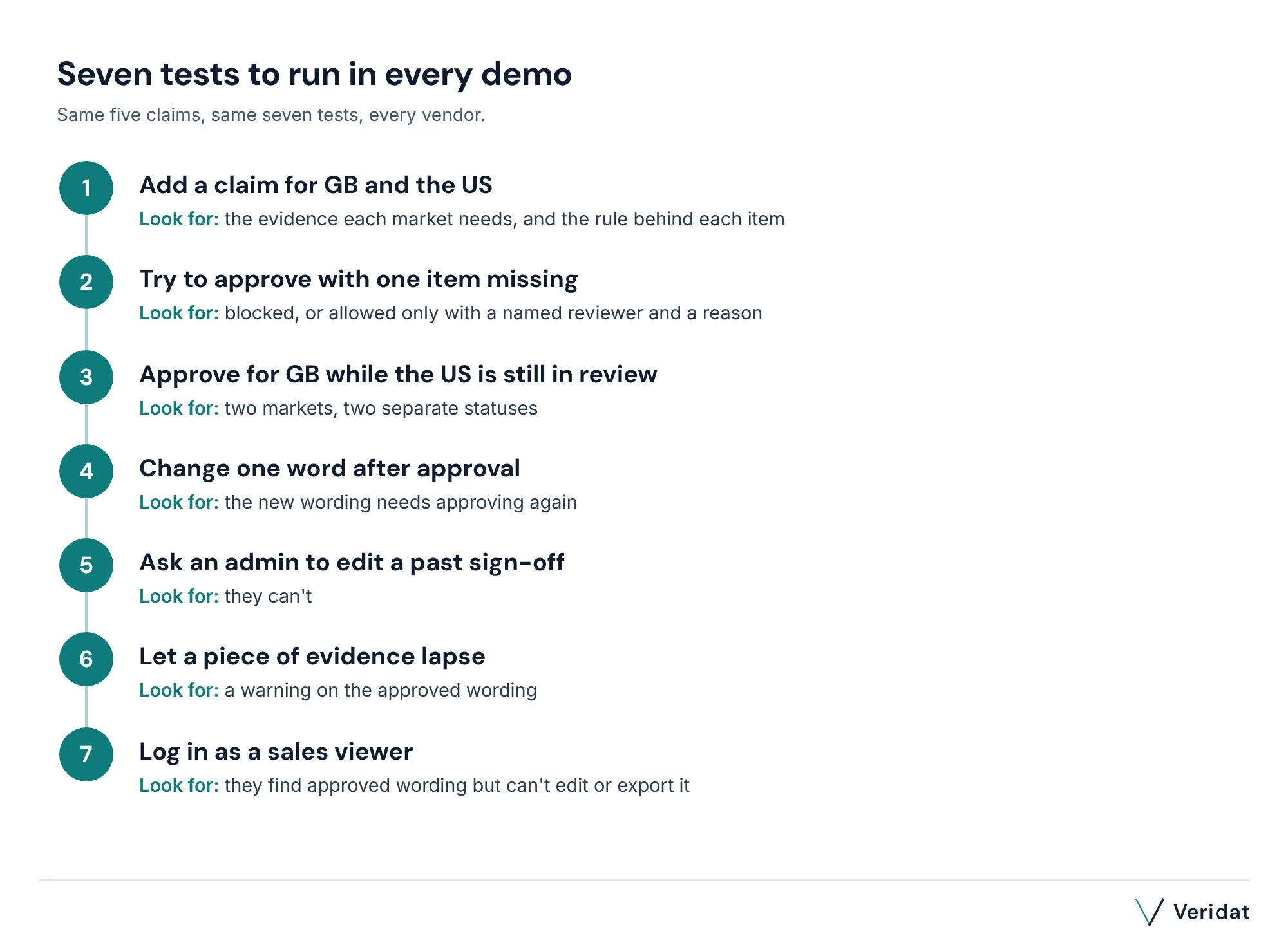
Our guide to how you check your claims before launch helps you prepare each one. Then ask every vendor to run the same seven tests:
- Add a claim for GB and the US, and see what evidence it asks for.
- Try to approve it with one item missing.
- Approve it for GB while the US is still in review.
- Change one word after approval.
- Ask an admin to edit a past sign-off.
- Let a piece of evidence lapse, and watch what happens to the approved wording.
- Log in as a sales viewer and try to edit or export.
Red flags that should end a demo early
Some answers tell you all you need. Each of these means more work or more risk for your team after you sign:
- They won't use your claims. You'd be buying the demo rather than the tool.
- "It depends on configuration", but nobody will configure it live. You'll find out after you've paid.
- Evidence sits as a comment on a PDF. Nobody will see which proof backs which words.
- The approval survives a wording change. You could publish words nobody approved.
- An admin can edit a past decision. Your record won't hold up when it matters.
- No price until the third call, or a trial that needs a card. You're committing before you know the cost.
- "Our AI approves your claims." Someone in your business still has to stand behind each decision.
Use the free trial as a pilot
A free trial is a pilot if you treat it like one. Write three success criteria before day one, for example:
- ten live claims approved with their evidence and sign-offs in the tool
- Legal can find any decision in one search
- sales can find approved wording without asking anyone
Give the trial one owner, and bring Legal in on day one, not day 13. The template's 14-day plan sets out who does what each day.
Score the shortlist and make the call
Every question scores 0 to 3, and a must-have passes only on a 2 or 3:
- 0: no
- 1: only with a workaround
- 2: yes, with limits
- 3: yes, shown live on your claims
Each of your three scorers works alone, then you compare. Where you disagree, there's usually a question nobody asked properly. Only score 3 for something you saw working on your own claims.
The template's scorecard applies your section weights and adds up each vendor's total. Any vendor that misses a must-have shows as "Out", however well it scores elsewhere.
Once you have a winner, our business case template for Legal and Finance helps you put it to the people who sign off the budget.
How Veridat answers these questions
We wrote this checklist, so it's only fair to show you our own answers.
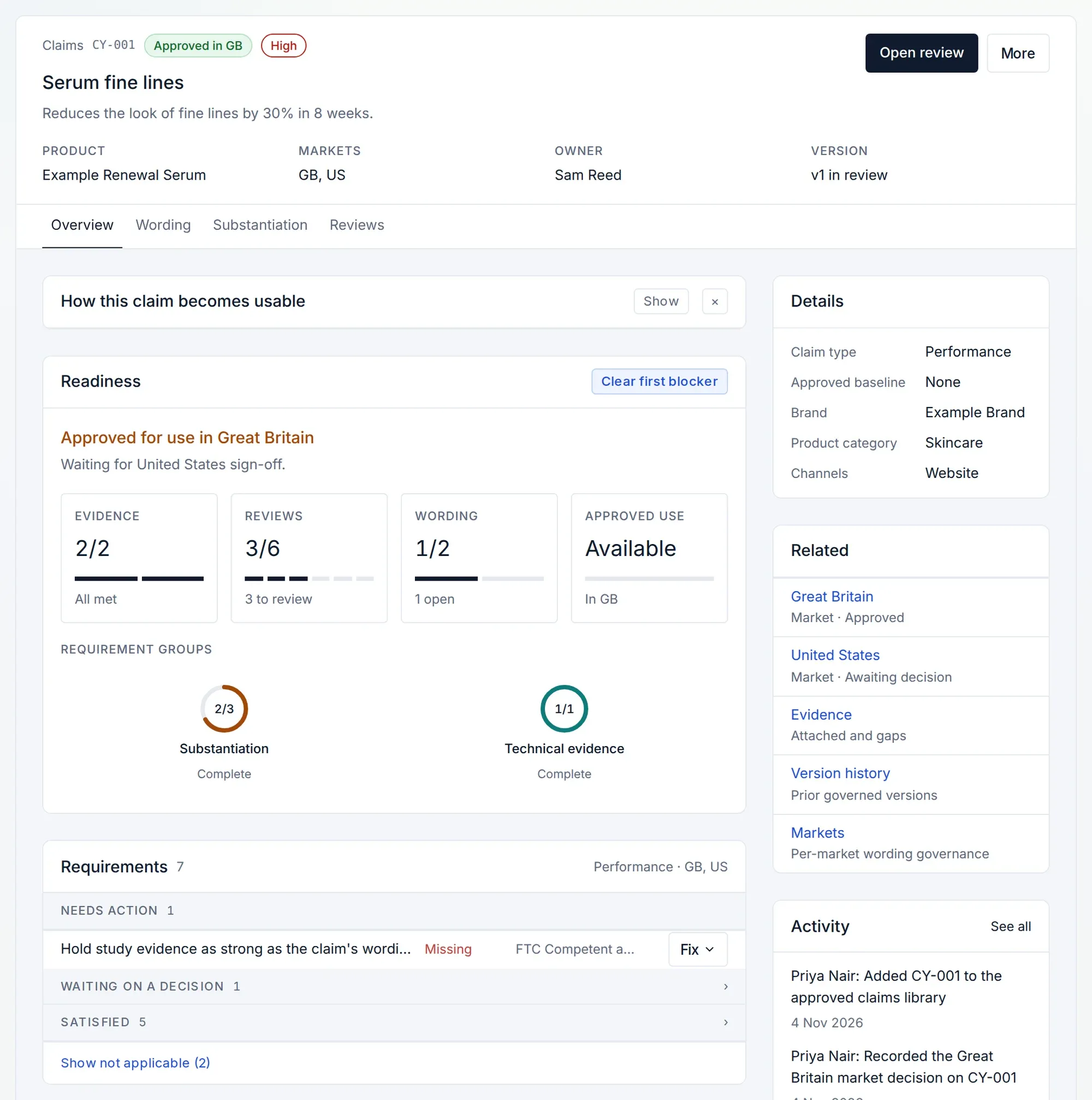
We built Veridat to give marketing, product, technical, compliance and legal teams one place to validate marketing and product claims. You add the claim with its wording, product, markets and channels. Veridat builds a checklist for it from 26 UK and US advertising rules, works out the substantiation it needs and turns each gap into a task with a due date, chased by reminder emails.
Then it sends the claim to the right reviewers, such as Legal and Product. No chasing evidence by email, and no guessing who still needs to sign. Here's how that maps to the template:
| Question | Veridat's answer |
|---|---|
| Does the tool say what each claim needs? (A2) | Yes. Each claim gets a checklist from 26 UK and US advertising rules, and missing evidence becomes a task. |
| Can a claim be approved with evidence missing? (A3, A5) | Nothing is approved until reviewers have accepted the evidence. A gap can be accepted only as "approved with conditions", with the reason recorded. Disputed evidence doesn't count until it's cleared with a note. |
| Is each market signed off separately? (B2) | Yes. Wording can be approved for one market while another is still in review. |
| How are claims routed and approved? (C1, C2, C5) | Each evidence gap becomes a task with a due date, and you can reassign a task to a teammate. The claim goes to the right reviewers, and it's approved when every market's required reviewers have signed. |
| What does each decision record, and can anyone edit it? (D1, D2) | Who decided, their review function, when and on which version. Sign-offs can't be edited afterwards. |
| What happens to approved wording? (E2, E3) | It goes into the approved claims library. The Approved view lists approved claims with their status and proof, and each claim's Wording tab shows its markets, channels and conditions. Evidence expiry shows on the evidence record and as a warning. |
| Can sales see approved wording, and is it charged? (F2, F3) | Viewers, such as sales teams, are free and unlimited. They can see approved wording but can't approve, edit, download or export. |
| Where is our data hosted? (G1) | In the EU, in Dublin. |
| What independent security testing have you had? (G3) | An independent security review was completed in October 2026. |
| Is the price published, and can we trial everything? (H1, H4) | Yes to both. See the prices below; the trial needs no card. |
You can try every feature free for 14 days. After that, plans start at £149 a month and go up to £899 a month, depending on your team size and needs, and our prices are published. Larger teams can talk to us about a custom plan.
Want to see it first? Here's how a claim moves from draft to approved, and how we look after your data.
Veridat works out the evidence each claim needs, turns each gap into a task with a due date and routes the claim to the right reviewers, then keeps the approved wording ready to reuse. Try every feature free for 14 days, no card needed.
Frequently asked questions
What should a marketing compliance software RFP include?
Your scope, the questions by section, your must-haves, a scoring method agreed before the demos and a demo script built on your own claims. Our template is a ready-made marketing compliance software RFP checklist with all five. With more than five vendors in view, send a short request for information (RFI) first.
How many vendors should get it?
Three to five is enough for most teams. Any more, and nobody reads the answers properly.
Is marketing compliance software the same as proofing software or a DAM?
No. Proofing software manages comments and approvals on creative files, and a digital asset management system (DAM) stores and shares your assets. Marketing compliance software built around claims manages the claim, its evidence and the decision. Some teams use two side by side.
What are the must-have requirements for marketing claim substantiation software?
Evidence linked to each claim's exact wording, sign-off by function and by market, a decision record nobody can edit, and an approved library that keeps each wording's conditions and warns you when its evidence lapses.
Should we run a free trial or a paid pilot?
A free trial is enough if you can run it on your own claims with every feature on. A paid pilot makes sense when set-up needs the vendor's own people.
Do we need special tools to run a marketing compliance software RFP?
No. A spreadsheet does the job. Ours is free with no email needed, and it's an ordinary Excel file with no macros, so you can reword questions or change priorities and weights, and the scores update.
This is general information, not legal advice.
Spotted something out of date? Drop us a line and we'll put it right within five working days.