ASA rulings this month caught 13 product claims, published between 21 October and 4 November 2026. The pattern is plain: game ads showing play that doesn't exist, weight-loss ads read as selling prescription pills, a "lifetime free" wifi box with no proof, and a price promise that hid its condition. Here's each ruling, and the lesson.
King put "Not actual gameplay" on its Farm Heroes Saga ad. The ASA banned it anyway, because a disclaimer that contradicts your own pictures doesn't clarify anything.
That's the thread through the latest ASA rulings: the impression your ad creates is the claim. Small print won't rescue it. Neither will a landing page, or even a pre-clearance. Voy's on-demand TV ad had been approved by Clearcast, and it was still banned. If marketing compliance is part of your job, this month shows exactly where the line sits.
Each ruling below gives you the claim, the outcome, the missing evidence, the rules and the lesson. Everything's dated.
This month's ASA rulings on product claims at a glance
| Advertiser | Published | Claim type | Outcome | Product-claim rules |
|---|---|---|---|---|
| Cara Capsules Ltd t/a Home + Health | 21 Oct 2026 | Comparative claims and reviews | Upheld | 2.1, 2.3, 2.4, 3.1, 3.7, 3.32 |
| Attraction Tickets Ltd | 28 Oct 2026 | Price promises | Upheld | 3.1, 3.3, 3.9 |
| Xun Meng International Ltd t/a Zouhyitao | 4 Nov 2026 | Tech performance | Upheld | 1.7, 3.1, 3.7, 3.11 |
| GMB Agency LLC t/a Pulmoria | 4 Nov 2026 | Health and supplement claims | Upheld | 1.7, 15.1, 15.1.1, 15.6, 15.6.2 |
| Antipadia Enterprises Ltd t/a Copymind | 4 Nov 2026 | Health and supplement claims | Upheld | 1.7, 12.1, 12.2 |
| Menwell Ltd t/a Voy (on-demand TV) | 4 Nov 2026 | Weight-loss medicines | Upheld | 12.12 |
| Menwell Ltd t/a Voy (bus poster) | 4 Nov 2026 | Weight-loss medicines | Upheld | 12.12 |
| MedExpress Enterprises Ltd | 4 Nov 2026 | Weight-loss medicines | Upheld | 12.12 |
| Juniper Technologies UK Ltd | 4 Nov 2026 | Weight-loss medicines | Upheld | 12.12 |
| King.com Ltd | 4 Nov 2026 | App and game representation | Upheld in part | 3.1, 3.7, 3.9, 3.11 |
| Scopely Inc | 4 Nov 2026 | App and game representation | Upheld in part | 3.1, 3.7 |
| Omnilojo Pte Ltd | 4 Nov 2026 | App and game representation | Upheld | 3.1, 3.7, 3.11 |
| Vistrex Ltd t/a Royal Ark | 4 Nov 2026 | App and game representation | Upheld | 3.1, 3.7 |
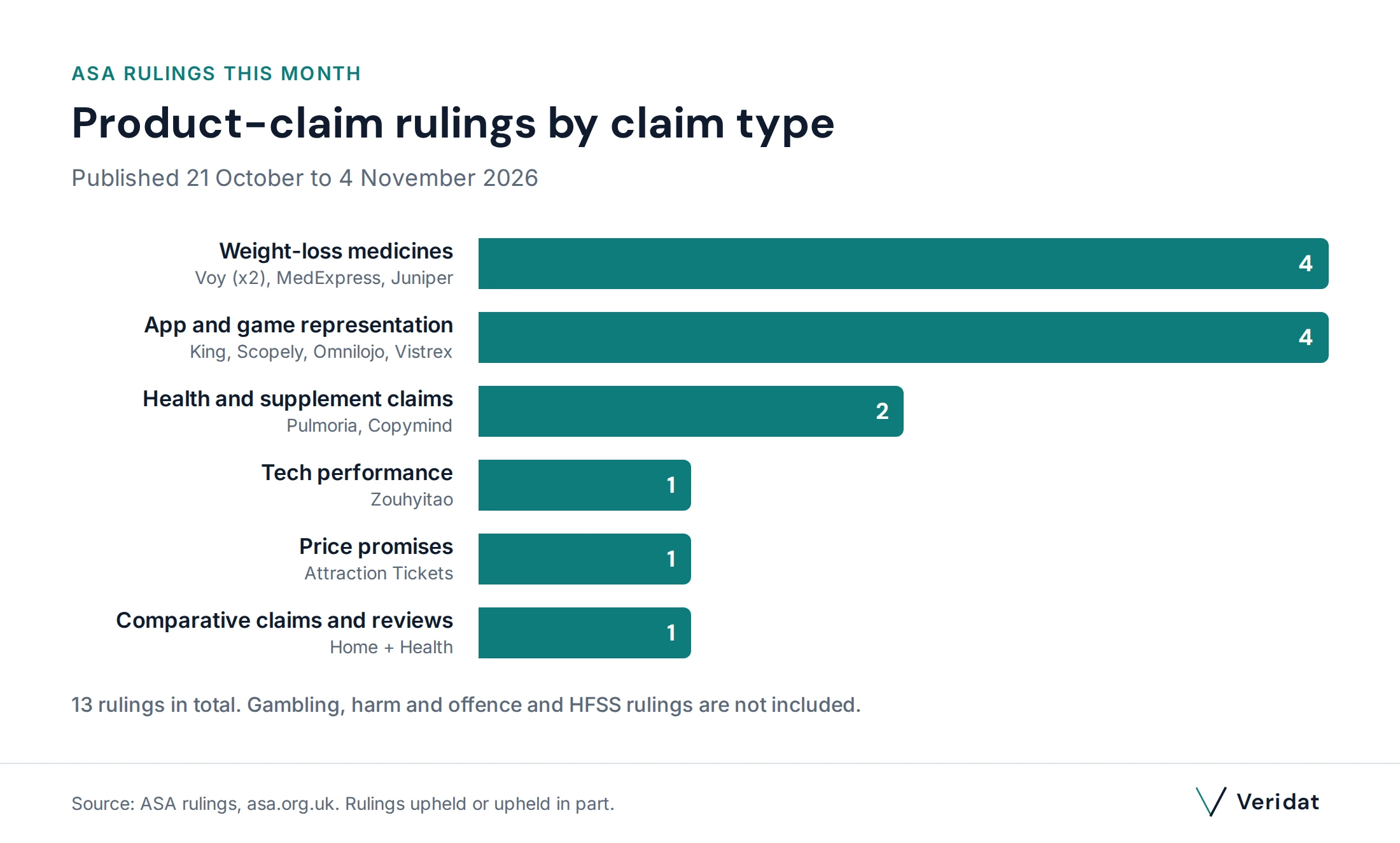
We've left out three banned ads that weren't about product claims: a gambling ad served against a self-exclusion search (Optival, 28 October) and two game and app ads ruled harmful or offensive (Last Light: Rebirth and RiseGuide, 21 October).
Health, beauty and supplement claims
Pulmoria: "Smoke all you want, just clear your lungs" (4 November)
Pulmoria's Facebook ad for mullein drops opened with "SMOKE ALL YOU WANT Just clear your lungs Daily". Beside it sat two pairs of lungs, black at "Day 0" and pink at "Day 90", and a promise that it "Clears Tar & Buildup".
A food supplement can't claim to prevent, treat or cure disease. Even the softer lines failed. "Supports healthy lung function and oxygen flow" is a health claim, and there was no sign it was on the GB Nutrition and Health Claims Register. Pulmoria never replied.
Outcome: Upheld on both issues, and referred to CAP's Compliance team.
Evidence missing: Proof the health claims were authorised on the GB NHC Register.
Rules: CAP Code 15.6 and 15.6.2, 15.1 and 15.1.1 (food supplements and health claims), 1.7 (unreasonable delay).
Lesson: For a supplement, the register wording is the ceiling. Go past it and you're on your own.
Copymind: a therapy app that sounded like a treatment (4 November)
Copymind sold an "AI twin for therapy" through Facebook ads. One line read: "I DIDN'T CRY IN THERAPY. BUT I CRIED AFTER FIRST 20 MINUTES WITH MY AI TWIN." Another line urged people to try "healing" with their AI twin.
That wording gave the app a medical purpose, in the ASA's view. The MHRA advised it likely fell under the medical device rules, and Copymind had no registration or conformity marking to show. One ad was also found to discourage essential treatment. Copymind didn't respond either.
Outcome: Upheld, and referred to CAP's Compliance team.
Evidence missing: MHRA registration and the conformity marking for a medical device.
Rules: CAP Code 12.1 and 12.2 (medicines and health-related products), 1.7 (unreasonable delay).
Lesson: If your app talks like a treatment, it'll be judged like one. Describe what it does, not what it heals.
Weight-loss pills: four ads read as prescription medicine (4 November)
Oral Wegovy "was licensed as a POM on 11 June 2026. Private availability followed in July 2026." On 4 November the ASA ruled against four pill ads, and not one named a prescription medicine. It didn't need to, as the ASA's own research had found that many people interpret ads for weight-loss treatments as promoting prescription-only medicines.
- Voy, on-demand TV: a round white pill under the words "Oral weight support". It was really a glucomannan supplement, named in small print, and Clearcast had approved the ad. Still, "we did not consider that the small text was sufficient to override that impression".
- Voy, bus poster: "The weight is over" beside a hand holding a white pill. Three people complained, and "consumers were likely to interpret the ad as promoting the new oral form of Wegovy".
- MedExpress, Instagram story: "New weight loss tablets", "No needles", "Coming soon", linking to a page for the Wegovy pill.
- Juniper, YouTube: white pills floating in the sky and a line that the weight loss pill had arrived. Its link ran through a filtering page to a named prescription medicine.
Outcome: All four upheld.
What sank them: The pill imagery and wording, read in context, and for three of the four, the page the ad led to.
Rules: CAP Code 12.12 (no advertising prescription-only medicines to the public).
Lesson: Your ad is judged with the page behind it. Selling a supplement? Keep well clear of imagery people link with a medicine.
Tech, app and software claims
Zouhyitao: "Pay 36 pounds once for unlimited lifetime wifi" (4 November)
Zouhyitao, the trading name of Xun Meng International Ltd, sold a portable wifi device on Google with a pitch that would make any broadband provider blush: "36 pounds for free lifetime internet", "500Mbps 5G SATELLITE WIFI ANYWHERE ON EARTH" and "Save £780+/year vs. traditional broadband plans".
No evidence came in for any of it, and the company ignored the ASA's enquiries. As the ruling drily put it, "it was highly unlikely that a device could provide such a service without a subscription".
Outcome: Upheld, and referred to CAP's Compliance team.
Evidence missing: Any test of speed, coverage or running costs.
Rules: CAP Code 3.1 (misleading advertising), 3.7 (substantiation), 3.11 (exaggeration), 1.7 (unreasonable delay).
Lesson: Speeds, coverage and "for life" are objective claims, so you need the test results before launch. Our CAP Code substantiation checklist covers what rule 3.7 expects.
Mobile game ads: the ASA's fake gameplay sweep (4 November)
Four mobile game companies got rulings on the same day, and it wasn't a coincidence. Each one "forms part of a wider piece of work on misleading gameplay in ads for mobile games".
- King, Farm Heroes Saga: matching tiles knocked out nails while a saw edged towards a cow. The nails, saw and cow aren't in the game, and the "Not in-game footage" and "Not actual gameplay" labels were "likely to contradict, rather than clarify, how consumers would understand the game." Upheld in part.
- Scopely, Pixel Flow!: opened with a pipe puzzle the game doesn't have, so "the playing experience differed materially from the gameplay depicted". Upheld in part.
- Vistrex (Royal Ark), Idle Zombie Miner: its bulldozer action came from a bonus stage that "lasted 60 seconds, was available on completion of four of 194 mines". Upheld.
- Omnilojo, Dark War Survival: exaggerated gameplay, plus laurels reading "2026 Game Creative" and "2026 Survival Game". Omnilojo said they meant app-store featuring, but they "gave the clear impression of awards won rather than app-store rankings". Upheld.
Rules: CAP Code 3.1 (misleading advertising) and 3.7 (substantiation) for all four, plus 3.9 (qualification) for King and 3.11 (exaggeration) for King and Omnilojo.
Lesson: Swap "gameplay" for "product demo" and this applies to every software company. Mocked-up screens, unbuilt features and award-style badges carry the same risk.
Pro tip: A disclaimer can explain your ad, but it can't contradict it. If the visuals show something the product doesn't do, "illustrative only" won't save you. Change the visuals.
Price and promotion claims
Attraction Tickets: a price match with the condition left out (28 October)
"Find A Lower Price & We'll Match It" reads like a promise to match anyone. It wasn't. Attraction Tickets only matched lower prices from ABTA or ABTOT members.
Its defence was Google's strict character limits, plus full terms on its website. That page "was at least two clicks away from the ad", "which was not a necessary step before buying tickets". And "the ad was not limited by time or space to such an extent that the information could not have been provided."
Outcome: Upheld. The company had already dropped the wording.
What was missing: The condition, in the ad itself.
Rules: CAP Code 3.1 and 3.3 (misleading advertising), 3.9 (qualification).
Lesson: If a condition changes the deal, it goes in the ad. Check every price promise in your Black Friday ads, as part of any pre-launch check of your advertising claims.
Comparative claims and "independent" reviews
Home + Health: "We tested 5 non-toxic dishwasher tablets" (21 October)
A Facebook ad from Home + Health announced "WE TESTED 5 NON-TOXIC DISHWASHER TABLETS 2026 UPDATE". It led to a review page with a "Product Testing Manager" byline, warnings about "Gut Barrier Damage" and "Increased Cancer Risk" from mainstream tablets, and a number one pick: Dip. Cara Capsules Ltd owned both the review site and Dip.
"This is an advertorial" did appear, in small text at the very bottom. Not good enough: "the page was not clearly labelled upfront as an advertisement feature for Dip." On the health scare and the comparison with big-name brands, the ruling is blunt: "Cara Capsules had not provided us with any evidence."
During the investigation, the company took the ads down and brought in a pre-publication approval process. Cheaper the other way round.
Outcome: Upheld on all three issues.
Evidence missing: Anything showing mainstream tablets harm health, or that the featured ones are safer.
Rules: CAP Code 2.1, 2.3 and 2.4 (recognising ads), 3.1 (misleading advertising), 3.7 (substantiation), 3.32 (comparisons with identifiable competitors).
Lesson: If you own the brand at number one, your "review" is an ad. Say so at the top, and don't call rivals harmful without proof.
Cleared this month: what the ASA let through
King and Scopely each had a second ad that opened with a themed animation before showing real play. Viewers would read those openings as an intro, and what followed matched the game. Of King's, the ruling says: "We therefore considered consumers would distinguish the introductory animation from the gameplay shown subsequently".
A Walkers influencer post was cleared too, because Oven Baked Sea Salt crisps aren't HFSS, but that's a placement ruling rather than a product claim.
Worth knowing from 14 October
Three mid-October rulings that land on two of this season's big questions: "clinically proven" and Black Friday deals.
- Nutrition Geeks (Unicorn Brands Ltd). "Clinically backed to support muscle strength" for creatine, next to a "pancake to peach" before-and-after of a bottom. That line "did not have the same meaning for consumers" as the authorised claims, which say nothing about building muscle or changing body shape. Upheld under CAP Code 15.1, 15.1.1 and 15.7.
- Harrison & James (JPD Retail Ltd). "CLOSING SUNDAY" with no fixed closing date, "EVERYTHING FREE" with a £13.95 delivery charge it couldn't justify (later £23.95), and an out-of-date "4.7/5 | 2540+ reviews". Upheld on all three issues under CAP Code 3.1, 3.7, 3.23, 3.23.2, 3.30, 3.44 and 3.47.
- Proud & Free. "Everything is FREE. Just cover the shipping costs." Shipping was at least £19, the "until midnight" offer kept running, and there was no business address. Its closing-down claims "created a false impression of urgency". Upheld under CAP Code 1.7, 3.1, 3.3, 3.4.2, 3.7, 3.23 and 3.30.
Patterns in this month's ASA rulings
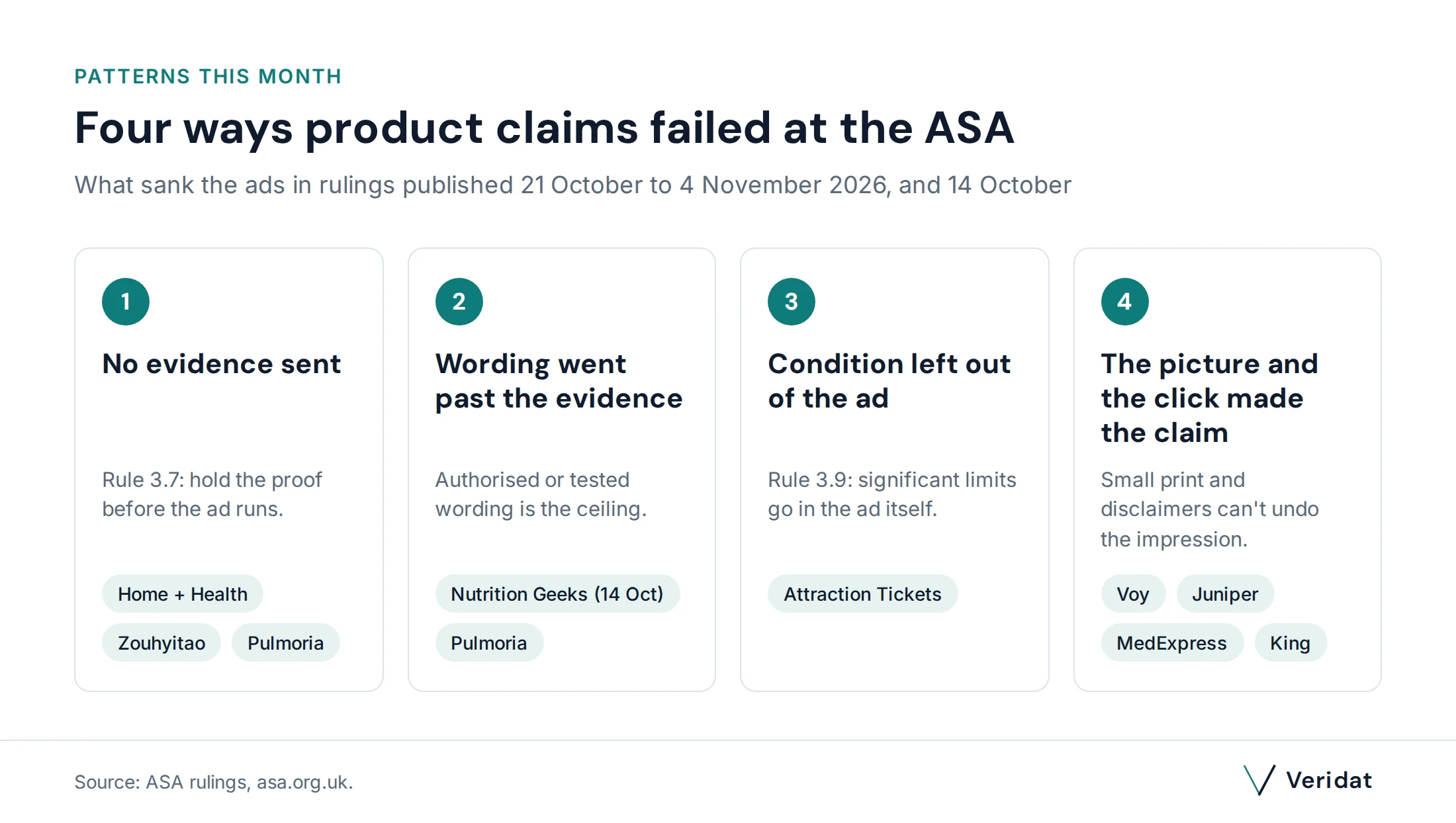
The impression is the claim. Voy, Juniper, MedExpress and King leaned on small print, a disclaimer or a carefully unnamed product. The ASA judged the whole package as a normal person sees it.
No evidence, no defence. Home + Health, Zouhyitao and Pulmoria sent nothing the ASA could weigh. Home + Health withdrew its claims during the investigation and still got a ruling. Keep the evidence for each claim, with who signed it off, before the ad runs. Our marketing claims template is a free place to start.
Conditions belong in the ad. Character limits are a reason to write tighter, not to leave the catch out.
Wording drifts past what's authorised. Nutrition Geeks stretched an authorised creatine claim; Pulmoria went much further. With health claims, every word you add to approved wording is a new claim.
Silence makes it worse. Zouhyitao, Pulmoria, Copymind and Proud & Free all ignored the ASA's enquiries. Each broke rule 1.7 on top of everything else and was referred to CAP's Compliance team. If you'd like a sound routine for all this, our step-by-step claim validation process walks through it.
Pro tip: Write the claim, then write the sentence a sceptical reader would take from it. If you can't prove that second sentence, you can't run the first.
How to check your copy against this month's rulings
Four quick checks catch most of what went wrong this month.
- Read it as a stranger. Cover the words and look at the pictures. What do they promise?
- Follow the click. Your landing page is part of your ad, so check what it names and shows.
- Put the condition next to the promise. If a limit changes the deal, it goes in the ad.
- Match the evidence to the exact words. Not the claim you meant, the one you wrote.
That last check is where most teams get stuck, because the evidence sits in inboxes and shared drives. We built Veridat to give marketing, product, technical, compliance and legal teams one place to validate marketing and product claims.
You create a claim, and Veridat's engine works out what's needed to back it up. It creates the tasks (evidence to attach, wording to confirm), routes them to the right people and sends the claim to the right reviewers. Nothing is approved until the relevant reviewers, such as Legal, have looked at the evidence and accepted it.
Approved wording then goes into a library your team can reuse without restarting legal review. You can see how it works or look around the product.
Try it with this made-up example, built from this month's rulings:
One payment, lifetime access, no monthly fees ever. Clinically backed to boost your energy. Find a lower price and we'll match it. Voted 2026's best app.
It runs on Veridat's own engine, built for marketing copy. Your copy is never sent to an AI service, and the same copy always gets the same result.
FAQ
How many ads did the ASA ban this month?
13 rulings on product claims were upheld, or upheld in part, between 21 October and 4 November 2026. We've left out the gambling, harm and offence and food placement cases published in the same weeks.
Which brands had ads banned by the ASA in November 2026?
On 4 November: King, Scopely, Omnilojo, Vistrex (Royal Ark), Voy (twice), MedExpress, Juniper, Zouhyitao, Pulmoria and Copymind, with King and Scopely upheld in part.
What happens when the ASA upholds a complaint?
The ad mustn't appear again in the form complained of, and the advertiser is told what to change. If it doesn't cooperate, the ASA refers it to CAP's Compliance team, as happened with four advertisers in this edition.
Can the ASA fine an advertiser?
No. Fines aren't among the ASA's sanctions. It can ask media owners to withhold ad space, have trading privileges withdrawn, run its own paid-search ads naming advertisers that break the rules, require mandatory pre-vetting, and refer persistent offenders to other statutory enforcement bodies. For broadcasters, Ofcom can impose fines.
Does Clearcast approval or a disclaimer protect my ad?
Not on their own. Voy's on-demand ad was approved by Clearcast and still banned, and King's "Not actual gameplay" label didn't save its ad. The overall impression decides it.
How often are ASA rulings published?
In weekly batches. The batches in this edition came out on Wednesdays: 21 October, 28 October and 4 November 2026. We round up the product claims once a month, and the next edition is out on Friday 11 December.
This is general information, not legal advice.
Spotted something out of date? Drop us a line and we'll put it right within five working days.