Under UK Black Friday advertising rules, "up to 50% off" needs a significant share of your range at the full 50% (the ASA says less than about one in ten products is unlikely to be enough), a "was" price must be one you genuinely charged for longer than the sale price, and a countdown timer must mean the deal really ends.
In May 2026, six months after Black Friday 2025, the ASA ruled against John Lewis, Boots and Debenhams over their deals. None of the ads was outrageous. A £150 saving on a MacBook Air. "Was £80, now £60" on a fragrance. A bed at "-44%". Each fell on the same question: could the retailer prove the higher price was real?
Then in October the CMA fined Wayfair £4.8 million over deals that didn't end when the timer said they would. This year, your evidence matters more than your banner.
Got your Black Friday copy drafted? Paste it into our free Claim Risk Checker and see which claims need evidence before 27 November.
Black Friday advertising rules: what's changed since last year?
Nobody has rewritten the rules. What's changed is who's watching, and what it costs you to get them wrong.
The CMA fines directly now. Under the Digital Markets, Competition and Consumers Act 2024 regime, in force since 6 April 2025, the CMA can use its own enforcement powers and fine a business up to 10% of its global turnover, or £300,000 if that's higher. On 14 October 2026 it fined three firms a total of £6 million.
A court reset the "was" price debate. In July 2026 the High Court refused the CMA's proposed sales-volume test for reference prices.
A ban on fake discounts is planned. In August 2026 the government said it would ban misleading claims about discounts and consult on adding fake "was" prices, invented discounts and misleading RRPs to the banned list. At the time of writing, that consultation hasn't opened.
Can you say "up to 50% off"?
Yes, if enough of your range is actually 50% off. "Up to" discount claims have their own rule: CAP Code rule 3.22 says they mustn't exaggerate how available or how big the saving is.
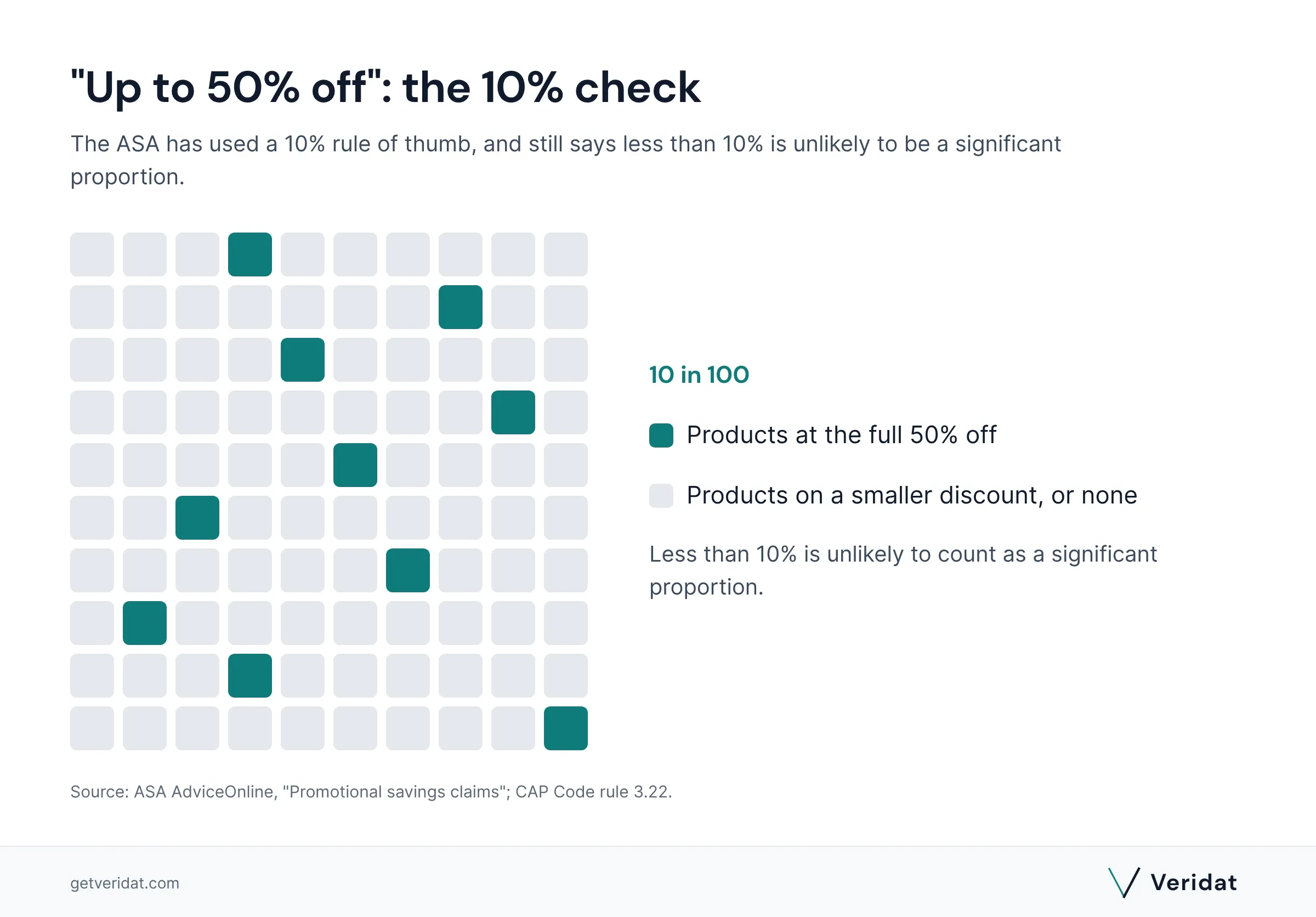
ASA guidance on savings claims gives a floor. The ASA has in the past used a rule of thumb that about 10% of the products you advertise should be available at the "up to" price, and it still says less than 10% is unlikely to count as a significant proportion.
The carpet sale that couldn't count to ten
Carpetright ran "up to 50% off" across banners and web pages in early 2022. When the ASA asked for the numbers, they didn't stack up. In hard flooring, only between two and nine of 109 product lines were at 50% off in any week, and some categories had none at all.
So the ASA upheld the complaint in January 2023 under rules 3.1, 3.17 and 3.22. Carpetright couldn't show the maximum discount applied to a significant proportion of products.
Why "up to 50% off everything" is a double claim
"Everything" is an absolute; "up to" is a maximum. Put them together and shoppers will expect every product to be cut, with plenty at the top discount. CAP's own Black Friday advice from October 2026 says particular caution is required where absolute and maximum discount claims are used together.
Before (made-up example): Black Friday: up to 50% off everything!
After: Black Friday: up to 50% off sofas, with 1 in 5 sofas at half price. Beds from 20% off.
Pro tip: Count your lines before the banner is designed, not after. Mark which products carry the top discount and keep that list with the sign-off. If you're below about 10%, lower the headline number.
Was/now prices: what makes a "was" price genuine?
Here's where most Black Friday trouble starts. The was/now pricing rules come down to one test: was the higher price real? Rule 3.17 says price statements mustn't mislead by omission, undue emphasis or distortion. Rule 3.7 says you must hold your evidence before the ad runs, and our CAP Code substantiation checklist covers that in more depth.
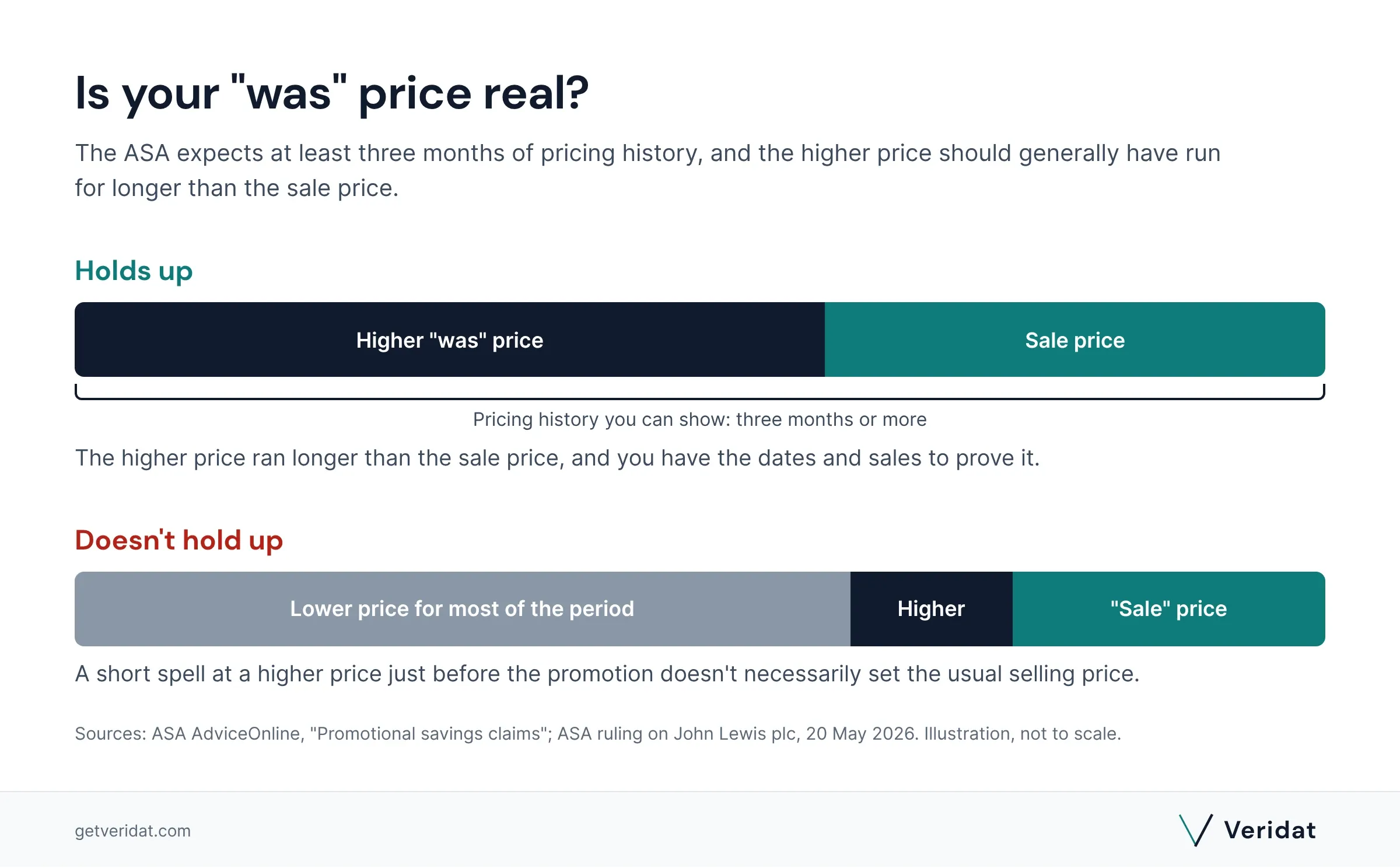
For a "was" price, the ASA expects:
- At least three months of pricing history.
- A higher price charged for longer than the promotional price, generally.
- History beyond the price you charged just before the cut.
Three Black Friday rulings, one lesson
John Lewis. A Facebook ad told shoppers to save £150 on a MacBook Air this Black Friday. John Lewis relied on the £849 it charged just before the promotion, but gave no data on how long it had charged it. For a £450 saving on an ASUS laptop, it supplied around seven weeks of history. The ASA wanted at least three months, and said a higher price just before a promotion would not necessarily establish the usual selling price.
Boots. Boots won half of its case, which makes it the useful one. Its "was £80, now £60" BOSS fragrance ad failed because £80 hadn't been established as the usual price. But a Yankee Candle set at "was £60, now £29.50" passed. It had sold at £60 for 54 days before 41 days at the lower price, and Boots could show it.
Debenhams. A bed at "-44%", £349 against a struck-through £619, sat under a Black Friday sign on 29 November 2025. Debenhams said its marketplace sellers set their own prices. That didn't wash with the ASA: the bed had been advertised at £349 since April 2025, and Debenhams was responsible for the saving being genuine.
Nobody lost because a discount was too generous. Each lost because the evidence didn't show the higher price was the usual selling price. We track new rulings like these every month in our ASA rulings round-up.
What the High Court said about the CMA's reference pricing test
Your "was" price, the CMA had argued, should only count if you'd sold at least half as many units at it as at the discount: a 1:2 ratio. In CMA v Emma Matratzen on 30 July 2026, Mr Justice Richards refused to make an order based on that ratio. He said it carried "a very real risk that the line is being drawn in the wrong place."
Don't read that as a free pass. Emma had already accepted that a reference price misleads if the product hasn't been offered at that price for at least as long as at the discount. That duration test still stands, and it matches what the ASA asks for. That same day the CMA temporarily withdrew its mattress pricing guidance. The CMA hasn't announced an appeal, and the final form of the court's order is still to be settled.
RRPs, bundles and "lowest price ever"
An RRP gets the same scrutiny. Rule 3.39 says an RRP comparison is likely to mislead if the RRP differs significantly from the price the product generally sells for. In September 2026 the ASA ruled against Sports Direct over "from £17.00 RRP £45.00" under "UP TO 50% OFF": £45 wasn't the price the top generally sold for.
Bundles catch people out too. Origin Mattress advertised "save up to 27% with 2 free pillows worth £196", and the 27% counted the pillows. Shoppers, the ASA found, would read it as 27% off the mattress.
"Lowest price ever" is a claim about your own history, and rule 3.7 means you'll need the price records to prove it before the ad runs. Plain "lowest price" is a claim about the whole market, and the ASA's advice on lowest price claims wants evidence you'll always beat, not merely match, rivals.
Pro tip: Export the price and sales history for every product in the promotion now, before the sale starts, and attach it to the claim it supports. If a regulator or a retail partner asks in March, you'll want the file, not a scramble through your ecommerce platform. Our guide to validating marketing and product claims shows how to keep evidence with the claim.
Countdown timers and "ends tonight": when are fake countdown timers illegal?
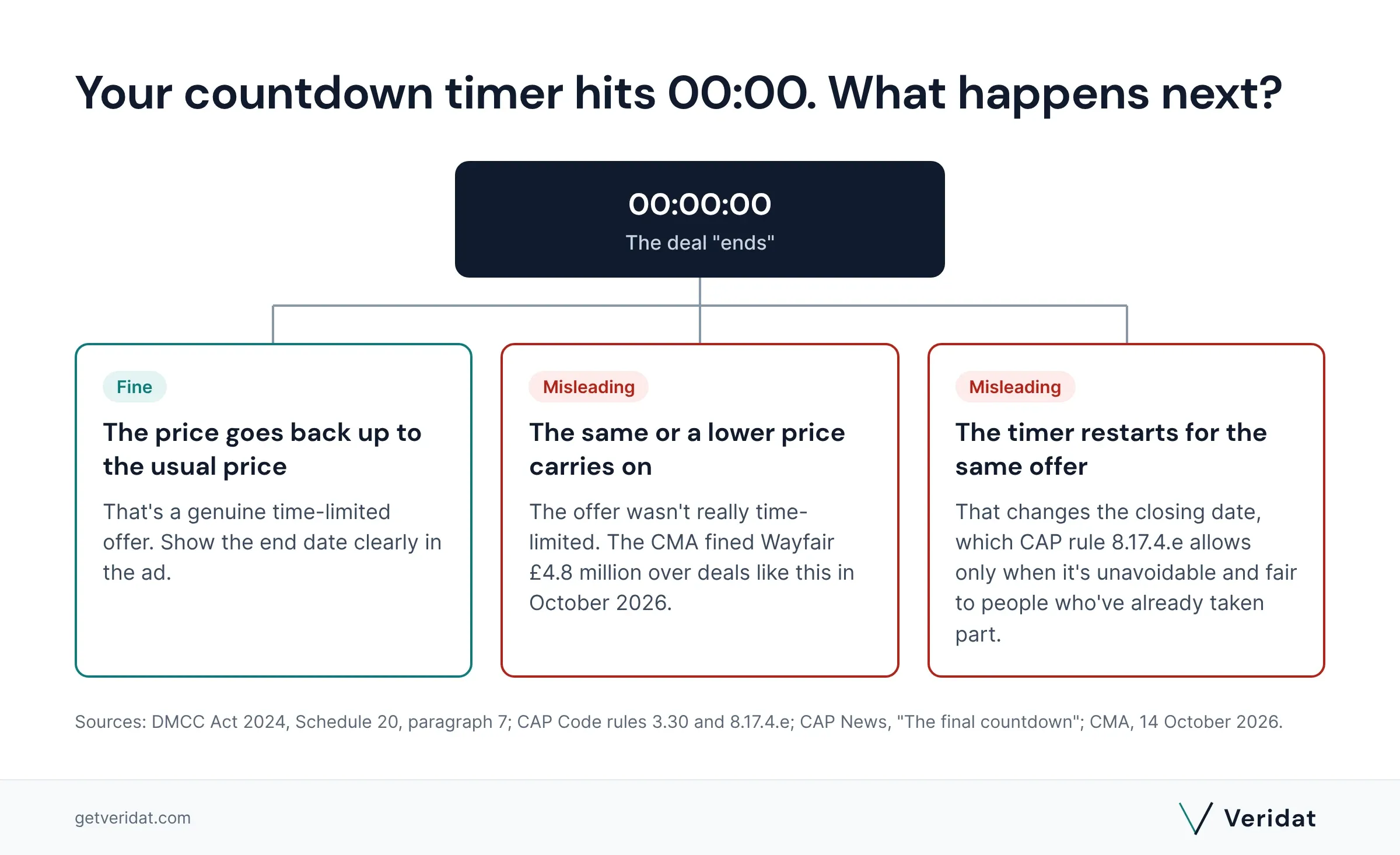
A countdown timer is fine if your deal really ends. A fake one is banned outright. Schedule 20, paragraph 7 of the DMCC Act covers falsely stating that a product, or its terms, will only be available for a limited time to push an immediate decision. Its 32 practices are considered unfair in all circumstances, so nobody needs to prove shoppers were affected.
CAP rule 3.30 says the same, and rule 8.17.4.e says a promotion's closing date mustn't change unless circumstances beyond your control make it unavoidable, and changing it is fair to people who've already taken part. CAP's countdown advice is blunt: "Once a countdown clock reaches zero, it shouldn't be restarted." If your prices stay the same or drop afterwards, it isn't a genuine time-limited offer.
The deals that didn't end
Wayfair ran "Daily Deals" and 24-hour "Flash Deals" with countdown timers. Many products stayed at the same price or lower after the deadline, and in its October 2026 enforcement round the CMA fined Wayfair £4.8 million. Appliances Direct was fined £1.2 million, partly because its "time-limited" discount codes kept reappearing. "The time is up for this kind of behaviour," said Hayley Fletcher, the CMA's Senior Director for Consumer Protection.
In July 2026 the ASA found that Origin Mattress's "HURRY! UP TO 34% OFF ENDS" timers implied the discounts would soon end, which could pressurise people into a swift decision. Emma Sleep, meanwhile, admitted in May 2026 that its countdown timers broke consumer law. Its court-backed undertakings stop it running "limited time" sales where similar deals carry on after the deadline.
Pro tip: Decide what happens at 00:00 before anyone builds the timer. Write the post-deadline price into your promotion plan, and don't schedule a near-identical deal straight after. If you can't say what the price goes back to, you don't have a time-limited offer.
Running a Black Friday deal on software or a subscription?
Subscription businesses get caught by the same rules. Domestika, an online course platform, ran a Facebook ad showing "98% OFF" with £49.99 struck through and £0.99 underneath. You could only get the £0.99 by starting a free trial of a subscription, but the ad read as a one-off purchase, and the ASA upheld the complaint in November 2025.
If you sell plans, check two more things. Mandatory fees belong in your headline price under CAP rule 3.18 and the CMA's price transparency guidance. (Gold's Gym had to refund £9,220 to 726 customers after leaving a joining fee out.) And "50% off your first year" still needs a real usual price behind it.
Who enforces Black Friday pricing rules in the UK, and what can it cost?
You're dealing with three bodies. Ads are the ASA's patch: it rules on them and can have them withdrawn. The CMA and Trading Standards enforce consumer law, and in the 18 months to October 2026 the CMA imposed more than £12 million in fines. Our marketing compliance guide explains how the regulators split the work.
If you sell in shops, note that the Price Marking Order changed on 6 April 2026, and the CMA can now enforce it directly. You can only use a general "20% off" sign instead of repricing each item where repricing isn't reasonably practicable, and that's a high bar.
Selling into the EU? There, a discount must be based on the lowest price applied in the past 30 days. When EU authorities checked 314 online traders during Black Friday and Cyber Monday sales (results published March 2026), 30% got their discounts wrong.
Your Black Friday pre-flight check: eight things to have on file
You don't need a lawyer on standby to get this right. You need your evidence in one place before the campaign goes live. For the full pre-launch routine, see our guide to checking advertising claims before launch. For Black Friday, check these eight:
- Price and sales history for every "was" price, covering at least three months.
- Proof the higher price ran longer than the sale price.
- Your share of lines at the top "up to" discount (aim for at least 10%).
- Exclusions shown in the ad itself, not only in the terms.
- What happens to the price when each countdown timer ends.
- Mandatory fees included in every headline price.
- RRP evidence from the wider market, not just the manufacturer's list.
- Who reviewed and signed off each claim, and when. Our claims governance guide covers who should sign what.
We built Veridat to give marketing, product, technical, compliance and legal teams one place to validate marketing and product claims. You create the claim, and Veridat's engine works out what's needed to back it up. It creates the tasks (evidence to attach, wording to confirm), routes them to the right people and sends the claim to the right reviewers.
Nothing gets approved until the relevant reviewers, such as Legal, have looked at the evidence and accepted it. Each sign-off records who decided, their review function, when, and which version of the claim. See how it works.
Approved wording then goes into a library your team can reuse without restarting legal review. Next year you start from wording your reviewers have already seen, and only the new prices need fresh evidence. You can try every feature free for 14 days. After that, plans start at £149 a month and go up to £899 a month, depending on your team size and needs.
Paste your Black Friday banner, email or product page copy and see which claims need evidence before 27 November. It runs on Veridat's own engine, built for marketing copy. Your copy is never sent to an AI service, and the same copy always gets the same result.
Try it with this example:
BLACK FRIDAY: Up to 50% off everything! Was £120, now £60. Hurry, this deal ends in 02:14:09. Our lowest price ever.
FAQ
Are there special legal rules for Black Friday in the UK?
No. Your Black Friday deals follow the same rules as any other promotion: the CAP Code, enforced by the ASA, and consumer law under the DMCC Act, enforced by the CMA and Trading Standards. What's different is the sheer number of savings claims, and the attention they get.
How long does a product need to be at the "was" price before Black Friday?
There's no fixed number of days. Expect the ASA to ask for at least three months of pricing history, with the higher price generally charged for longer than the sale price.
Does "up to 50% off" really need 10% of products at 50%?
It's not a legal line. The ASA has used 10% as a rule of thumb, and it still says less than 10% is unlikely to count as a significant proportion. If you're short, lower the headline figure.
Can I use a countdown timer on a Black Friday deal?
Yes, if your deal genuinely ends when the timer says and the price goes back up. A timer that restarts, or a deal that carries on at the same price, misleads.
Can I use the RRP as my "was" price?
Only if the RRP reflects what the product generally sells for across the market, and you tell shoppers clearly that it's an RRP. A manufacturer's list price on its own isn't evidence, as Sports Direct found.
Do the same evidence rules apply to product claims in Black Friday ads?
Yes. "Clinically proven" or "lasts twice as long" needs the same evidence in a sale ad as at any other time. Our guide to clinically proven claims explains what that evidence looks like.
This is general information, not legal advice.
Spotted something out of date? Drop us a line and we'll put it right within five working days.